If you are struggling to figure out which ISO 42001 course fits your career goals or organizational needs, you are in the right place. ISO/IEC 42001 is the world’s first international standard for an Artificial…
If you are struggling to figure out which ISO 42001 course fits your career goals or organizational needs, you are in the right place. ISO/IEC 42001 is the world’s first international standard for an Artificial Intelligence Management System (AIMS). As regulatory frameworks like the EU AI Act come into force and corporate adoption of artificial intelligence accelerates, certified expertise in ISO 42001 is becoming one of the most sought-after credentials in technology governance.
In this guide, we break down all four primary ISO 42001 training courses: their purpose, target audience, duration, examination structure, and curriculum. We will also share a practical framework for choosing the right training provider so you can invest your time and budget wisely.
The 4 Primary ISO 42001 Training Courses
Most accredited training providers structure their ISO 42001 education into four progressive tiers:
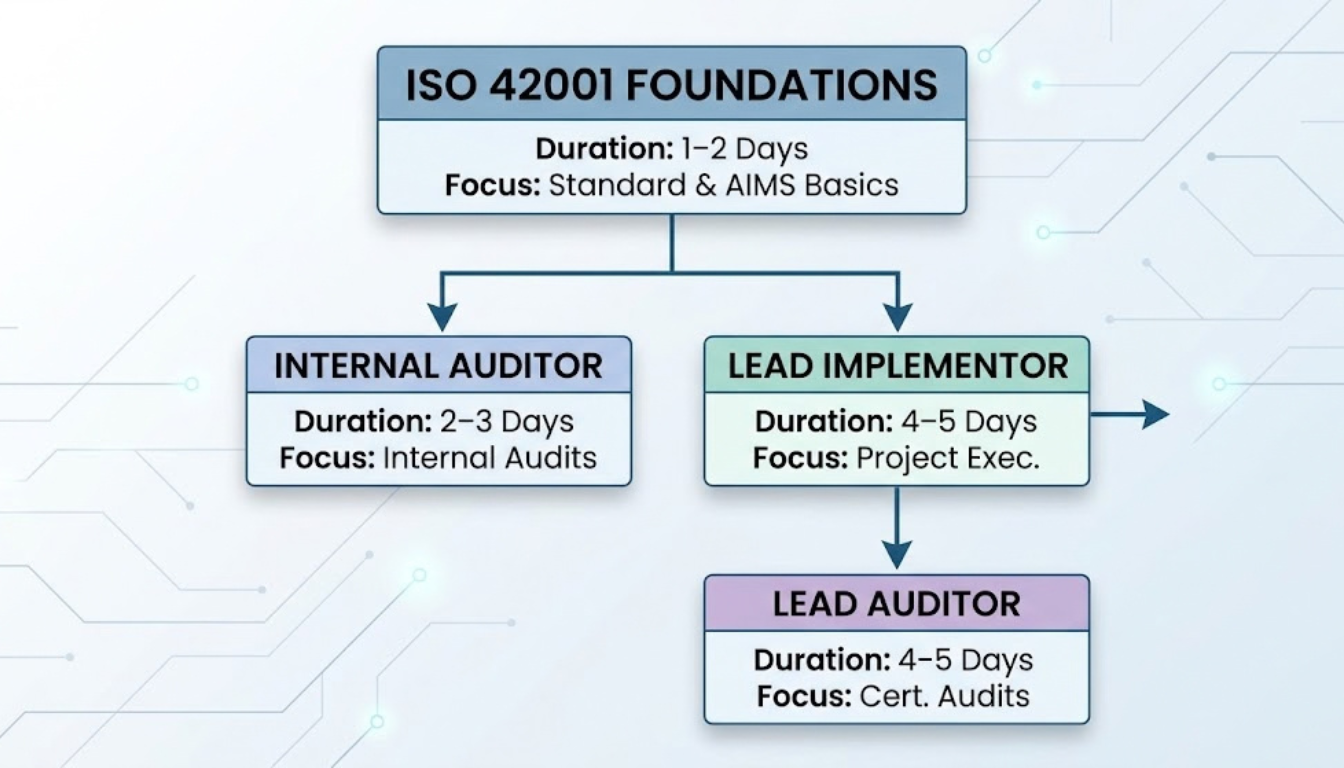
1. ISO 42001 Foundations Course
- Duration: 1 to 2 days
- Target Audience: Implementation team members, mid-to-senior management, executive sponsors, scholars, and compliance officers who need an overview of the standard.
- Purpose: To teach the core fundamentals of ISO/IEC 42001. You will learn the structure of the standard, its primary clauses, basic AI terminology, and how an AIMS operates across the AI lifecycle.
- Exam & Certification: A short-written exam or recap evaluation. Passing grants an ISO 42001 Foundation Certificate demonstrating basic standard literacy.
2. ISO 42001 Internal Auditor Course
- Duration: 2 to 3 days
- Target Audience: Professionals assigned to conduct internal evaluations, quality managers, compliance personnel, and internal audit staff.
- Purpose: Covers foundational knowledge alongside practical auditing methodologies. You will learn how to plan, execute, and report on internal AIMS audits, write nonconformity reports, and evaluate corrective actions.
- Exam & Certification: Requires passing a written examination covering both standard clauses and internal auditing techniques (aligned with ISO 19011 principles). Successful candidates receive an ISO 42001 Internal Auditor Certification.
3. ISO 42001 Lead Auditor Course
- Duration: 4 to 5 days
- Target Audience: Third-party certification auditors, independent consultants, senior risk professionals, and compliance leaders aiming to perform external or certification-level audits.
- Purpose: Equips students to lead third-party certification audits. In addition to deep clause-by-clause analysis, it covers advanced auditing techniques, ISO/IEC 17021-1 requirements, managing audit teams, lead-auditor responsibilities, and certification decision workflows.
- Exam & Certification: Requires passing a comprehensive, proctored written exam evaluating theoretical knowledge and scenario-based audit applications. Passing leads to formal authorization as an ISO 42001 Lead Auditor.
4. ISO 42001 Lead Implementor Course
- Duration: 4 to 5 days
- Target Audience: Chief AI Officers (CAIOs), Chief Technology Officers (CTOs), AI governance leads, project managers, and enterprise AI consultants.
- Purpose: Focused on end-to-end execution. You will learn how to secure executive buy-in, define AIMS scope, conduct AI risk and impact assessments (Annex A.5), integrate ISO 42001 with standards like ISO 27001 or ISO 9001, and guide an organization through Stage 1 and Stage 2 certification audits.
- Exam & Certification: Concludes with a rigorous implementation-focused written exam. Successful candidates are awarded the ISO 42001 Lead Implementor credential.
How to Choose the Right Training Provider
Selecting the right provider ensures your certification is recognized by employers, clients, and accreditation bodies. Focus on three main criteria:
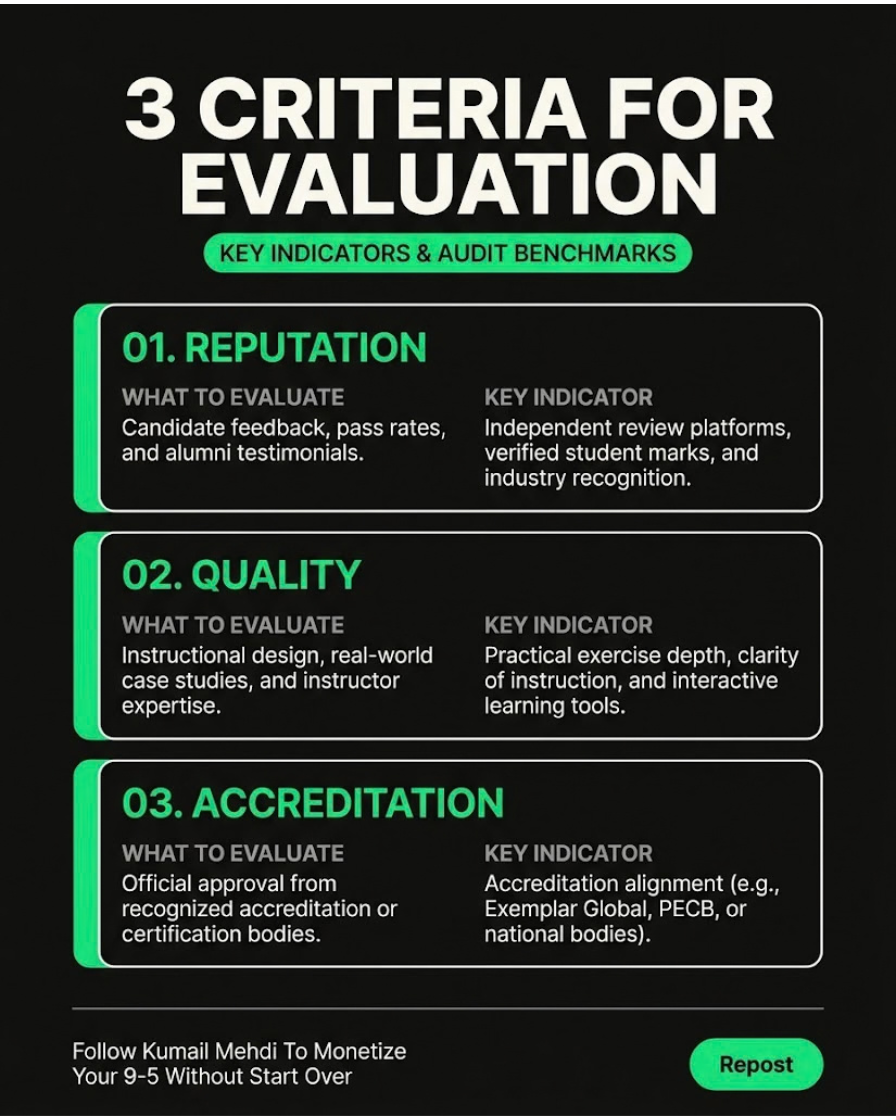
Detailed Curriculum Comparison across Courses
Understanding where course modules overlap and diverge helps you select the right starting point for your experience level:
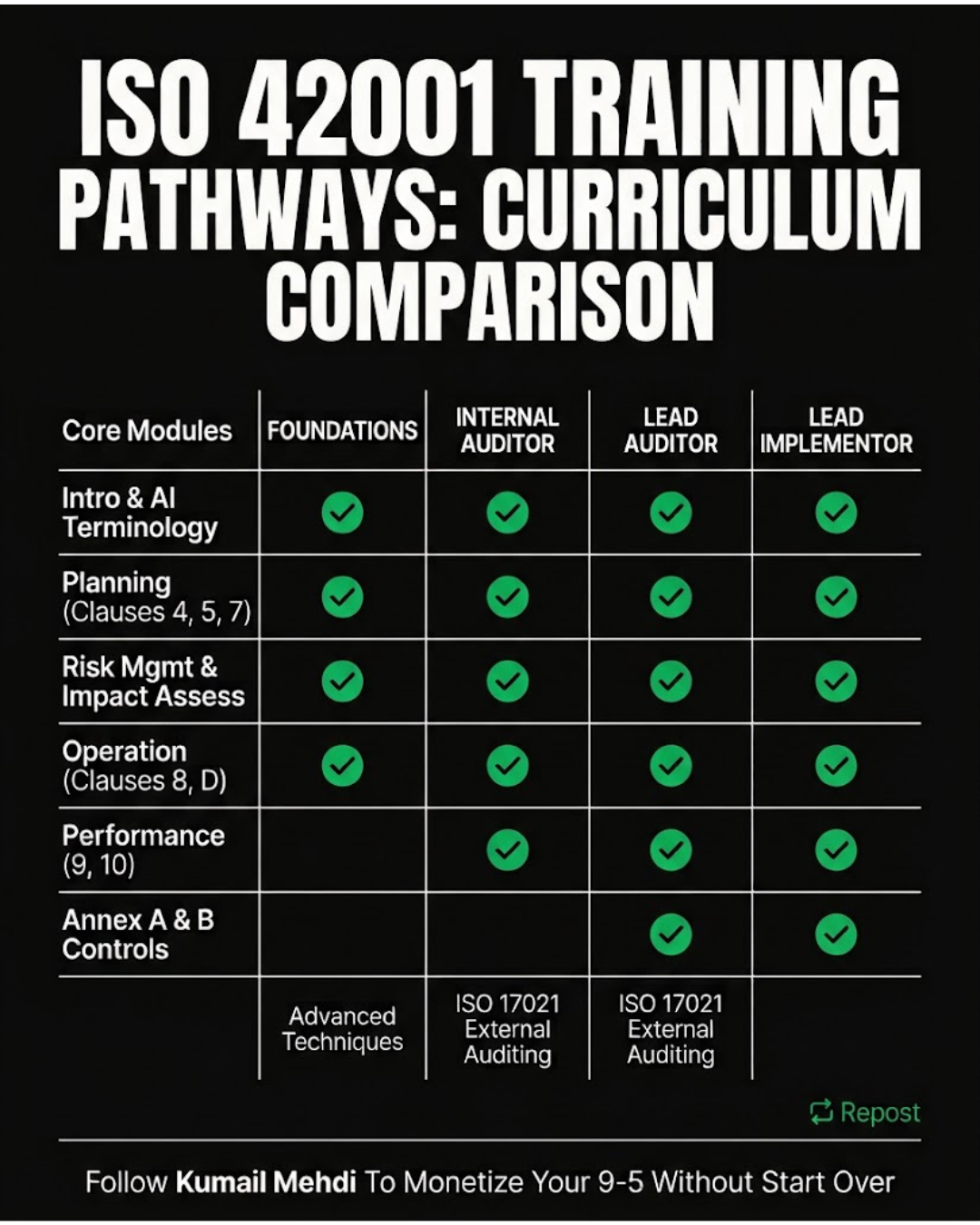
Modules 1 to 6 (Common Baseline Across All 4 Courses)
All four courses share a foundational core covering the mechanics of ISO/IEC 42001:
- Module 1: Introduction to ISO 42001: Definition of AIMS, PDCA cycle, documentation basics, core AI concepts (machine learning, neural networks, lifecycle stages), and Annex C.2 objectives.
- Module 2: The Planning Phase: Context of the organization (Clause 4.1), interested parties (4.2), AIMS scope (4.3), leadership commitment (5.1), policies (5.2), roles (5.3), and support resources (7.1–7.5).
- Module 3: Risk Management, Impact Assessment & Objectives: Risk identification and treatment (Clause 6.1, Annex C.3), Statement of Applicability (SoA), AI System Impact Assessment (Clause 6.1.4, Annex A.5), and setting AI objectives (6.2).
- Module 4: Implementation & Operation: Operational control (Clause 8), executing risk/impact assessments, and integrating AIMS with ISO 27001, ISO 27701, and ISO 9001 (Annex D.2).
- Module 5: Monitoring, Review & Improvement: Performance evaluation (Clause 9.1), management review (9.3), nonconformity handling, and continual improvement (10.1–10.2).
- Module 6: Overview of Annexes A and B: AI policies, system development guidance, data management for AI (Annex A.7/B.7), transparency, third-party relationship controls, and usage guidance.
Specialized Modules by Course Track
ISO 42001 Internal Auditor Course (Modules 7–10)
- Module 7: Introduction to Internal Audit: Internal vs. external audit scope, ISO 19011 audit criteria, categorizing nonconformities (major vs. minor), and observations.
- Module 8: Organizing the Audit: Establishing annual audit programs, single audit plans, and procedures.
- Module 9: Execution Elements: Document reviews, preparing checklists, writing audit reports, and tracking corrective actions.
- Module 10: The Main Audit: Interview techniques, evidence sampling, recording findings, remote auditing, and auditing integrated management systems.
ISO Lead Auditor Course (Modules 7–13)
- Module 7: Auditing Basics: Core auditing assumptions, evidence gathering, sampling methods, and reporting.
- Module 8: Auditing Standards: ISO/IEC 17021-1 accreditation requirements, IAF guidance documents, ISO 19011 auditing principles, and certification stages.
- Module 9: Audit Roles: Responsibilities for Audit Team Leaders, Technical Specialists, Certification Reviewers, Auditees, and Guides.
- Module 10: Audit Planning: Risk-based audit planning, remote technique selection, resource allocation, and initial client engagement.
- Module 11: Managing the Audit Process: Conducting opening meetings, managing interviews, handling on-site conflict, and debriefings.
- Module 12: Managing Audit Teams: Progress tracking, handling team issues, evaluating auditor performance, and record management.
- Module 13: Completing the Audit: Formulating conclusions, leading closing meetings, writing certification audit reports, and overseeing post-audit corrections.
ISO 42001 Lead Implementor Course (Modules 7–12)
- Module 7: Project Approval: Building business cases for top management, presenting AIMS value, and drafting consulting proposals.
- Module 8: Implementation Preparation: Defining project scope, estimating schedules/costs, building implementation teams, and establishing project plans.
- Module 9: System Implementation: Managing change resistance, embedding documented processes into daily workflows, and resource management.
- Module 10: Monitoring & Control: Status reporting, holding internal audits, conducting management reviews, and project sign-off.
- Module 11: Preparing for Certification: Selecting accredited certification bodies, navigating Stage 1 and Stage 2 audits, team prep, and post-audit remediations.
- Module 12: Maintaining Certification: Overseeing annual surveillance audits, continuous AIMS refinement, and maintaining executive alignment.
Which ISO 42001 Course Should You Choose?
- Choose Foundations if you need a quick, comprehensive introduction to ISO 42001 without audit or implementation responsibilities.
- Choose Internal Auditor if you are tasked with auditing your own company's AI management system internally.
- Choose Lead Auditor if you want to work for a certification body, perform external vendor audits, or offer compliance auditing services as a consultant.
- Choose Lead Implementor if you are leading an AIMS deployment within your organization or advising client companies on gaining ISO 42001 certification.
Stay tuned as we launch comprehensive preparatory resources and training materials designed to help you pass your ISO 42001 certification exam on the first attempt.
Ready to build trust with your enterprise clients?
Connect with me today to get your AI startup ISO 42001 certified or choose the right training program for your team.

Kumail Mehdi
ISO 42001 Lead Auditor and AI strategist. 11 years in corporate leadership, 14 years running a digital agency. I help professionals, consultants and AI startups turn expertise into governed, AI-powered systems.