In the ever-evolving landscape of technology, Artificial Intelligence (AI) has emerged as a game-changing technology, revolutionizing how we live and work. As we witness the rapid growth and widespread adaptation of AI…
In the ever-evolving landscape of technology, Artificial Intelligence (AI) has emerged as a game-changing technology, revolutionizing how we live and work. As we witness the rapid growth and widespread adaptation of AI across various industries, establishing a structured approach to manage this transformative technology has become critical.
This is where ISO/IEC 42001 comes in, providing a comprehensive framework for the implementation, governance, and management of AI systems. In this post, we will explore the significance of ISO/IEC 42001 and show how it is actively shaping the future of AI across all sectors.
What Is ISO/IEC 42001?
ISO/IEC 42001 is the world's first certifiable international standard that specifies requirements for establishing, implementing, maintaining, and continually improving an Artificial Intelligence Management System (AIMS) within an organization.
It is designed for entities developing, providing, or utilizing AI-based products or services, ensuring the responsible development and deployment of their systems. As the foundational benchmark for AI governance, it directly addresses:
- Unique AI Challenges: Tackling complex risks like data poisoning, algorithmic bias, and model drift.
- Ethical Considerations: Protecting human rights, fairness, and accessibility.
- Transparency: Enabling clear accountability and explainable outputs.
- Continual Learning: Managing how adaptive models evolve over time without breaking compliance.
- Continual Improvement: Refining governance practices as technology advances.
For organizations, ISO/IEC 42001 sets out a structured path to balance innovation with rigorous risk management.
Who Is ISO/IEC 42001 For?
The standard is universally applicable. It is designed for organizations of any size involved in creating, delivering, or utilizing AI-based products or services. Whether you are a fast-growing AI startup, a global enterprise, a public sector agency, or a non-profit, ISO/IEC 42001 serves as a practical roadmap.
This guidance is crucial given the inherent complexities, dynamic risks, and ethical questions surrounding Machine Learning (ML) and generative models.
While 87% of executives report having an AI governance framework, Deloitte research shows that only 25% actually execute enterprise-wide AI governance fully. Adopting ISO/IEC 42001 closes this execution gap.
What Is an AI Management System (AIMS)?
An AI Management System (AIMS), as specified by ISO/IEC 42001, is a structured set of interrelated or interacting organizational elements designed to establish policies, objectives, and operational controls for responsible AI.
Using the familiar Plan-Do-Check-Act (PDCA) cycle (similar to ISO 27001), an AIMS embeds AI governance directly into business operations rather than treating compliance as a one-time checklist.
What Is the Purpose of ISO/IEC 42001?
Organizations that align with the objectives and address the risk factors outlined in the ISO/IEC 42001 framework can expand their AI capabilities safely. With generative AI investment expanding rapidly and expected to drive massive global economic growth, ISO/IEC 42001 ensures that this growth occurs securely and ethically.
A targeted approach through ISO/IEC 42001 equips organizations to incorporate specific safeguards necessary for distinct AI characteristics:
- Autonomous Decision-Making: Unpacks black-box models to ensure specialized administrative oversight, explainability, and transparency.
- Machine Learning Insights: Replaces rigid, human-coded logic with probabilistic models, requiring specialized validation and data governance.
- Ongoing Learning: Governs adaptive systems that continuously update behavior post-deployment, preventing unexpected drift or non-compliant outputs.
Key Benefits of Implementing ISO/IEC 42001
Here is how implementing ISO/IEC 42001 delivers tangible value to businesses, service providers, and tech developers:
1. Responsible AI Practice
The standard establishes clear principles for ethical AI deployment. It requires organizations to conduct AI System Impact Assessments to evaluate societal impacts, human rights, and fairness, aligning tech with public values.
2. Enhanced Trust & Reputation
Demonstrating adherence to an internationally recognized standard signals a genuine commitment to security and transparency. This builds credibility among users, enterprise clients, investors, and public regulators.
3. Streamlined Regulatory Compliance
ISO/IEC 42001 offers a proactive framework that streamlines compliance with evolving global regulations, such as the EU AI Act. Instead of building siloed programs for every new regional law, organizations use an "assess-once, comply-many" approach.
4. Structured Risk Management
The framework offers practical guidance to identify, evaluate, and mitigate risks across the AI lifecycle, from training data preparation to production monitoring, improving system reliability.
5. Accelerated & Safer Innovation
By setting clear operational boundaries, ISO 42001 encourages confident experimentation. Organizations with a structured AIMS deploy AI systems up to 40% faster while experiencing 60% fewer post-deployment compliance incidents.
How to Manage AI Systems with ISO/IEC 42001: The Annexes
ISO/IEC 42001 integrates cleanly into existing corporate structures and standard ISO management skeletons (like ISO 27001 and ISO 9001). The operational heart of the framework relies on key 4 annexes that guide control selection and implementation:
- Annex A (Normative Controls): Details 38 specific controls grouped across 9 objectives that organizations select based on their unique risk assessment and Statement of Applicability.
- Annex B (Implementation Guidance): Provides actionable blueprints for managing training data, labeling workflows, ML documentation, data lineage, and fairness assessments. It also mandates explicit justifications for AI development, performance metrics, and technical design logs.
Step-by-Step ISO 42001 Implementation Roadmap
If you are preparing your team or client for ISO/IEC 42001 adoption, follow these core steps:
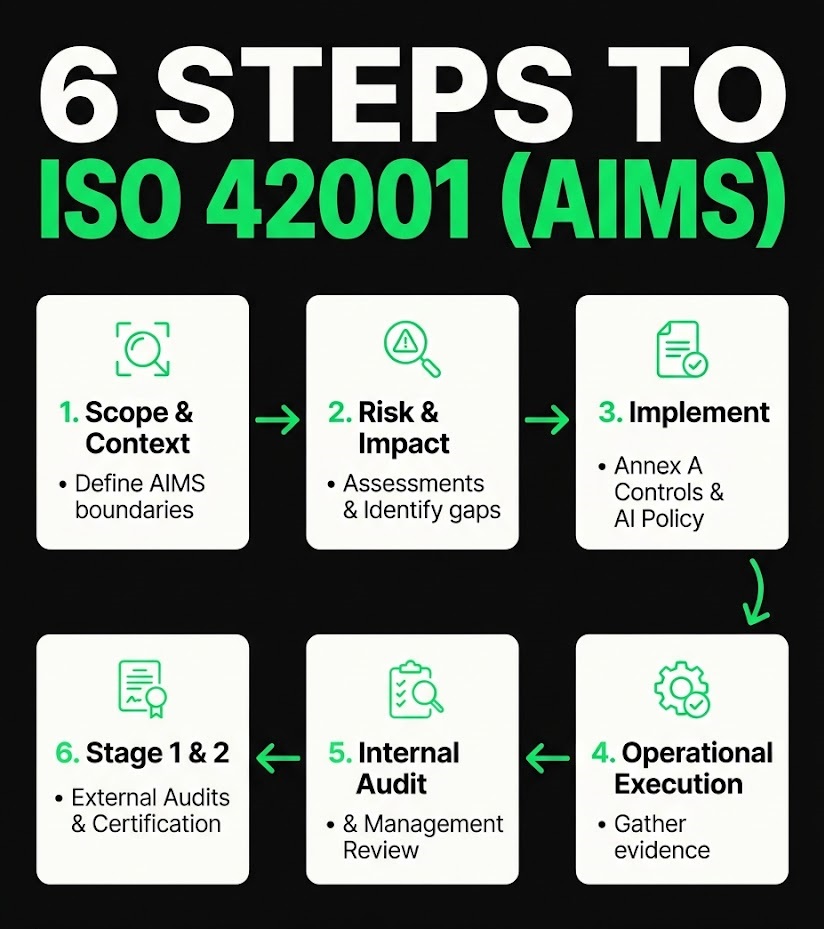
- Define the Scope: Outline the specific business units, products, and AI models covered under your AIMS boundary.
- Perform Impact & Risk Assessments: Map potential harms regarding fairness, explainability, safety, and system drift.
- Select Controls: Apply applicable Annex A controls and document exclusions in a Statement of Applicability.
- Operationalize Governance: Execute continuous monitoring, data validation, and model logging in your engineering pipelines.
- Internal Audit & External Certification: Conduct internal checks before engaging an accredited certification body for Stage 1 and Stage 2 audits.
Ready to build trust, reduce compliance risks, and position your organization as an ethical leader in artificial intelligence? Implementing ISO/IEC 42001 is the most effective path forward.
Ready to build trust with your enterprise clients and prepare your company for global AI regulation?
Connect with me today to get your organization ISO/IEC 42001 ready and turn AI compliance into a competitive advantage.

Kumail Mehdi
ISO 42001 Lead Auditor and AI strategist. 11 years in corporate leadership, 14 years running a digital agency. I help professionals, consultants and AI startups turn expertise into governed, AI-powered systems.