Spend five minutes on social feeds, and you’ll encounter a familiar apocalyptic narrative: AI is arriving for every job, knowledge work is collapsing, and human expertise is destined for obsolescence.The panic is…
Spend five minutes on social feeds, and you’ll encounter a familiar apocalyptic narrative: AI is arriving for every job, knowledge work is collapsing, and human expertise is destined for obsolescence.
The panic is understandable, but it misidentifies what is actually unfolding.
We are not entering an era of wholesale human replacement; we are living through an AI amplification cycle. Generative AI and intelligent systems do not eliminate the need for work, they completely reorganize what makes work valuable.
The thesis is clear: AI is not an existential threat to all careers, but it is an aggressive catalyst for a permanent market shift. As routine execution becomes free, frictionless, and automated, the economic value of routine labor drops to zero. What increases in value is everything machines cannot automate: contextual decision-making, ethical nuance, accountability, and practical human judgment.
If you are waiting for the AI landscape to "settle down" before taking action, you are walking into the quietest, most hazardous career hazard of this decade.
The New Gold Standard: Why Judgment-Based Work Always Wins
For decades, career security meant being a faster, more accurate execution machine. If you could churn out clean spreadsheets, synthesize a research memo in four hours, or write boilerplate code, you commanded a premium.
Today, large language models and autonomous agents handle routine synthesis in seconds. When execution becomes a commodity, the bottleneck moves upstream.
The new gold standard of professional value is judgment-based work.
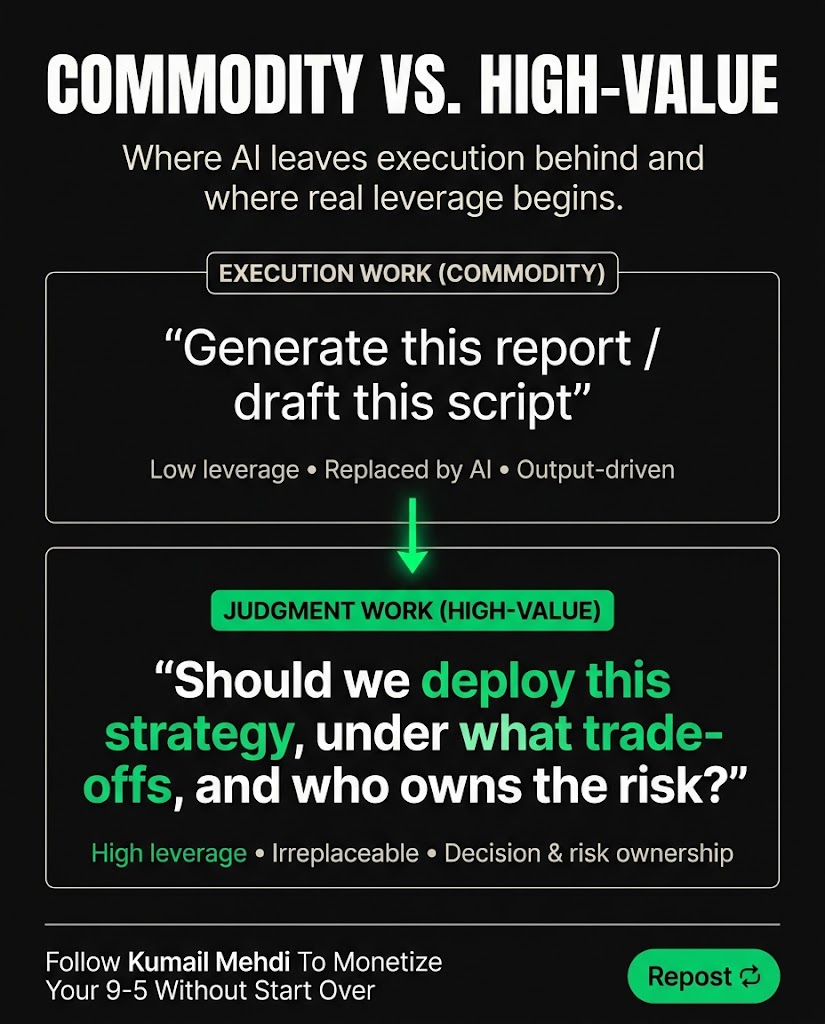
According to analysis from the World Economic Forum, the rapid enterprise adoption of AI is producing a structural "judgement premium". As routine analysis and drafting are automated away, the decisive career differentiator becomes the human capacity to validate context, navigate ethical ambiguity, balance trade-offs, and take responsibility for outcomes.
AI produces endless options; humans must supply the conviction to pick the right one.
Beware the "Mobility Trap": The True Career Hazard of Our Era
Former Meta and WhatsApp product leader Jean Lee frequently highlights an overlooked career risk: the mobility trap.
The mobility trap occurs when an ambitious professional remains anchored to manual, procedural execution because "that’s how our team has always done it." You stay busy. Your calendar remains full. You feel productive. Yet, behind the scenes, your primary daily activities are quietly depreciating in market value.
Recent workplace data from McKinsey & Company emphasizes that the economic dividend of AI stems from compressed decision cycles and faster execution, warning that delay in operationalizing these workflows carries compounding organizational and personal costs.
The old risk: Making a mistake while trying a new tool.
The new risk: Perfecting workflows that an autonomous model will execute natively next quarter.
Delaying adoption does not insulate you from disruption—it locks you into obsolescence. You cannot build strategic leverage on a foundation of tasks that software will soon do for pennies.
The Four Career Archetypes That Will Thrive in the Age of AI
As the baseline for desk work shifts, where does durable career leverage reside? Across every industry, professionals who thrive fall into four core categories:
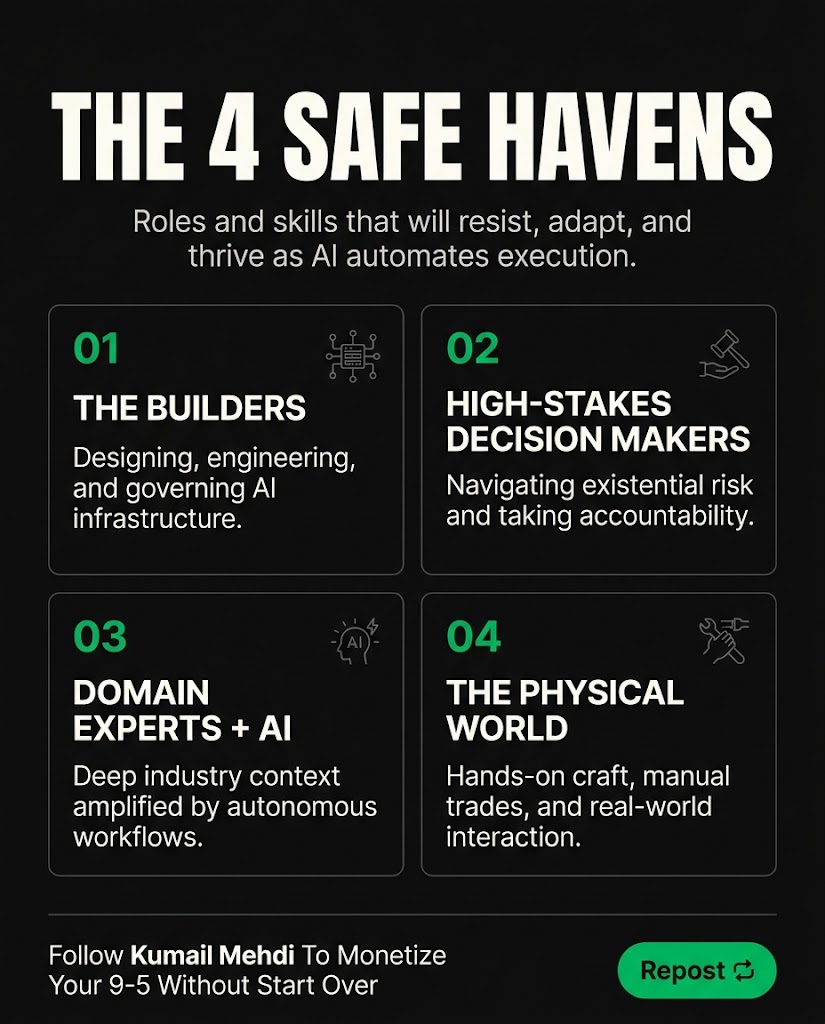
1. The AI Architects and Builders
These are the technologists engineering, fine-tuning, and deploying AI models, alongside the governance leaders designing safety boundaries. They build the rails the digital economy runs on.
Why they win: They understand system architectures, model limitations, and integration pipelines.
2. High-Stakes Decision Makers
When millions of dollars, legal liability, or human lives hang in the balance, no executive board delegates the final call to a prompt window. High-stakes leaders—crisis communicators, strategic consultants, general counsels, and enterprise risk officers—are paid to own the consequences of complex calls.
Why they win: Accountability cannot be outsourced to software.
3. Deep Domain Experts Who Master AI Amplification
This group represents the largest opportunity for corporate professionals. A mid-tier copywriter or junior analyst using AI produces mediocre, generic output. But a veteran healthcare strategist, supply-chain operator, or financial forensic specialist armed with AI becomes a 10x force multiplier.
Why they win: They possess the hard-earned domain context required to spot hallucinations, interrogate synthetic data, and extract non-obvious insights from AI tools.
4. Physical World & Manual Specialists
From master electricians, HVAC technicians, and aerospace mechanics to surgical nurses and physical therapists, jobs requiring tactile adaptability, spatial dexterity, and real-time physical interaction remain insulated from digital disruption.
Why they win: Physical environments are unpredictable, chaotic, and resistant to pure software automation.
Actionable Roadmap: What to Do Right Now
Navigating this transition does not require going back to university for a computer science degree or waiting for your company's HR department to launch a training program. It requires taking initiative within your current role.
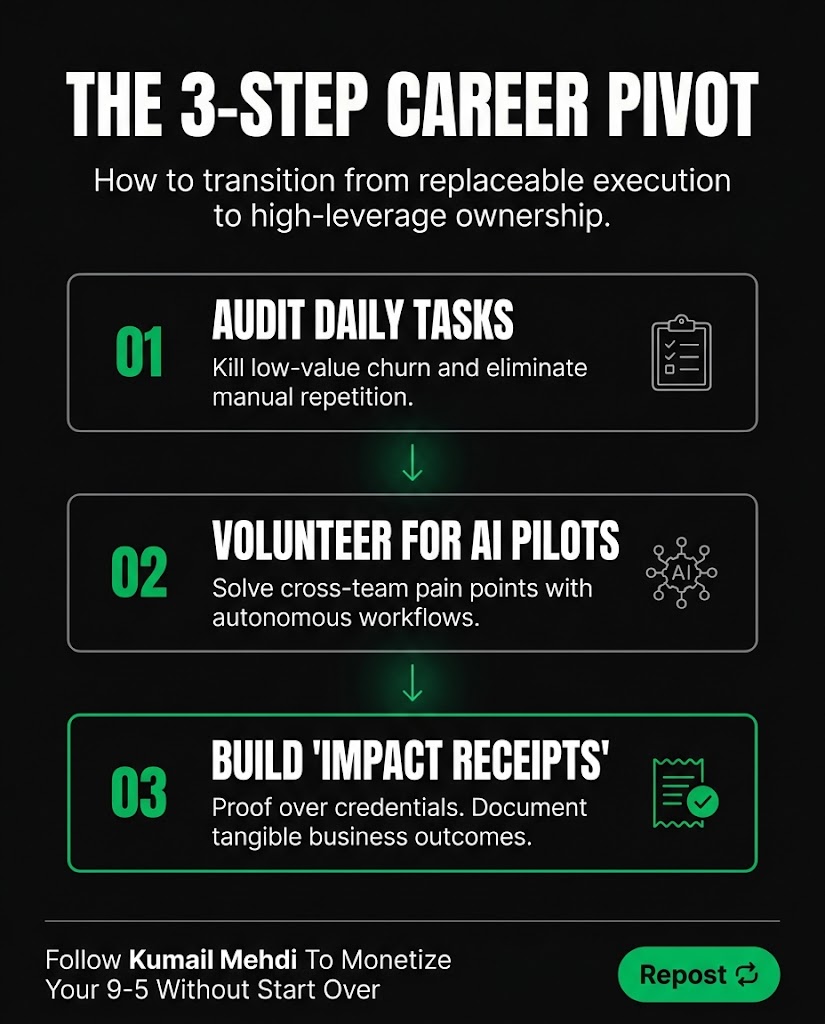
1. Audit Your Daily Tasks for Automation
Take inventory of your work week. Highlight tasks that are repetitive, rule-based, or centered around data reformatting:
Summarizing meeting notes into action items
Drafting first passes of routine correspondence
Pulling recurring metrics and building weekly digests
Delegate these tasks to AI tools immediately. Use the hours saved to focus on high-impact initiatives that require relationship building, cross-functional strategy, and contextual judgment.
2. Volunteer for AI-Driven Pilots Across Your Organization
Don't wait for permission or formal policy rollouts. Be the person in your department who tests internal tools, sets up structured prompts, builds internal knowledge bases, or stress-tests automated workflows. When leadership searches for someone to pilot a new enterprise AI initiative, you should already be the clear internal choice.
3. Collect "Impact Receipts," Not Just Certificates
A digital certificate proving you took a 20-hour video course on prompt engineering carries little weight in the market. Hiring managers and clients look for demonstrated impact.
Instead of: "Completed Prompt Engineering Certification."
Show this: "Engineered an AI-assisted research pipeline that cut team proposal turnaround times from 5 days to 24 hours while boosting win rates by 18%."
Build tangible case studies that highlight where AI handled the heavy lifting and your judgment steered the outcome.
Frequently Asked Questions (FAQ)
Will AI replace 9-to-5 knowledge workers entirely?
AI is far more likely to replace tasks rather than entire job titles. Roles that consist solely of repetitive data entry, basic synthesis, or mechanical content drafting face severe downsizing. However, professionals who use AI to augment their strategic thinking, client handling, and decision-making will see their value rise.
Do I need to learn Python or machine learning to survive the AI shift?
No. Unless your goal is to work directly in model engineering, baseline AI literacy, knowing how to formulate complex prompts, validate model outputs, prevent data leaks, and chain tools together, paired with deep domain knowledge is significantly more practical for most professionals.
What is the biggest mistake professionals make with AI today?
Treating AI as a casual parlor trick rather than a workflow partner, or deferring adoption until company guidelines mandate it. By the time top-down corporate mandates arrive, early adopters will already have consolidated their competitive lead.
The Path Forward: Judgment Is Your Moat
The future of work is not a zero-sum conflict between human ingenuity and artificial intelligence. It is a partnership defined by leverage.
AI supplies unprecedented speed, scale, and computational muscle. You supply context, empathy, ethics, and accountability. By letting go of low-value manual tasks, refusing the comfort of the mobility trap, and deliberately cultivating your judgment, you transform AI from a career threat into your greatest professional asset.
Ready to turn your domain expertise into a high-leverage asset?
Connect with me on LinkedIn to exchange insights, explore AI workflows, and future-proof your career.

Kumail Mehdi
ISO 42001 Lead Auditor and AI strategist. 11 years in corporate leadership, 14 years running a digital agency. I help professionals, consultants and AI startups turn expertise into governed, AI-powered systems.