South Korea has officially stepped into a new era of technology governance. As the second major jurisdiction globally—following the European Union, to enact a comprehensive national AI law, South Korea’s Framework Act…
South Korea has officially stepped into a new era of technology governance. As the second major jurisdiction globally—following the European Union, to enact a comprehensive national AI law, South Korea’s Framework Act on the Development of Artificial Intelligence and Establishment of Trust (commonly known as the Korea AI Basic Act) is reshaping how tech startups, boutique firms, and compliance leaders approach artificial intelligence.
Enacted in January 2025 and officially taking effect in January 2026, this legislation strikes a delicate balance between fostering explosive industry innovation and establishing rigorous guardrails against societal risks.
If you are a consultant, software developer, or compliance strategist navigating this new regulatory terrain, here is everything you need to know about what the Act requires, why it matters, and how to prepare.
The Dual Mandate: Innovation Meets Trustworthiness
Lawmakers crafted the AI Basic Act with a clear philosophy: 80% to 90% of the legislation focuses on industry promotion and national competitiveness, while the remaining portion governs safety and trustworthiness.
Rather than adopting a purely restrictive posture, the South Korean government wants to cement the country as one of the world's top three AI powerhouses. To achieve this, the law establishes sweeping institutional frameworks:
The National AI Committee: Operating under the presidency, this body coordinates national AI strategy, ministerial implementation, and long-term planning.
The AI Safety Institute (AISI): Tasked with researching, analyzing, and mitigating safety-related AI risks to protect citizens' lives and property.
Massive Financial Backing: Backed by substantial public-private investments, such as the multi-billion-won R&D injections for strategic technologies and national AI computing infrastructure, the Act actively encourages startups and small-and-medium enterprises (SMEs) to scale rapidly.
Regulatory Core: High-Impact and High-Performance AI
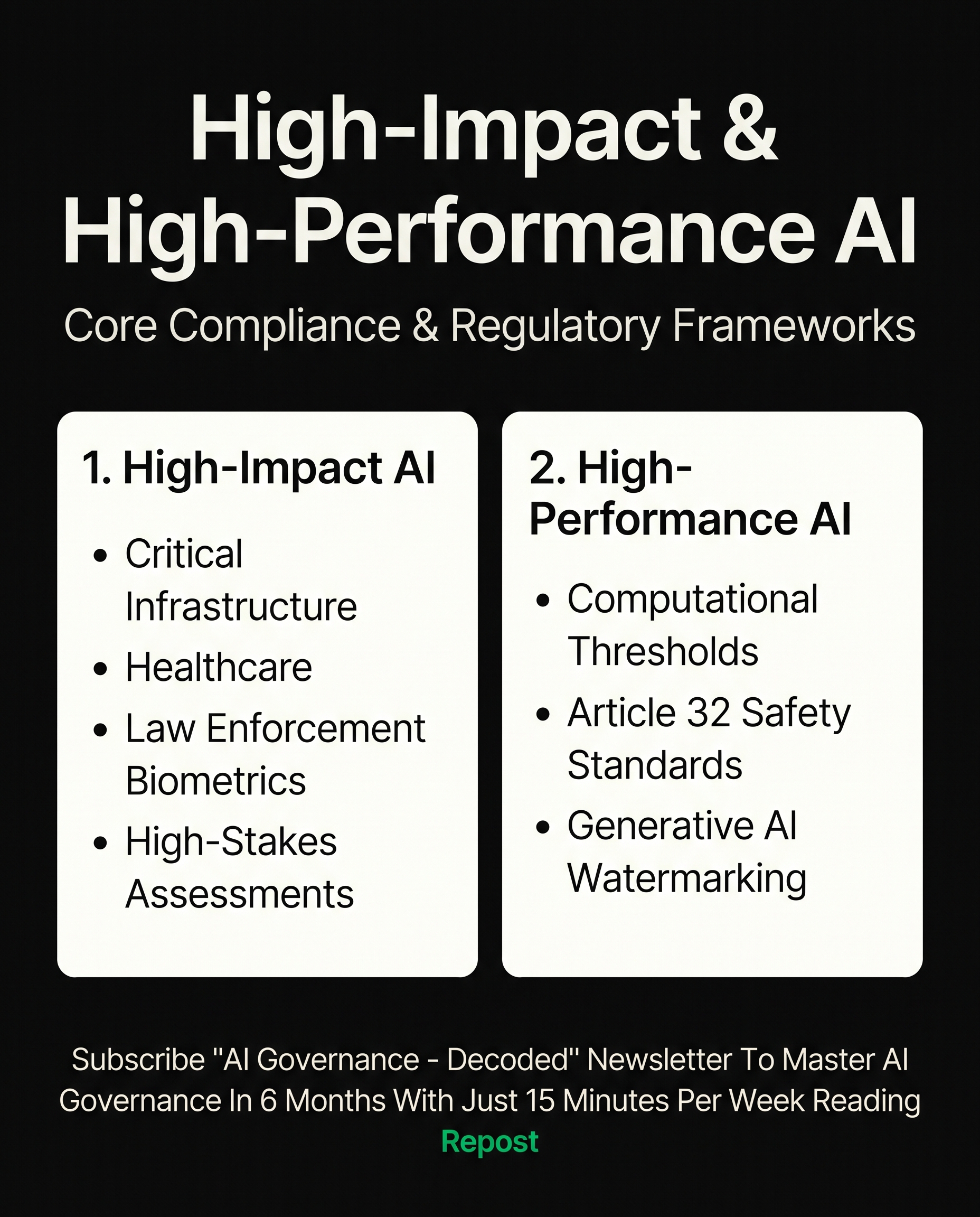
While the promotion side is generous, the compliance requirements for specific classes of AI systems demand careful attention. The Act introduces stringent transparency, risk assessment, and labeling obligations for two main categories:
1. High-Impact AI
Systems that significantly affect human life, safety, or fundamental rights fall under strict oversight. This includes AI deployments in:
Critical infrastructure (energy supply, drinking water production, nuclear material management)
Healthcare services and medical devices
Law enforcement applications (biometric analysis for criminal investigations)
High-stakes evaluations (employment screening, loan assessments, and student academic evaluations)
Businesses operating in these sectors must publish risk-mitigation plans, establish user-protection measures, and designate clear managerial accountability on their websites.
2. High-Performance AI
The regulatory framework also introduces computational thresholds (specifically targeting models operating above $10^{26}$ floating-point operations per second, or FLOPs). These high-performance foundation models are subjected to rigorous safety measures outlined in Article 32 of the Act. Furthermore, developers and deployers of generative AI must ensure clear watermarking and labeling of AI-generated content to prevent the spread of deceptive deepfakes.
Key Implementation Challenges and Real-World Pushback
Despite its ambitious scope, the rollout of the AI Basic Act has faced notable growing pains:
Startup Readiness: A survey conducted by Startup Alliance revealed that 98% of local AI startups felt unprepared to meet the complex compliance demands of the Act when it was initially introduced. Many smaller firms lack the dedicated legal and compliance teams required to handle exhaustive documentation and reporting.
Defining Ambiguities: Critics and human rights groups have pointed out that key definitions—particularly regarding what constitutes "high-impact" deployment—leave room for regulatory gray areas.
The Grace Period Solution: Recognizing the intense pressure on businesses, the Ministry of Science and ICT (MSIT) introduced an enforcement grace period (lasting at least through the initial phase), ensuring that heavy fines are temporarily deferred while companies adapt to the subordinate regulations and enforcement decrees.
Strategic Takeaways for Consultants and Tech Founders
If you are building AI solutions or advising clients operating in or targeting the Korean market, consider these actionable steps:
Audit Your AI Systems Now: Determine whether your tools touch high-impact sectors (like HR, finance, healthcare, or public administration) or cross high-performance computational thresholds.
Implement Robust Watermarking: For any generative AI applications, ensure that automated labeling and cryptographic watermarking are baked into your product pipelines to comply with transparency mandates.
Designate a Local Representative: Foreign AI companies operating in South Korea must ensure they have designated a local representative to liaise effectively with regulatory authorities like MSIT.
Ready to future-proof your AI architecture and navigate international compliance with confidence?
Connect with me today to explore how our specialized strategies can help your boutique firm or startup scale securely.
Subscribe to "AI Governance - Decoded" Newsletter to Master AI Governance With Just 15 Minutes Read Per Week.

Kumail Mehdi
ISO 42001 Lead Auditor and AI strategist. 11 years in corporate leadership, 14 years running a digital agency. I help professionals, consultants and AI startups turn expertise into governed, AI-powered systems.