As artificial intelligence rapidly transitions from experimental chat interfaces to core enterprise infrastructure, the attack surface for applications powered by Large Language Models (LLMs) has exploded. Whether you…
As artificial intelligence rapidly transitions from experimental chat interfaces to core enterprise infrastructure, the attack surface for applications powered by Large Language Models (LLMs) has exploded. Whether you are building custom AI agents, deploying automated workflows, or advising clients on secure implementations under frameworks like ISO 42001, understanding application security is no longer optional, it is a critical requirement for survival.
The Open Web Application Security Project (OWASP) Top 10 for Large Language Model Applications serves as the definitive baseline for identifying and mitigating these critical risks. Grounded in thousands of real-world security incidents analyzed by global experts, let’s break down all 10 essential vulnerabilities that every AI startup, developer, and consultant must master.
What is OWASP and Why Does the LLM Top 10 Matter?
The Open Web Application Security Project (OWASP) is an international non-profit organization dedicated to improving software and web application security. Through community-driven projects, documents, and tools, OWASP helps organizations defend against evolving cyber threats.
When generative AI adoption surged, traditional web application firewalls (WAFs) and security models proved insufficient for catching probabilistic, language-based threats. To bridge this gap, OWASP launched the OWASP GenAI Security Project to focus exclusively on LLM and GenAI application vulnerabilities.
The Complete OWASP Top 10 for LLM Applications
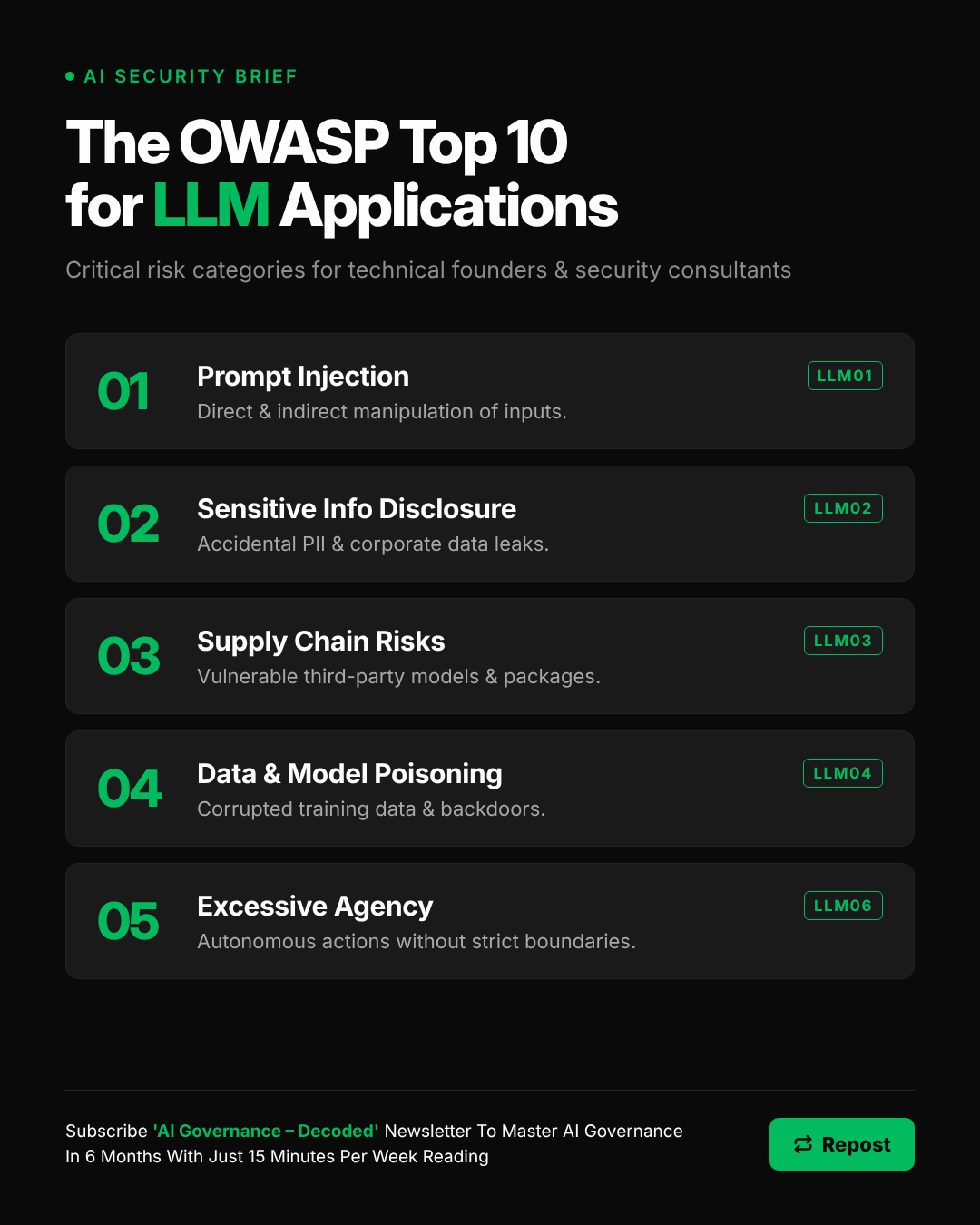
The official OWASP framework highlights ten critical risk categories that every technical founder and security consultant must account for across the development and deployment lifecycle:
1. Prompt Injection (LLM01)
Prompt injection occurs when malicious users or external vectors manipulate natural language inputs to override system prompts or developer instructions.
Direct Prompt Injection ("Jailbreaking"): Users craft inputs that trick the model into bypassing safety filters or executing unintended commands.
Indirect Prompt Injection: The LLM ingests compromised external data—such as poisoned web pages, uploaded files, or tool responses—that contains hidden instructions forcing the model to act against the user's best interests.
2. Sensitive Information Disclosure (LLM02)
LLMs can inadvertently leak proprietary corporate data, intellectual property, or personally identifiable information (PII) across multiple channels, including tool-call arguments, retrieval chunks, and logs. Robust data scrubbing, access controls, and automated localization controls are vital to keeping sensitive information secure.
3. Excessive Agency (LLM06 / Updated to LLM03)
As agentic deployments have evolved, excessive agency has climbed rapidly up the risk rankings. Developers frequently grant LLM applications and autonomous agents the ability to take actions automatically via plugins and tools. Without strict permission boundaries and human-in-the-loop validation, an unexpected model output or prompt injection can trigger disastrous, irreversible actions.
4. Supply Chain Vulnerabilities (LLM03 / Updated to LLM04)
Modern AI development relies heavily on third-party components, including pre-trained foundation models, open-source datasets, third-party plugins, and custom packages. If a component in the AI supply chain—such as a backdoored model or a "slopsquatting" package dependency—is compromised, the entire downstream application inherits those vulnerabilities.
5. Data and Model Poisoning (LLM04 / Updated to LLM05)
Attackers may target the pre-training, fine-tuning, or embedding stages by injecting corrupted or biased data. Successful data poisoning bakes malicious behavior or backdoors directly into the model artifacts, degrading accuracy and manipulating automated decisions.
6. Unbounded Consumption (LLM10 / Updated to LLM06)
Similar to distributed denial-of-service (DDoS) vectors, attackers can execute resource-heavy, complex operations or recursive loops using an LLM to degrade service quality, disrupt operations, and drive up API cloud hosting costs. Enforcing strict rate limits and monitoring resource spikes are essential countermeasures.
7. Misinformation / Hallucination Vulnerabilities (LLM09 / Updated to LLM07)
LLMs can occasionally produce factually incorrect results or hallucinations while maintaining an authoritative tone. When organizations rely on these outputs blindly without independent verification, it can lead to regulatory violations, legal exposure, and reputational damage.
8. Hidden Context Exposure (Formerly System Prompt Leakage - LLM08)
Expanded beyond just the core system prompt, this category covers everything an application quietly places in front of the model without the user seeing it—including retrieved policy text, tool definitions, prior conversation turns, and application state configuration.
9. Vector and Embedding Weaknesses (LLM09)
Vulnerabilities in vector databases and embedding generation pipelines can expose semantic search indexes to manipulation, unauthorized data retrieval, or similarity search exploits, compromising the integrity of Retrieval-Augmented Generation (RAG) applications.
10. Improper Output Handling (LLM05 / Updated to LLM10)
Failing to properly validate, sanitize, or filter LLM outputs before passing them to downstream systems, browsers, or APIs can lead to severe web-application exploits—including Cross-Site Scripting (XSS), Server-Side Request Forgery (SSRF), and Remote Code Execution (RCE). Treat LLM outputs with the same strict suspicion as untrusted user input under a Zero Trust model.
How Organizations Can Secure LLM Applications
Mitigating these ten core risks requires a multi-layered, defense-in-depth approach rather than a single software patch. Effective security strategies include:
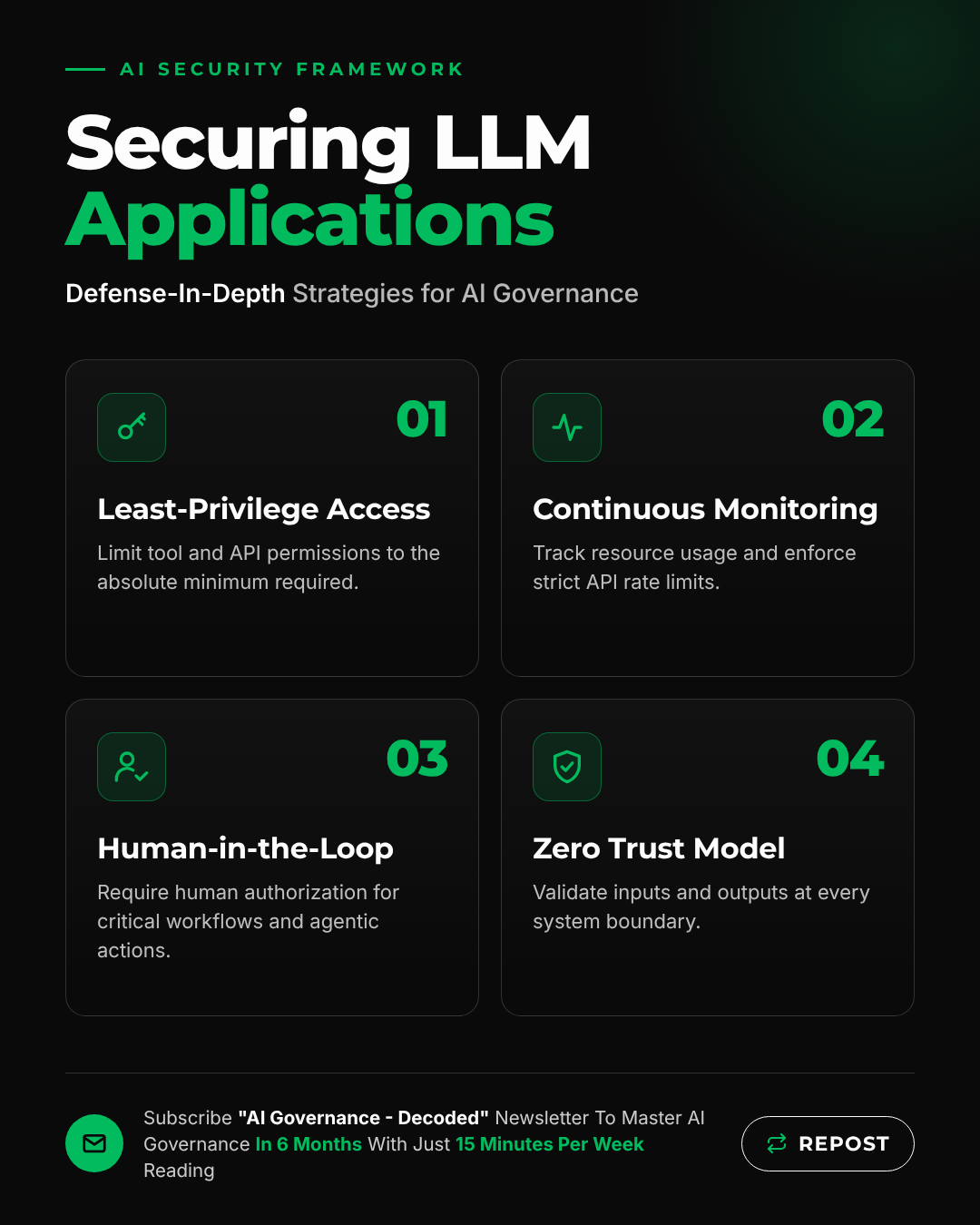
Enforcing Least-Privilege Access: Limit the functionality, permissions, and autonomy of plugins, APIs, and tools to the absolute minimum required.
Continuous Monitoring & Rate Limiting: Track resource usage closely and set strict API rate limits to prevent model denial-of-service and unbounded consumption attacks.
Integrating Human-in-the-Loop Oversight: For critical workflows and agentic actions, require human authorization before an LLM-driven process executes high-impact changes.
Adopting a Zero Trust Model: Treat every model, plugin, and user interaction as potentially untrusted, validating inputs and outputs at every system boundary.
Conclusion
Securing Large Language Model applications requires vigilance, continuous auditing, and alignment with evolving frameworks like the OWASP Top 10 and ISO 42001. By baking security best practices into your development and consulting workflows from day one, you can protect your enterprise clients and build scalable, trustworthy AI systems.
Ready to build trust with your enterprise clients?
Connect with me today to secure your AI workflows and get your startup aligned with top-tier AI management standards.
Subscribe to "AI Governance - Decoded" Newsletter to Master AI Governance With Just 15 Minutes Read Per Week.

Kumail Mehdi
ISO 42001 Lead Auditor and AI strategist. 11 years in corporate leadership, 14 years running a digital agency. I help professionals, consultants and AI startups turn expertise into governed, AI-powered systems.


