As artificial intelligence systems scale rapidly across modern enterprises, ensuring their security and resilience has become a core operational challenge. Whether you are building an AI-powered startup or preparing for…
As artificial intelligence systems scale rapidly across modern enterprises, ensuring their security and resilience has become a core operational challenge. Whether you are building an AI-powered startup or preparing for compliance audits, understanding how bad actors target machine learning models is no longer optional, it is a foundational requirement.
If you are aligning your operations with the ISO 42001 Artificial Intelligence Management System (AIMS) standard, you need robust frameworks to address these vulnerabilities. Enter the National Institute of Standards and Technology (NIST) and its landmark publication: NIST AI 100-2 (E2025), titled Adversarial Machine Learning: A Taxonomy and Terminology of Attacks and Mitigations.
Let us break down what this report means for AI startups, security professionals, and aspiring ISO 42001 consultants.
What is Adversarial Machine Learning (AML)?
Traditional cybersecurity focuses on securing software code, networks, and databases against unauthorized access. Machine learning introduces a completely new attack surface. Because AI systems learn from data and probabilistic models rather than rigid deterministic rules, they can be manipulated without breaking traditional firewalls.
Adversarial Machine Learning (AML) encompasses the techniques attackers use to compromise the confidentiality, integrity, or availability of AI and ML systems. According to NIST, these threats span multiple learning methods, including supervised, unsupervised, reinforcement, and federated learning, and impact both Predictive AI (PredAI) and Generative AI (GenAI) models.
Key Highlights from the NIST AI 100-2 Framework
The updated NIST report establishes a standardized taxonomy and unified terminology for the ML and cybersecurity communities. Here are the core attack categories identified in the framework:
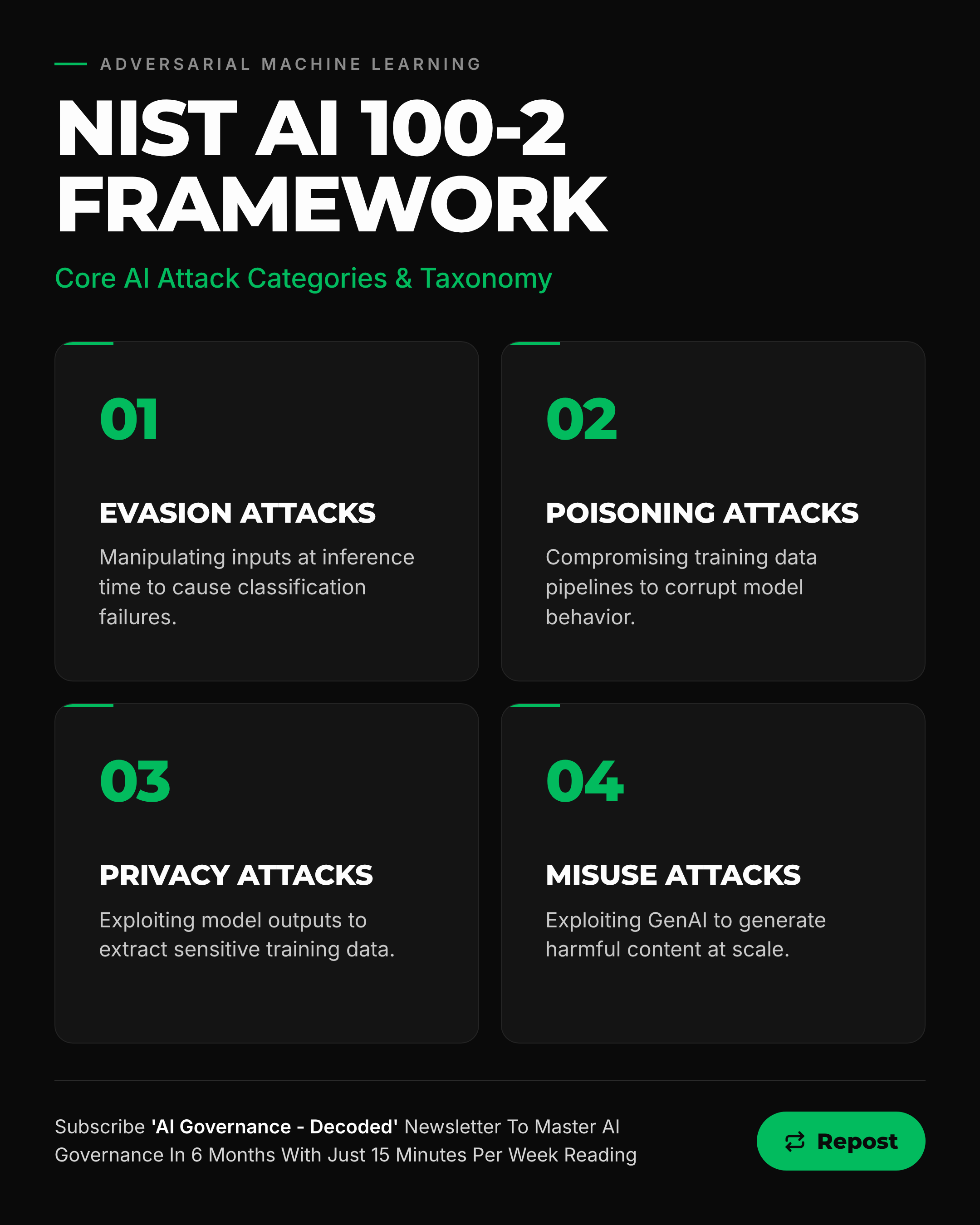
Evasion Attacks: Attackers manipulate inputs at inference time (such as altering pixels in an image or injecting specific prompts into a Large Language Model) to cause the model to make incorrect classifications or outputs.
Poisoning Attacks: Bad actors compromise the training data pipeline, injecting malicious data points to corrupt the model's behavior before it is deployed.
Privacy Attacks: Adversaries exploit model outputs or side-channel behaviors to extract sensitive training data or reverse-engineer proprietary architectures.
Misuse Attacks: Specifically prevalent in Generative AI systems, where models are exploited to generate harmful, toxic, or unauthorized content at scale.
Crucially, the report emphasizes that while mitigation techniques exist, many have distinct limitations. Securing an AI system requires continuous risk assessment rather than a "set-and-forget" patch.
Connecting AML to ISO 42001 Compliance
If you are implementing an AI Management System under ISO 42001, managing adversarial risks directly feeds into your risk assessment and treatment processes (Clause 6 and Annex B).
Organizations deploying AI cannot simply trust that their models will behave securely in production. Demonstrating compliance to enterprise clients means you have:
Identified specific threat vectors (using taxonomies like NIST AI 100-2).
Established technical controls and continuous monitoring for evasion and poisoning risks.
Documented mitigation strategies and residual risks within your AIMS framework.
Conclusion
The expansion of AI brings unprecedented business capabilities, but it also introduces sophisticated threat vectors that standard cybersecurity frameworks miss. By integrating NIST’s adversarial machine learning taxonomy into your risk management practices, you build defensible, trustworthy AI systems that enterprise clients can rely on.
Ready to build trust with your enterprise clients?
Connect with me today to get your AI startup ISO 42001 certified and secure your models against modern adversarial threats.
Subscribe to "AI Governance - Decoded" Newsletter to Master AI Governance With Just 15 Minutes Read Per Week.

Kumail Mehdi
ISO 42001 Lead Auditor and AI strategist. 11 years in corporate leadership, 14 years running a digital agency. I help professionals, consultants and AI startups turn expertise into governed, AI-powered systems.


