Artificial intelligence has evolved from a futuristic productivity experiment into the core engine of modern enterprise operations. But as our reliance on LLMs, automated pipelines, and autonomous AI agents deepens, so…
Artificial intelligence has evolved from a futuristic productivity experiment into the core engine of modern enterprise operations. But as our reliance on LLMs, automated pipelines, and autonomous AI agents deepens, so does the sophistication of those looking to exploit them.
If you've spent any time in traditional cybersecurity, you already know the value of threat modeling frameworks. But when it comes to machine learning and generative AI, standard network defenses won't cut it. Traditional IT security frameworks were never designed to catch data poisoning, prompt injection, or model theft.
That is where MITRE ATLAS (Adversarial Threat Landscape for Artificial-Intelligence Systems) comes in. Whether you are building an AI-backed startup, preparing for compliance audits, or looking to sharpen your defensive posture, understanding ATLAS is no longer optional, it is a baseline requirement for modern security engineering.
What Is MITRE ATLAS?
Modeled after the widely adopted MITRE ATT&CK framework, MITRE ATLAS is a globally accessible, community-driven knowledge base that catalogs real-world adversary tactics, techniques, and procedures (TTPs) targeting AI and machine learning systems.
While ATT&CK maps out how attackers compromise traditional IT infrastructure, endpoints, and cloud networks, ATLAS zooms in specifically on the AI lifecycle, covering everything from training data pipelines and model inference APIs to agentic workflows and vector databases.
The framework is organized into a matrix structure that helps security teams visualize threats, run red-teaming simulations, and prioritize defensive controls. As of 2026, the framework tracks 16 distinct tactics and over 80 techniques, with continuous monthly updates reflecting the rapid emergence of agentic AI threats.
How ATLAS Differs from ATT&CK
It is common for practitioners to conflate the two frameworks or try to apply ATT&CK rules to AI infrastructure. Doing so leaves massive blind spots. While ATLAS inherits several high-level concepts from ATT&CK (like Reconnaissance, Initial Access, and Exfiltration), it introduces specialized mechanics tailored entirely to machine learning systems.
| Dimension | MITRE ATT&CK | MITRE ATLAS |
| Primary Target | Traditional IT, endpoints, and enterprise cloud infrastructure | ML models, training pipelines, LLMs, and AI agents |
| Core Focus | Network intrusion, lateral movement, credential theft | Adversarial machine learning, data corruption, model evasion |
| AI-Specific Tactics | None | ML Model Access (AML.TA0004) & ML Attack Staging (AML.TA0012) |
| Best Used For | Endpoint monitoring, SIEM log analysis, SOC alert triage | AI threat modeling, red teaming, and model boundary defense |
The Two AI-Unique Tactics
ML Model Access (AML.TA0004): How adversaries probe, query, or extract target models via inference APIs or direct weight access. Traditional IT does not have an attack surface where an attacker can systematically query a system just to learn its decision boundaries.
ML Attack Staging (AML.TA0012): How adversaries prepare AI-specific exploits—such as building proxy shadow models or crafting adversarial perturbation data locally before launching production attacks.
The 16 ATLAS Tactics at a Glance
The framework spans the entire lifecycle of an AI-targeted attack. Understanding these phases allows security architects to place controls where adversaries are most likely to strike:
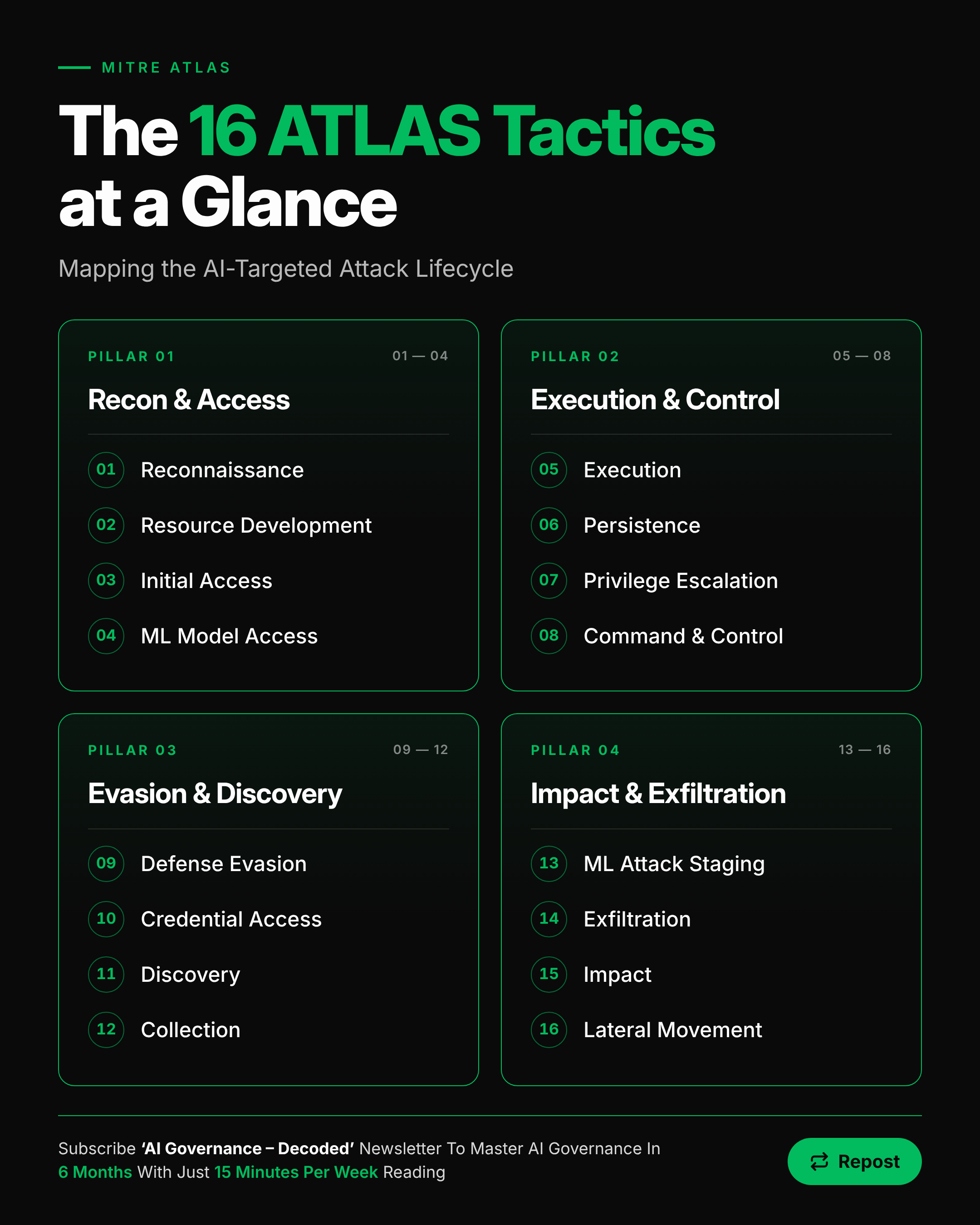
Reconnaissance (AML.TA0001): Gathering information about target model architecture, training data sources, and API endpoints.
Resource Development (AML.TA0002): Acquiring malicious ML artifacts or building proxy models for testing.
Initial Access (AML.TA0003): Gaining entry via compromised APIs, supply chain flaws, or Prompt Injection.
ML Model Access (AML.TA0004): Interacting with inference endpoints to map system vulnerabilities.
Execution (AML.TA0005): Running malicious inputs or exploiting vulnerable LLM plugins.
Persistence (AML.TA0006): Establishing ongoing access through modified agent configurations or memory backdoors.
Privilege Escalation (AML.TA0007): Moving from standard user controls toward configurations that dictate model behavior.
Defense Evasion (AML.TA0008): Using adversarial perturbations or meta-prompt extraction to bypass safety filters.
Credential Access (AML.TA0009): Stealing API keys or tokens embedded in AI agent configuration files.
Discovery (AML.TA0010): Mapping data flows and sensitive information locations within RAG databases.
Collection (AML.TA0011): Harvesting training datasets, proprietary model parameters, or sensitive ingested user data.
ML Attack Staging (AML.TA0012): Executing training-data poisoning or backdoor insertions.
Exfiltration (AML.TA0013): Leaking proprietary data via model extraction queries or agent tool invocations.
Impact (AML.TA0014): Causing large-scale misclassification, service disruption, or downstream operational harm.
Command and Control (AML.TA0015): Using AI service APIs as covert communication channels that blend seamlessly into normal application traffic.
Lateral Movement (AML.TA0016): Pivoting across connected AI infrastructure and downstream data stores.
Navigating the Shift to Agentic AI and MCP Security
The threat landscape shifted dramatically with the widespread adoption of autonomous Agentic AI and the Model Context Protocol (MCP).
Unlike legacy LLMs that simply wait for a prompt and output text, modern agents are given autonomy: they execute code, read local files, query databases, and make external API calls. Consequently, the attack surface has expanded from "what does the model say?" to "what does the model do?"
Recent updates to ATLAS integrate critical agent-specific techniques:
AI Agent Context Poisoning (AML.TA0058): Injecting malicious content into agent memory or thread context to hijack multi-step workflows.
Exfiltration via AI Agent Tool Invocation (AML.TA0062): Forcing authorized tools (like email clients or CRM APIs) to leak sensitive data through sanctioned channels.
Tool Poisoning (AML.TA0061): Exploiting MCP server configurations to execute unauthorized actions or publish malicious tools that appear legitimate in registries.
How to Operationalize MITRE ATLAS in Your Organization
Reading about threat frameworks is a great start, but securing production systems requires actionable execution. You can operationalize ATLAS in three straightforward steps:
Map Your AI Assets: Open the free ATLAS Navigator tool at
atlas.mitre.org. Walk through your AI architecture system-by-system (e.g., an LLM chatbot with a RAG backend) and highlight applicable techniques like prompt injection or RAG data exfiltration.Integrate ATLAS into Incident Tagging: When an AI-related near-miss or security anomaly occurs, tag it with its corresponding
AML.TXXXXidentifier. This builds a standardized internal incident record that helps your team prioritize detection rules.Validate with Adversarial Emulation: Use tools like MITRE's Arsenal (a CALDERA plugin) to run pre-built adversary emulation profiles against non-production AI environments, validating whether your monitoring controls catch simulated prompt injections and API probing.
Conclusion
MITRE ATLAS transforms AI security from an abstract guessing game into a structured, evidence-based defense strategy. By mapping out how attackers target machine learning pipelines, LLMs, and autonomous agents, it gives security professionals the exact vocabulary needed to build resilient architectures.
However, theoretical knowledge alone cannot stop a live adversarial attack. Mastering AI security requires hands-on offensive training, practical red-teaming experience, and a deep understanding of how to operationalize frameworks like ATLAS and the OWASP LLM Top 10 in real-world environments.
Ready to master advanced AI threat defense and secure your enterprise infrastructure?
Connect with me today on LinkedIn or drop a message via our contact form to explore hands-on training paths, custom AI security assessments, and specialized certification roadmaps.
Subscribe to "AI Governance - Decoded" Newsletter to Master AI Governance With Just 15 Minutes Read Per Week.

Kumail Mehdi
ISO 42001 Lead Auditor and AI strategist. 11 years in corporate leadership, 14 years running a digital agency. I help professionals, consultants and AI startups turn expertise into governed, AI-powered systems.


