If you are building artificial intelligence applications today, you already know that your models are only as good as the data feeding them. Yet, many organizations treat data quality as an afterthought, until poor…
If you are building artificial intelligence applications today, you already know that your models are only as good as the data feeding them. Yet, many organizations treat data quality as an afterthought, until poor datasets trigger biased outputs, inaccurate predictions, or expensive compliance failures under tightening global regulations.
Enter the ISO/IEC 5259 series, the definitive international standard for data quality in analytics and machine learning. Among its parts, ISO/IEC 5259-3 stands out as the crucial blueprint for establishing robust data quality management requirements across training, validation, and test datasets.
In this guide, we will break down what ISO/IEC 5259-3 requires, how it connects to key regulatory mandates like the EU AI Act, and how you can implement these principles to build reliable, high-performing AI systems.
Why Data Quality Governance is Critical for AI Success
Poor data quality represents one of the single greatest threats to AI reliability. When data is incomplete, unrepresentative, or riddled with hidden biases, the resulting AI models fail in production—costing businesses time, capital, and trust.
According to research from the IEEE Computer Society, organizations implementing comprehensive data quality frameworks see a 52% improvement in AI model performance and significantly reduced time-to-deployment. Furthermore, empirical findings highlighted by Nature Machine Intelligence demonstrate that systematic data quality management reduces AI system failures by 43% while substantially enhancing stakeholder trust.
The Regulatory Imperative: Connecting to Article 10 of the EU AI Act
As regulatory scrutiny intensifies, data governance is no longer just a best practice, it's a legal mandate. Under Article 10 of the EU AI Act, providers of high-risk AI systems must adhere to strict data governance and management practices concerning training, validation, and testing datasets.
While the ISO/IEC 5259 series provides the concrete, measurable framework you need to operationalize data quality, compliance experts note that the series must be supplemented with specific AI Act requirements, such as explicit examinations for fundamental rights bias and representativeness for the intended EU user population.
Deconstructing the ISO/IEC 5259 Series Overview
The ISO/IEC 5259 framework is structured into a multi-part family designed to cover every angle of data reliability in machine learning environments:
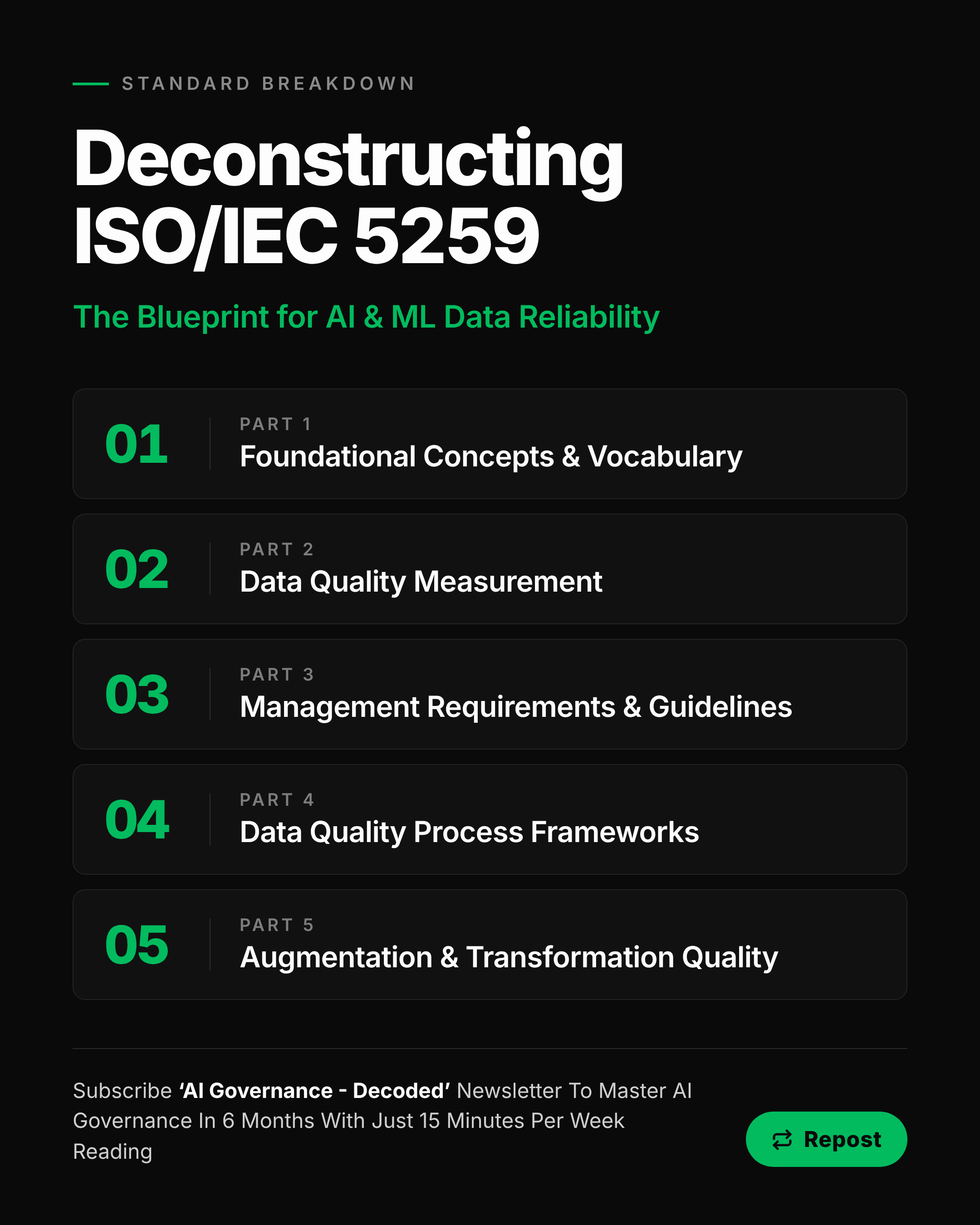
ISO/IEC 5259-1: Establishes foundational concepts, overview, and vocabulary.
ISO/IEC 5259-2: Focuses on data quality measurement methodologies (making data quality quantifiable rather than theoretical).
ISO/IEC 5259-3: Details specific data quality management requirements and guidelines for AI and ML systems.
ISO/IEC 5259-4: Covers data quality process frameworks.
ISO/IEC 5259-5: Addresses data augmentation and transformation quality.
Core Pillars of ISO/IEC 5259-3
ISO/IEC 5259-3 establishes stringent requirements across several core quality dimensions and lifecycle stages:
1. Core Quality Dimensions
Accuracy: Ensuring the correctness and precision of individual data values.
Completeness: Guaranteeing the presence of all necessary data elements without critical gaps.
Consistency: Maintaining uniformity across disparate datasets and upstream systems.
Timeliness: Verifying that data remains current and relevant for real-world AI applications.
Representativeness: Ensuring datasets accurately reflect real-world conditions and intended populations.
Fairness: Actively checking for and mitigating discriminatory biases.
2. Full Lifecycle Data Management
The standard demands rigorous governance from inception to decommissioning:
Standardized data collection and acquisition protocols.
Transparent data preparation and preprocessing workflows.
Systematic quality assessment methodologies during model training.
Rigorous validation processes for test and benchmark datasets.
Clear data decommissioning procedures for end-of-life data.
Step-by-Step Implementation Strategies for Organizations
Implementing ISO/IEC 5259-3 does not have to happen overnight. Organizations can adopt a phased approach to integrate these practices into existing workflows:
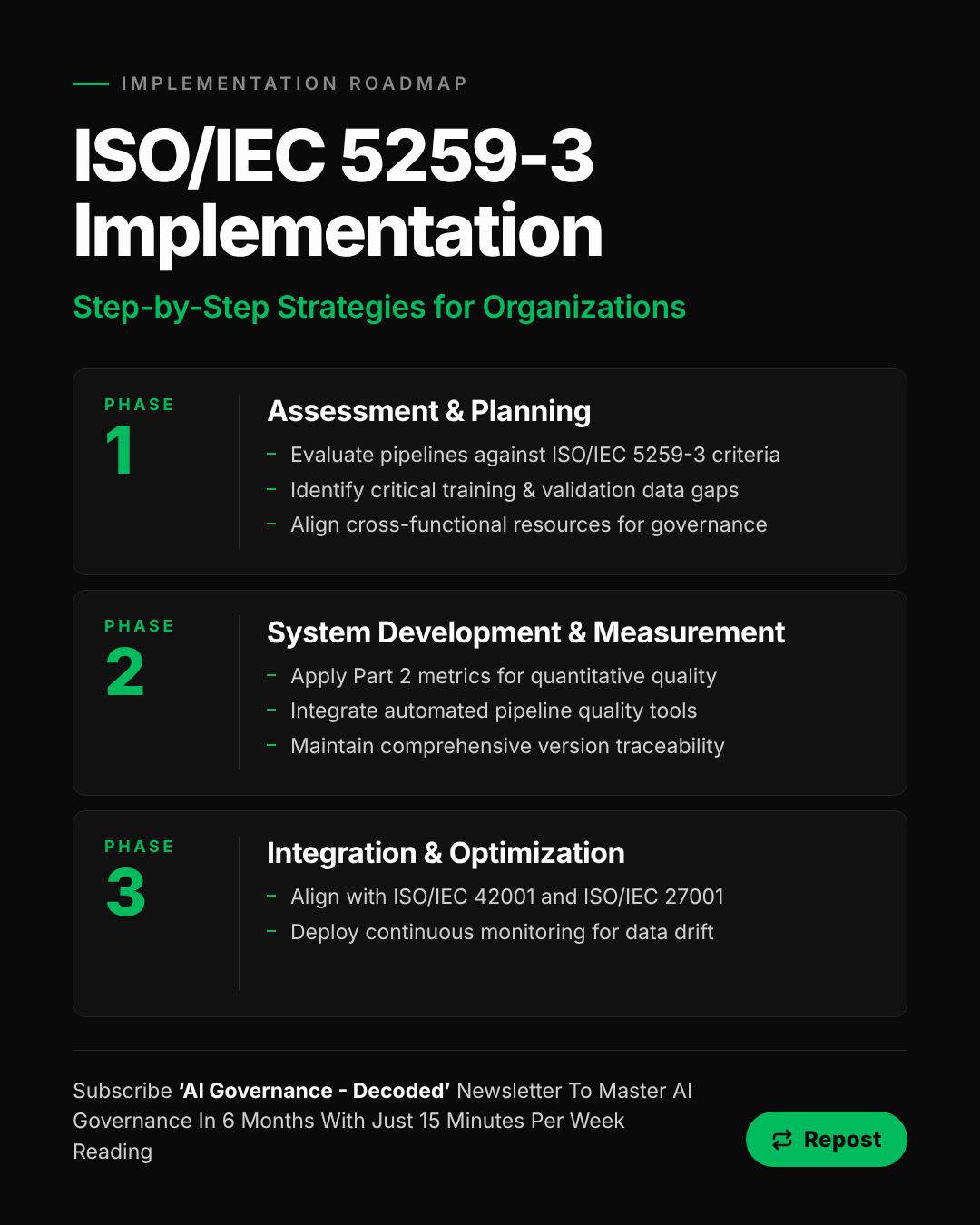
Phase 1: Assessment and Planning
Evaluate your current data ingestion, cleaning, and labeling pipelines against ISO/IEC 5259-3 criteria.
Identify critical data gaps relative to training, validation, and testing datasets.
Secure cross-functional alignment and allocate resources for data governance oversight.
Phase 2: System Development & Measurement
Leverage Part 2 of the series to establish a small, hard set of core quantitative quality metrics per dataset.
Incorporate automated data quality measurement tools into your ML pipelines.
Develop comprehensive documentation and traceability protocols to retain measurement results across all dataset versions—not just the latest iteration.
Phase 3: Integration and Optimization
Align your data quality framework with existing management systems, such as ISO/IEC 42001 (Artificial Intelligence Management Systems) and ISO/IEC 27001 (Information Security Management).
Establish continuous monitoring systems to track data drift and degradation over time.
Frequently Asked Questions
Why is ISO/IEC 5259-3 important for AI developers?
It provides the only globally recognized standard specifically tailored for machine learning data pipelines. By addressing the root cause of most AI project failures—bad data—it helps teams avoid costly rework and regulatory penalties.
Is ISO/IEC 5259-3 compatible with popular AI frameworks?
Yes. The standard is technology-agnostic. It focuses on processes and quality principles, making it fully compatible with popular ML stacks like PyTorch, TensorFlow, and various cloud-based AI environments.
How long does implementation take?
For most organizations, initial implementation takes between 6 to 12 months. Companies that already maintain quality management systems like ISO 9001 or ISO 27001 typically experience a faster onboarding curve.
Ready to Build Trustworthy AI?
Adopting ISO/IEC 5259-3 is your roadmap to achieving superior AI performance, minimizing project risks, and meeting emerging regulatory mandates with complete confidence.
Ready to transform your AI data quality framework?
Connect with me on LinkedIn or reach out via our contact form today to discuss how to implement robust ISO/IEC standards in your organization and scale your AI initiatives responsibly.
Subscribe to "AI Governance - Decoded" Newsletter to Master AI Governance With Just 15 Minutes Read Per Week.

Kumail Mehdi
ISO 42001 Lead Auditor and AI strategist. 11 years in corporate leadership, 14 years running a digital agency. I help professionals, consultants and AI startups turn expertise into governed, AI-powered systems.