If you are building artificial intelligence solutions or scaling an ISO 42001 consultancy, keeping up with global standards isn't optional, it is your ultimate competitive moat. While everyone is talking about the EU AI…
If you are building artificial intelligence solutions or scaling an ISO 42001 consultancy, keeping up with global standards isn't optional, it is your ultimate competitive moat. While everyone is talking about the EU AI Act and NIST, the Institute of Electrical and Electronics Engineers (IEEE) dropped a game-changing framework that every AI governance professional needs on their radar: IEEE 7003-2024, "Standard for Algorithmic Bias Considerations."
Approved in late 2024 and officially published in January 2025, this standard provides the exact operational playbook developers and compliance officers need to tackle algorithmic bias head-on.
Let's break down what IEEE 7003-2024 is, why it matters for your Artificial Intelligence Management System (AIMS), and how you can leverage it to build bulletproof trust with your enterprise clients.
What is IEEE 7003-2024?
At its core, IEEE 7003-2024 is a voluntary framework designed to help organizations define, measure, and mitigate algorithmic bias throughout the entire lifecycle of an autonomous intelligent system (AIS).
Unlike high-level legislative acts, IEEE 7003 gets into the engineering trenches. It establishes rigorous methodologies to ensure that algorithmic systems, whether rule-based, statistical, or machine learning models, don't produce unwanted differential impacts on stakeholders based on protected characteristics like race, gender, or socio-economic background.
Wanted vs. Unwanted Bias
One of the most pragmatic aspects of the standard is its nuance regarding bias. IEEE 7003 recognizes that not all bias is bad:
Wanted Bias: This is essential for the functional objectives of an AI system. For example, a search engine needs a built-in bias to return results that match your specific search query.
Unwanted Bias: This occurs when systemic differences in treatment cause unintended harm, discrimination, or reputational damage to specific stakeholder groups.
The standard doesn't try to eliminate bias entirely; instead, it provides a structured process to identify, isolate, and manage unwanted bias while maintaining the functional integrity of your algorithms.
Key Pillars of the IEEE 7003 Framework
For AI startups and consultants building out an AIMS, the standard outlines several core mechanisms you need to integrate into your development pipeline:
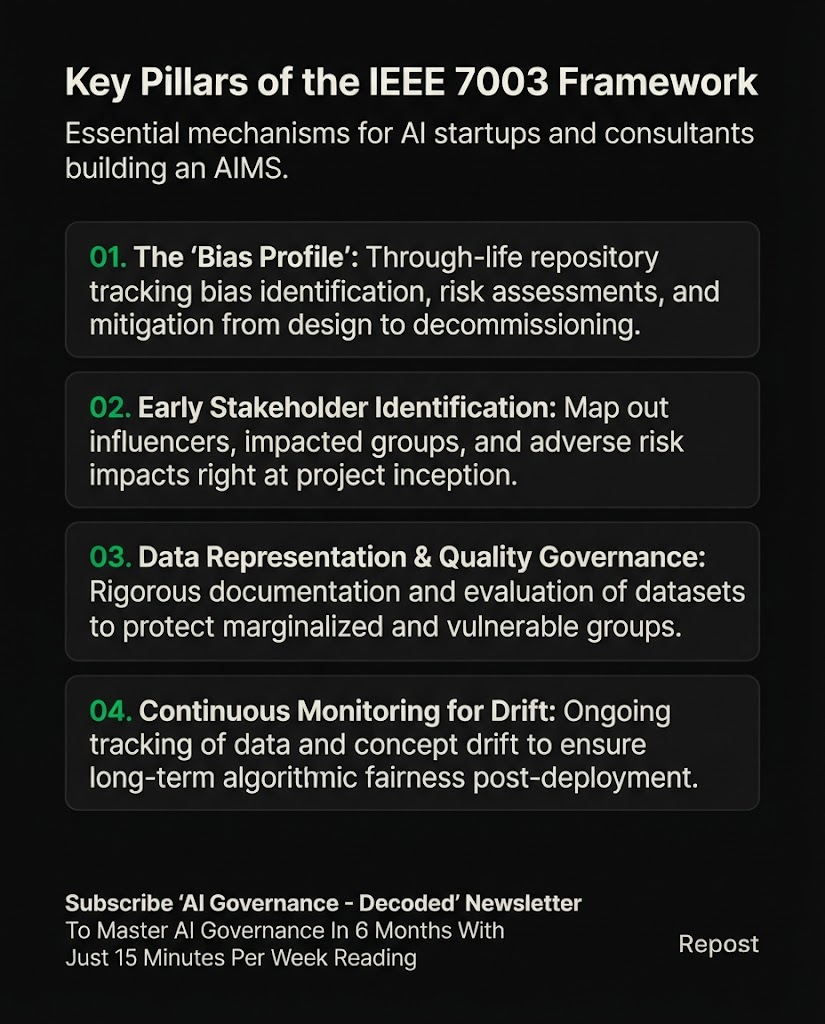
The "Bias Profile": Much like a technical data sheet, organizations are encouraged to create and maintain a through-life repository that tracks every decision related to bias identification, risk assessments, and mitigation strategies from initial design to decommissioning.
Early Stakeholder Identification: The standard forces teams to identify both those who influence the system and those impacted by it right at the project's inception, mapping out adverse risk impacts before deployment.
Data Representation & Quality Governance: Because unrepresentative training data is the root cause of most algorithmic bias, IEEE 7003 mandates rigorous documentation and evaluation of datasets to ensure marginalized or vulnerable groups are properly accounted for.
Continuous Monitoring for Drift: Models change over time as real-world environments shift. The framework demands ongoing monitoring to catch both data drift and concept drift to ensure fairness remains intact long after deployment.
How IEEE 7003 Complements ISO 42001 and the EU AI Act
If you are already aligning your startup or your clients with ISO/IEC 42001 (Artificial Intelligence Management System), you might be wondering how IEEE 7003 fits into the puzzle.
Think of ISO 42001 as the macro-level management system (the organizational umbrella governing policies, risk management, and continuous improvement), and IEEE 7003 as the micro-level technical standard that fulfills specific operational requirements—such as Clause 6.1.4 (impact assessment) and Annex controls on data and system transparency.
While IEEE 7003 is not a legal statute like the EU AI Act, proactive adoption bridges the gap between high-level regulatory expectations and engineering reality. Enterprises procuring AI solutions are increasingly looking for verifiable proof that algorithms are fair and auditable. Showing conformance to IEEE 7003 gives you a massive edge in enterprise sales cycles.
Action Plan for AI Startups and Consultants
Audit Your Development Pipeline: Review your current AI development lifecycle to see where bias assessments and stakeholder mapping can be injected early.
Build a Bias Profile Template: Create a centralized document repository for your models that records design choices, data inclusion/exclusion rationales, and known limitations.
Tie It Back to AIMS: Map your IEEE 7003 practices directly into your ISO 42001 documentation to streamline future compliance audits.
Ready to build bulletproof trust with your enterprise clients and position your AI startup at the cutting edge of governance?
Connect with me on LinkedIn today to discuss how we can get your AI solutions ISO 42001 certified and audit-ready.
Subscribe to "AI Governance - Decoded" Newsletter to Master AI Governance With Just 15 Minutes Read Per Week.

Kumail Mehdi
ISO 42001 Lead Auditor and AI strategist. 11 years in corporate leadership, 14 years running a digital agency. I help professionals, consultants and AI startups turn expertise into governed, AI-powered systems.