Artificial intelligence models are transitioning from experimental pilot projects to mission-critical infrastructure. Whether powering autonomous diagnostics in healthcare, automated decision-making in financial…
Artificial intelligence models are transitioning from experimental pilot projects to mission-critical infrastructure. Whether powering autonomous diagnostics in healthcare, automated decision-making in financial underwriting, or generative workflows across enterprise operations, the stakes are undeniably high.
With this expanded footprint comes exposure. Technical vulnerabilities, stochastic drift, opaque algorithmic decisions, and compliance liabilities can rapidly undermine a deployment.
ISO/IEC TR 24028 (Information technology — Artificial intelligence — Overview of trustworthiness in artificial intelligence) provides the foundational technical architecture organizations need to systematically establish, measure, and scale reliable, ethical, and defensible AI systems.
What Is ISO/IEC TR 24028?
Published by the Joint Technical Committee ISO/IEC JTC 1/SC 42, ISO/IEC TR 24028 is an international technical report designed to establish an objective benchmark for AI trustworthiness.
The standard defines trustworthiness as:
The ability of an AI system to meet stakeholders’ expectations in a verifiable and documented manner.
Rather than treating trust as an abstract moral aspiration, ISO/IEC TR 24028 frames it as an engineering discipline. It inventories existing technical safeguards, surveys threat vectors unique to machine learning (ML), and details methodologies to audit critical system attributes, including:
Availability and Resiliency: Sustaining operations through faults and anomalous runtime environments.
Robustness and Accuracy: Maintaining output fidelity under varying data conditions and edge-case distributions.
Safety and Controllability: Guaranteeing fail-safes and human-in-the-loop oversight to curb unintended emergent behaviors.
Privacy and Data Governance: Safeguarding sensitive training corpora and inference data against exfiltration.
Why AI Trustworthiness Dictates Market Access
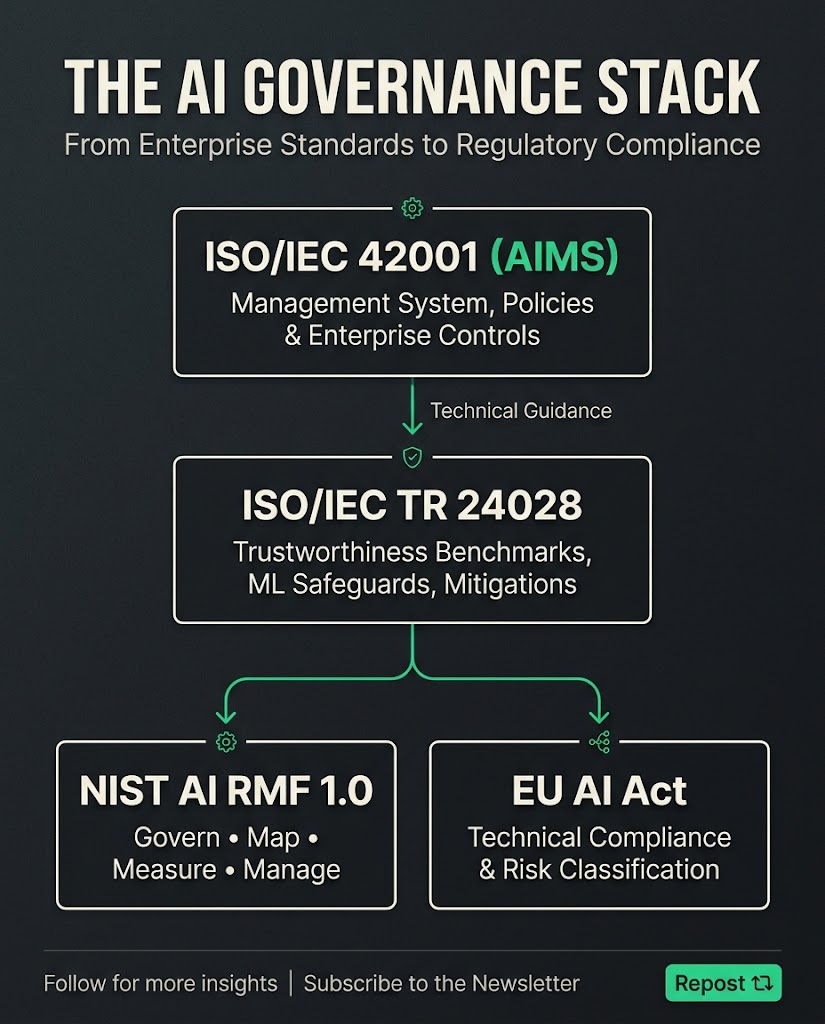
The conversation around AI accountability has moved from voluntary ethical charters to enforceable legal mandates. Regulatory mechanisms like the European Union AI Act impose binding technical documentation, risk management, and oversight standards on high-risk AI deployments. Concurrently, US market frameworks like the NIST AI Risk Management Framework (AI RMF 1.0) establish expectations for systematic system governance.
Recent industry data highlights the business impact of trust-focused engineering:
According to an MIT Technology Review Insights study, organizations prioritizing explainable AI (XAI) see 34% higher user adoption rates and 28% greater stakeholder trust.
Findings from the National Institute of Standards and Technology (NIST) indicate that organizations deploying standardized AI risk management architectures experience 42% fewer critical AI incidents and recover 37% faster when edge-case anomalies occur.
ISO/IEC TR 24028 serves as an essential technical crosswalk, bridging daily engineering pipelines with high-level corporate governance benchmarks.
The Core Pillars of AI Trustworthiness
ISO/IEC TR 24028 breaks trustworthiness down into operational dimensions that engineering teams and compliance officers must systematically address.
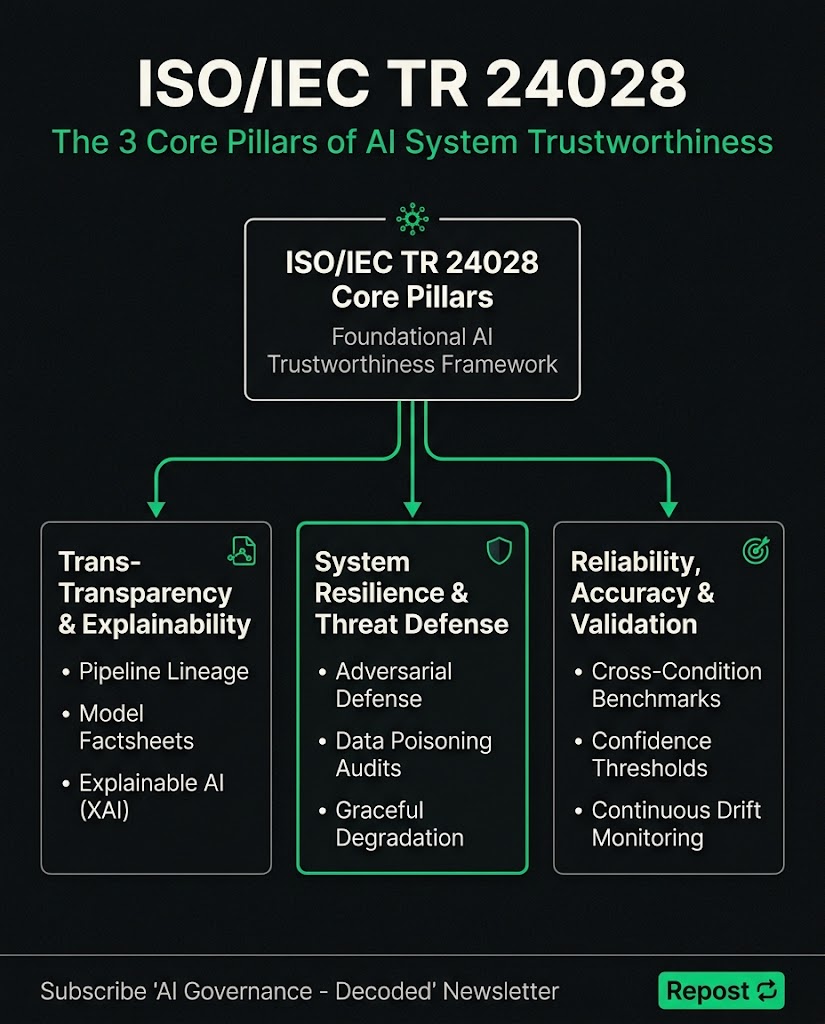
1. Transparency and Explainability
Trust starts with system traceability. A trustworthy AI system cannot operate as an uninspected black box.
Pipeline Documentation: Detailed record-keeping of data provenance, data cleansing techniques, feature engineering choices, and deployment boundaries.
Algorithmic Fairness: Auditing models for hidden demographic, historical, or sampling bias—essential when managing stochastic, non-deterministic outputs. Integrating structural guidance from sister frameworks like ISO/IEC 23053 ensures architectures follow documented machine learning pipelines.
Explainability (XAI): Deploying model-agnostic interpretability tools (such as SHAP values, LIME, or counterfactual examples) so technical teams, auditors, and end-users can trace how inputs convert to decisions.
2. Resilience, Security, and Threat Defense
Machine learning introduces unique cyber and operational vulnerabilities that traditional software QA does not cover. ISO/IEC TR 24028 details countermeasures for critical failure modes:
Adversarial Attacks: Defending inference endpoints against prompt injection, evasion attacks, and adversarial perturbations designed to trigger system hallucinations or classification errors.
Data Poisoning & Leakage: Implementing cryptographically verifiable data lineage to stop malicious data from degrading training splits, while defending against membership inference attacks.
Graceful Degradation: Designing safety interlocks that detect out-of-distribution inputs and automatically downscale system autonomy or route queries to human operators.
3. Reliability, Accuracy, and Continual Validation
Operating Bounds: Stress-testing model precision, recall, and F1 scores against synthetic perturbations, noisy environments, and domain shifts.
Confidence Scoring: Structuring models to output calibrated confidence metrics, rejecting low-certainty predictions before they hit production services.
Continuous Monitoring: Monitoring production APIs for data and concept drift to preserve inference accuracy over time.
How Does ISO/IEC TR 24028 Connect to ISO/IEC 42001?
Understanding the relationship between standard types prevents common implementation errors:
ISO/IEC 42001 is a normative Management System Standard (MSS). It outlines the overarching requirements for establishing, certifying, and maintaining an AI Management System (AIMS) across an enterprise.
ISO/IEC TR 24028 is an informative Technical Report (TR). It supplies the foundational taxonomy, vulnerability overviews, and mitigation mechanics that fuel your ISO 42001 risk treatment plan.
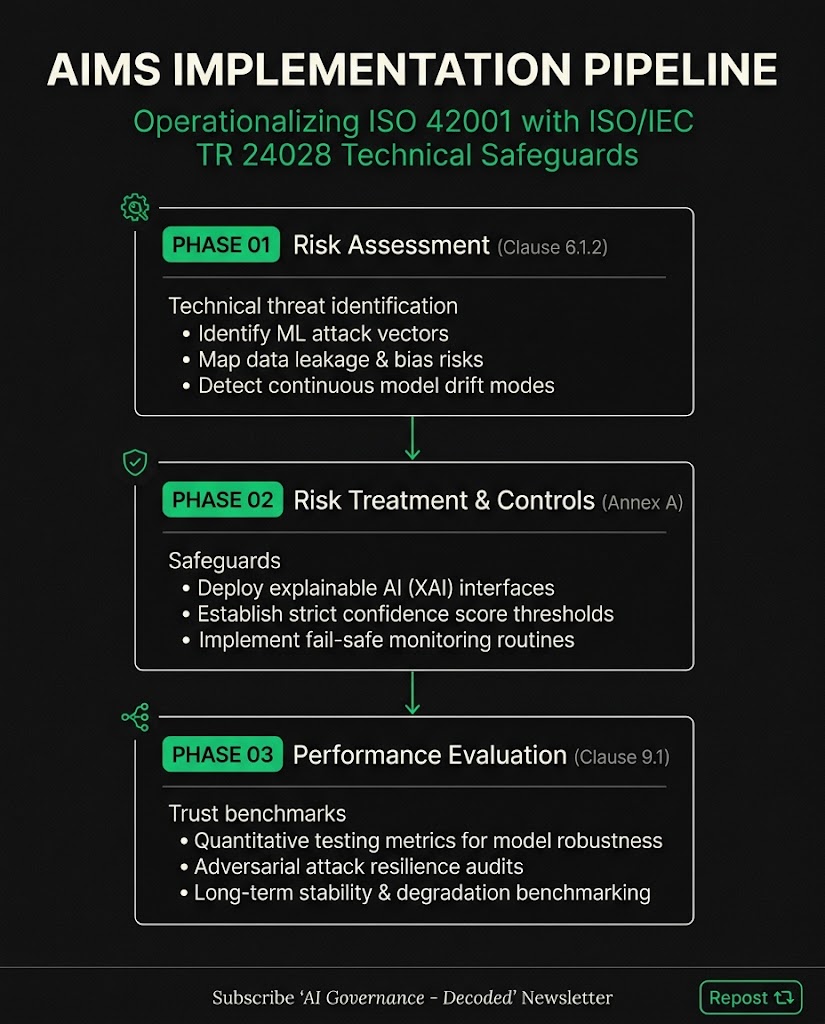
When building an enterprise AI governance framework, ISO/IEC TR 24028 supplies the technical criteria needed to satisfy ISO 42001 audit requirements.
4-Step Playbook: Implementing ISO/IEC TR 24028
Adopting this technical report requires converting high-level guidance into operational engineering checkpoints across the development lifecycle.
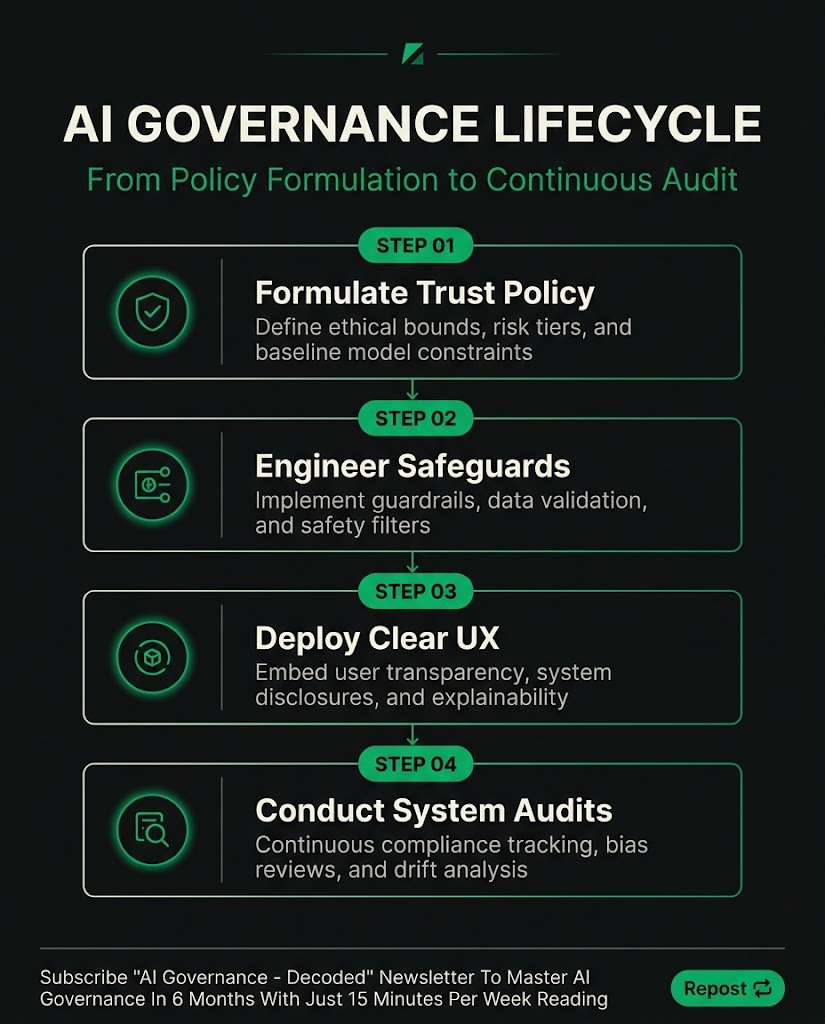
Establish an organization-wide AI Trustworthiness Policy. Document your acceptable risk thresholds across accuracy, data privacy, and unintended model outputs. Identify operational boundaries: what tasks can your system execute autonomously, and which require human confirmation?
Step 2: Implement Engineering Safeguards
Integrate verification suites directly into your CI/CD pipelines.
Use synthetic adversarial test sets to evaluate model robustness prior to merge.
Embed runtime drift detection (e.g., population stability indexes, embedding drift alerts) on live data streams.
Log all model versions, hyperparameters, and dataset snapshots to ensure reproducible training runs.
Step 3: Expose Model Disclosures & Interpretability
Build transparency into your user experience. Document the operational limits and intended scope of your AI tooling using Model Cards or System Factsheets. Ensure critical automated decisions provide end-users with contextual rationales.
Step 4: Execute Ongoing Lifecycle Audits
AI trustworthiness is an ongoing discipline, not a static checkpoint. Conduct recurring security evaluations against emerging adversarial tactics, review edge-case telemetry, and update system constraints to maintain alignment with evolving compliance standards like the EU AI Act and ISO 42001.
Frequently Asked Questions
What is the primary difference between ISO/IEC TR 24028 and ISO/IEC 42001?
ISO/IEC 42001 provides the auditable, certifiable organizational framework for governing AI across an enterprise (an AI Management System). ISO/IEC TR 24028 is a technical report detailing the specific components, engineering risks, and mitigation strategies required to make AI systems technically reliable, explainable, and secure.
Can an organization be certified in ISO/IEC TR 24028?
No. Because it is classified as a Technical Report (TR) rather than a normative standard, organizations cannot receive formal accreditation for ISO/IEC TR 24028. Instead, teams use its architectural recommendations to satisfy the technical control requirements of auditable frameworks like ISO/IEC 42001.
How does ISO/IEC TR 24028 address machine learning bias?
The framework addresses bias through end-to-end transparency and rigorous validation. It recommends data provenance tracking, balanced cohort sampling across training splits, and model-agnostic interpretability tools to detect, isolate, and remediate systemic bias before deployment.
The Strategic Advantage of Trustworthy AI
Adopting standardized trustworthiness controls moves your compliance efforts from reactive adjustments to a measurable market advantage. Building verifiable, transparent, and resilient AI systems reduces operational exposure, accelerates regulatory approvals, and shortens procurement cycles with enterprise buyers.
Ready to build trust with your enterprise clients?
Connect with me today to get your AI startup ISO 42001 certified.
Subsribe to "AI Governance - Decoded" Newsletter to Master AI Governance With Just 15 Minutes Read Per Week.

Kumail Mehdi
ISO 42001 Lead Auditor and AI strategist. 11 years in corporate leadership, 14 years running a digital agency. I help professionals, consultants and AI startups turn expertise into governed, AI-powered systems.


