When engineering artificial intelligence, technical teams often focus heavily on model weights, hyperparameter tuning, and training data pipelines. However, as AI systems move from experimental sandboxes into…
When engineering artificial intelligence, technical teams often focus heavily on model weights, hyperparameter tuning, and training data pipelines. However, as AI systems move from experimental sandboxes into mission-critical enterprise environments, fragmented accountability and unmanaged lifecycle drift quickly derail production projects.
Enter ISO/IEC 5338:2023—the international standard for AI system lifecycle processes. Published by ISO/IEC JTC 1/SC 42, this standard brings rigorous process-driven structure to how AI systems are specified, developed, validated, deployed, and maintained.
In this guide, we break down what ISO/IEC 5338 covers, how it differs from broader governance frameworks like ISO/IEC 42001, and how your organization can apply it for operational reliability.
What is ISO/IEC 5338 and Why Does It Matter?
ISO/IEC 5338 defines comprehensive lifecycle processes for AI-enabled systems, building directly upon established systems and software engineering lifecycle models like ISO/IEC/IEEE 15288 and ISO/IEC/IEEE 12207.
Without a shared lifecycle model, accountability in AI projects easily fractures across data scientists, software architects, risk owners, and business stakeholders. ISO/IEC 5338 solves this fragmentation by:
Improving cross-functional consistency: Aligning data scientists, engineers, and risk officers under a unified process framework.
Strengthening audit readiness: Providing verifiable evidence for governance, compliance, and assurance reviews.
Bridging the gap to production: Eliminating blind spots between experimental model development and operational scaling.
Clarifying ownership: Defining distinct responsibilities for data management, model training, release decisions, and ongoing monitoring.
What the Standard Covers Across the AI Lifecycle
Rather than viewing AI engineering as a single monolithic task, ISO/IEC 5338 structures work into logical stages—concept, development, production, utilization, support, and retirement—categorized into four core process groups:
Agreement Processes: Govern acquisition, vendor management, and supply relationships for external AI components or services.
Organizational Processes: Establish the infrastructure, resource allocation, and project-level accountability needed to sustain AI development.
Technical Management Processes: Coordinate planning, risk tracking, and configuration activities across the entire lifecycle.
Technical Processes: Cover the core engineering work—including requirements analysis, data readiness, model engineering, verification, and validation.
Navigating "AI Particularities"
A standout feature of ISO/IEC 5338 is its focus on AI-specific operational nuances, including:
Sensitive Training Data: Unlike traditional software engineering where teams rely on anonymous test data, AI engineering requires strict protections around proprietary or sensitive training datasets.
Emergent Risk Topics: Proactively managing challenges like algorithmic bias, model transparency, and purpose-binding.
Experimental Uncertainty: Acknowledging that AI development cycles are inherently iterative and harder to predict than standard software roadmaps.
Model Staleness: Planning for continuous validation in production to combat performance degradation and data drift over time.
ISO/IEC 5338 vs. ISO/IEC 42001: Understanding the Layers
A common point of confusion for organizations is how ISO/IEC 5338 interacts with other prominent AI standards. They are complementary layers rather than competing alternatives:
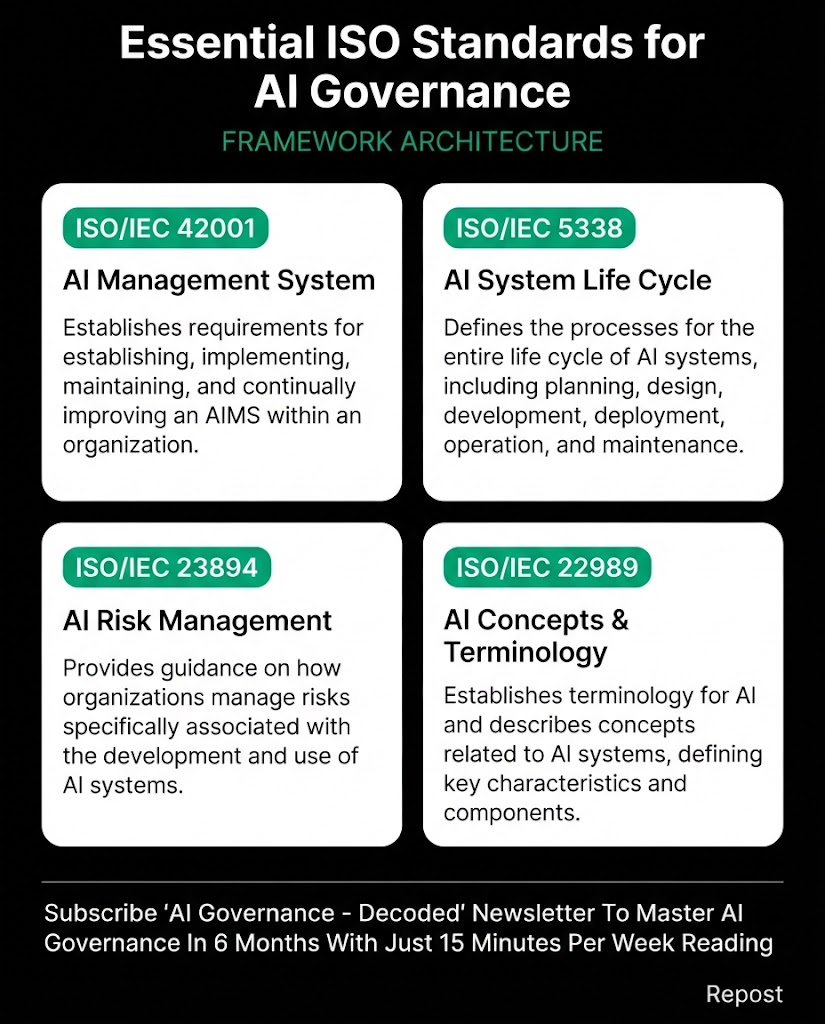
In short, ISO/IEC 42001 helps you govern AI, while ISO/IEC 5338 helps your engineering teams execute it.
What Makes AI Lifecycles Different From Traditional Software?
Traditional software engineering standards remain vital, but AI systems introduce unique challenges that make ISO/IEC 5338 essential:
Data-Centric Behavior: System quality relies as much on the provenance, cleanliness, and representativeness of training data as it does on source code.
Post-Release Evolution: Machine learning models change behavior in production as real-world data distributions shift.
Complex Validation: Teams must evaluate not just functional correctness, but also robustness, fairness, and safety under varied operating conditions.
Traceable Evidence: Decisions regarding model deployment and retraining must be backed by verifiable audit trails.
How to Apply ISO/IEC 5338 in Practice
Implementing ISO/IEC 5338 should not feel like checking boxes for a theoretical audit. Instead, use it to inject rigor into your daily development workflows:
Map Current AI Workflows: Audit where your organization currently designs, trains, deploys, and monitors AI models.
Define Clear Ownership: Assign named accountability for data quality, verification gates, and release approvals.
Establish Stage-Gate Checkpoints: Build formal review moments for data readiness, security testing, and production performance.
Align with Governance: Connect your technical lifecycle evidence directly to your broader AI management system and risk oversight frameworks.
Frequently Asked Questions (FAQ)
Is ISO/IEC 5338 a certification standard?
No. ISO/IEC 5338 is primarily a process reference model. It is designed to structure and optimize how AI systems are engineered and managed across their lifecycle rather than serving as a standalone certification standard (unlike ISO/IEC 42001).
Who should use the ISO 5338 AI systems standard?
It is ideal for enterprise IT leaders, software architects, machine learning engineering teams, risk officers, and compliance leads who design, build, or operate AI systems.
Does ISO/IEC 5338 only apply to machine learning models?
No. The standard takes a holistic system-level perspective. It covers the surrounding software infrastructure, integration data, deployment pipelines, operational monitoring, and management controls.
Ready to Streamline Your AI Engineering?
Mastering AI lifecycle processes is essential for scaling trustworthy AI systems that satisfy both technical stakeholders and enterprise auditors. Whether you are building an AI startup or maturing a boutique consulting practice, establishing process discipline early sets you apart.
Connect with me today to learn how to align your AI development workflows with international standards and get your systems ready for enterprise adoption.
Subscribe to "AI Governance - Decoded" Newsletter to Master AI Governance With Just 15 Minutes Read Per Week.

Kumail Mehdi
ISO 42001 Lead Auditor and AI strategist. 11 years in corporate leadership, 14 years running a digital agency. I help professionals, consultants and AI startups turn expertise into governed, AI-powered systems.