As artificial intelligence systems become deeply embedded in core business operations, enterprises face an urgent demand for trust, accountability, and verifiable governance. Enter ISO/IEC 42001, the premier global…
As artificial intelligence systems become deeply embedded in core business operations, enterprises face an urgent demand for trust, accountability, and verifiable governance. Enter ISO/IEC 42001, the premier global standard for Artificial Intelligence Management Systems (AIMS).
However, a critical question has lingered across the compliance landscape: Who audits the auditors?
How do we ensure that third-party certification bodies possess the specialized technical depth required to evaluate complex machine learning models, algorithmic bias, and data governance?
The release of ISO/IEC 42006:2025 provides the definitive answer. This standard establishes rigorous requirements for bodies performing the audit and certification of AIMS. Whether you are an aspiring ISO 42001 consultant or an AI startup preparing for your inaugural audit, understanding this framework is essential for navigating the future of AI compliance.
What is ISO/IEC 42006:2025?
Published in July 2025 by ISO/IEC JTC 1/SC 42 (the joint technical committee dedicated to artificial intelligence), ISO/IEC 42006:2025 specifies supplementary requirements to ISO/IEC 17021-1 (the foundational standard for management system auditing bodies).
While ISO/IEC 42001 outlines how organizations should manage AI risks, ethics, data quality, and security internally, ISO/IEC 42006 governs how conformity assessment and certification bodies must evaluate those management systems.
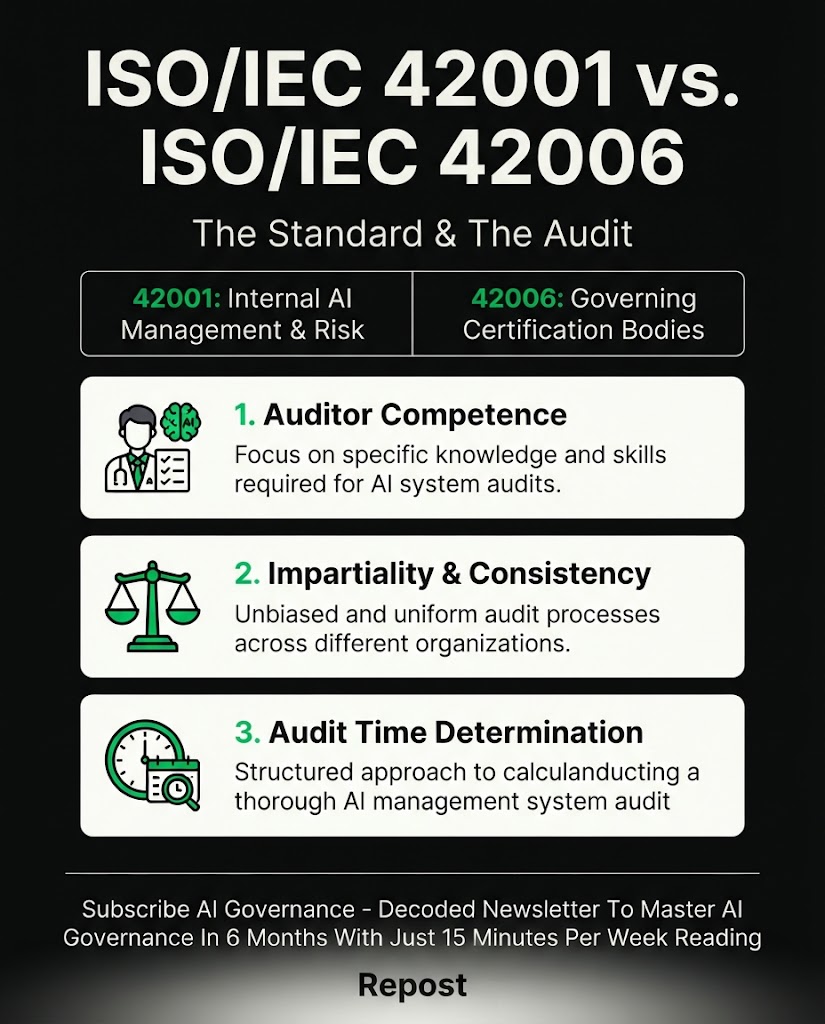
Key pillars of the standard include:
Auditor Competence: Establishing strict baseline qualifications for audit personnel regarding AI concepts, risk management, and algorithmic validation.
Impartiality & Consistency: Mitigating conflicts of interest inherent in rapidly evolving tech markets.
Audit Time Determination: Providing structured guidelines (including Annexes A and B) to calculate accurate audit durations based on the complexity of an organization's AI deployments.
Why ISO/IEC 42006 Matters for AI Startups and Consultants
If you help organizations implement AI governance frameworks, ISO/IEC 42006 directly impacts your clients and your go-to-market strategy.
1. Eliminating "Box-Ticking" Audits
Traditional ISO audits (like ISO 9001 or ISO 27001) rely on standardized frameworks for quality and information security. AI, however, introduces dynamic challenges—such as non-deterministic model outputs, continuous learning loops, and data drift. ISO/IEC 42006 ensures that certification bodies cannot treat an AIMS audit like a standard IT review. Auditors must understand the lifecycle processes defined in ISO/IEC 5338 and the AI risk management guidance in ISO/IEC 23894.
2. Boosting Enterprise Trust
Enterprise buyers are increasingly hesitant to adopt third-party AI tools without verifiable proof of safety and compliance. When an organization achieves ISO/IEC 42001 certification via a body accredited under ISO/IEC 42006 standards, prospective clients gain absolute confidence that the certification is credible, rigorous, and internationally recognized.
Key Requirements Outlined in the Standard
The standard builds directly upon established conformity frameworks while introducing critical AI-specific controls:
Integration with ISO/IEC 17021-1: It functions as an extension, meaning certification bodies must maintain baseline management system competence while layering on specialized AI expertise.
Multidisciplinary Audit Teams: Because AI touches data science, ethics, cybersecurity, and legal compliance, ISO/IEC 42006 emphasizes that audit teams must possess collective competence across these varied domains.
Lifecycle Awareness: Audits must account for the entire AI system lifecycle—from initial conception and data collection to deployment, monitoring, and eventual decommissioning.
Frequently Asked Questions
Does ISO/IEC 42006 replace ISO/IEC 17021-1?
No. ISO/IEC 42006 does not replace ISO/IEC 17021-1; rather, it supplements it. Certification bodies must comply with both standards simultaneously to offer accredited AIMS audits.
Who needs to comply with ISO/IEC 42006?
This standard is specifically designed for conformity assessment bodies, accreditation bodies, and peer assessors. However, understanding its requirements gives AI startups and consultants a massive advantage in knowing precisely what auditors will look for during an AIMS certification readiness review.
Conclusion
As regulatory scrutiny intensifies globally—from the European Union AI Act to regional compliance frameworks—formal AI governance is shifting from a nice-to-have differentiator to an operational necessity. ISO/IEC 42006:2025 bridges the gap between high-level AI ethics and verifiable audit execution, ensuring that certified AIMS frameworks carry genuine market weight.
Ready to build trust with your enterprise clients and position your business at the forefront of AI governance?
Connect with me today to get your AI startup ISO 42001 certified.
Subscribe to "AI Governance - Decoded" Newsletter to Master AI Governance With Just 15 Minutes Read Per Week.

Kumail Mehdi
ISO 42001 Lead Auditor and AI strategist. 11 years in corporate leadership, 14 years running a digital agency. I help professionals, consultants and AI startups turn expertise into governed, AI-powered systems.


