An Artificial Intelligence impact assessment framework is a structured methodology for evaluating the potential risks, societal implications, and operational benefits of AI systems before and during deployment. With the…
An Artificial Intelligence impact assessment framework is a structured methodology for evaluating the potential risks, societal implications, and operational benefits of AI systems before and during deployment. With the publication of ISO/IEC 42005, organizations now possess an internationally recognized benchmark designed to guide ethical, compliant, and responsible AI implementation.
As global regulations tighten and enterprise buyers scrutinize algorithm safety, systematic AI governance is no longer optional. Here is an actionable guide for compliance officers, enterprise risk architects, and AI consultants navigating the ISO/IEC 42005 standard.
The Critical Need for Standardized AI Impact Assessment
The rapid proliferation of enterprise AI has outpaced traditional governance. From diagnostic clinical decision-support systems to automated underwriting algorithms, AI applications directly shape human lives. Until recently, organizations lacked a unified, auditable approach to assess these broader consequences.
The release of ISO/IEC 42005 marks a pivotal shift in AI governance. According to the OECD AI Policy Observatory, over 1,000 national AI policy initiatives across more than 70 countries have emerged to enforce algorithm accountability and risk management. Meanwhile, the BSI Standards Publication underscores that evaluating societal and ethical consequences alongside technical reliability is vital for regulatory resilience.
Without a standardized assessment framework, businesses face fragmented audits, expensive retrofits, and catastrophic liability risks.
Understanding ISO/IEC 42005: A Companion to ISO/IEC 42001
ISO/IEC 42005 establishes comprehensive, international guidance for conducting AI system impact assessments across various domains and operational tiers.
While ISO/IEC 42001 defines the overarching certifiable requirements for an AI Management System (AIMS)—covering organizational policies, risk management, and operational controls—ISO/IEC 42005 serves as its practical execution companion, specifically fulfilling assessment obligations such as those detailed in Clause 6.1.4 and Clause 8.4.
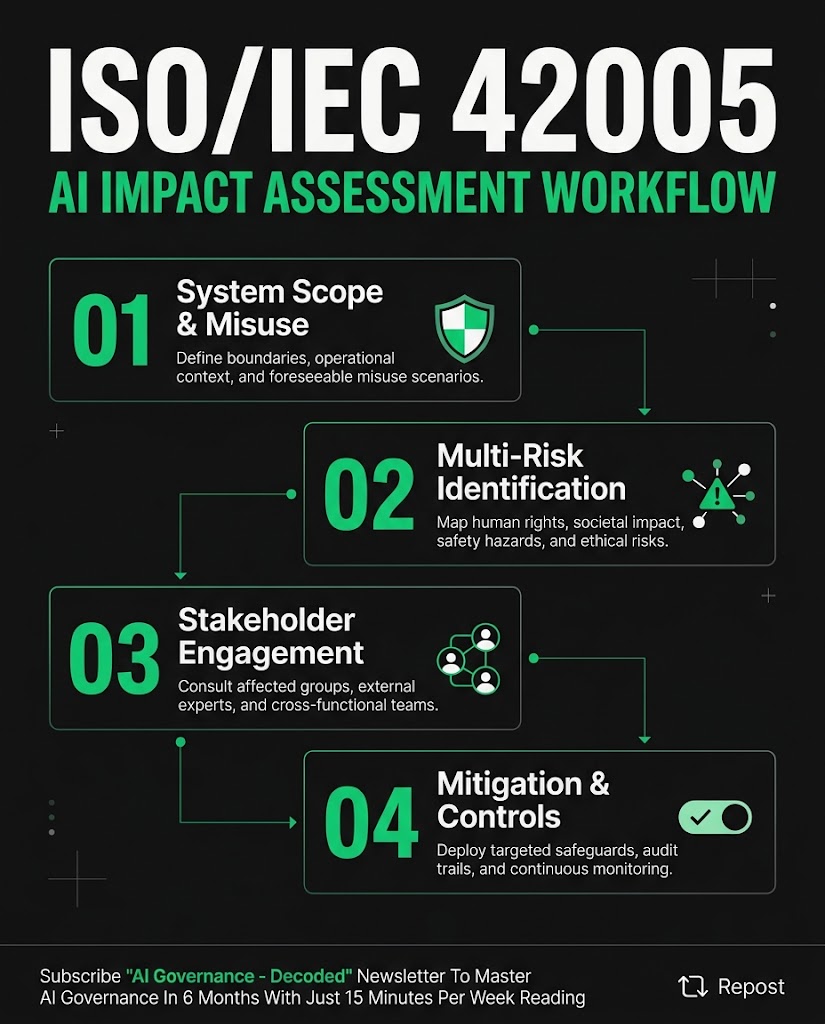
The ISO/IEC 42005 framework emphasizes four core tenets:
Comprehensive Multi-Dimensional Scope: Systematically evaluating algorithmic harms and benefits across fairness, transparency, data privacy, environmental footprint, and human rights.
Meaningful Stakeholder Engagement: Incorporating perspectives from directly affected user groups, compliance officers, domain specialists, and external communities.
End-to-End Lifecycle Integration: Embedding assessments across every phase—from initial concept screening and model training to deployment and decommissioning.
Continuous Monitoring & Review: Establishing iterative feedback loops and re-assessment thresholds when models drift or system context shifts.
Core Components of an Effective AI Impact Assessment Framework
1. Risk Identification and Categorization
A standard assessment begins with systematic risk categorization. Organizations must evaluate potential harms across technical and societal dimensions:
Technical Risks: Algorithmic bias, data drift, non-deterministic hallucinations, prompt injection vulnerabilities, and system failures that degrade performance.
Societal & Fundamental Rights Risks: Labor displacement, discriminatory resource allocation, echo-chamber effects, and privacy erosion.
Regulatory & Legal Risks: Non-compliance with the EU AI Act, FTC enforcement orders, and local data protection regimes.
Reputational Risks: Loss of client trust, negative press, and enterprise brand erosion stemming from unethical or unaccountable outputs.
2. Stakeholder Impact Analysis
Meaningful consultation separates check-the-box exercises from true governance. The framework requires teams to identify both direct users (e.g., credit officers using an automated dashboard) and downstream affected individuals (e.g., loan applicants impacted by an automated credit score).
3. Mitigation Strategies and Actionable Controls
Identifying risks is useless without technical and procedural mitigation:
Algorithmic Guardrails: Real-time bias auditing, output moderation layers, and data anonymization pipelines.
Human-in-the-Loop (HITL) Controls: Empowered, trained human reviewers with the authority to override automated decisions.
Escalation & Recourse Protocols: Accessible appeal channels for individuals subjected to adverse automated decisions.
Real-World Applications: Implementing ISO/IEC 42005 by Industry
Healthcare AI Systems
Consider an enterprise deploying a machine learning model to triage radiology scans. Using ISO/IEC 42005, the team analyzes:
Potential disparities in false-negative rates across specific demographic demographics.
The risk of clinician automation bias (over-relying on automated diagnostics).
Clinical safety fallbacks, mandatory radiologist sign-offs, and multi-cohort validation protocols.
Financial Services & Lending
When a commercial bank deploys automated underwriting:
The assessment evaluates historical training sets for redlining patterns and proxy-variable bias.
It tests model explainability to ensure adverse action notices comply with fair lending mandates.
Cross-functional reviews are conducted involving risk managers, credit compliance officers, and consumer advocacy benchmarks.
Smart City Infrastructure
For municipal camera networks running automated traffic and transit optimization:
Impact analyses measure citizen surveillance concerns, biometric data leak risks, and energy consumption metrics.
Controls include edge processing, localized data retention caps, and public transparency disclosures.
Alignment with Global Regulations (EU AI Act & Beyond)
ISO/IEC 42005 aligns directly with emerging global compliance mandates. Under the European Union’s AI Act, deployers of high-risk AI systems must perform a Fundamental Rights Impact Assessment (FRIA) prior to market placement. Similarly, the US NIST AI Risk Management Framework (AI RMF 1.0) centers around systematic mapping and measuring of impact.
Organizations adopting ISO/IEC 42005 gain operational synergy:
One Single Source of Truth: A unified impact assessment template (derived from ISO/IEC 42005 Annex E) fulfills overlapping cross-border assessment demands.
Auditable Evidence: Third-party auditors evaluating an ISO/IEC 42001 certification can directly reference ISO/IEC 42005 records to verify compliance with Clause 6.1.4.
Frequently Asked Questions
What is the primary difference between ISO/IEC 42001 and ISO/IEC 42005?
ISO/IEC 42001 is a certifiable management standard that outlines how to build and maintain an organizational AI Management System (AIMS). ISO/IEC 42005 is an implementation standard that provides specific methodology, templates, and guidance on how to conduct a comprehensive impact assessment for individual AI systems.
Is ISO/IEC 42005 a mandatory standard?
While ISO/IEC 42005 itself is voluntary guidance rather than a stand-alone certifiable regulation, performing AI impact assessments is becoming mandatory under frameworks like the EU AI Act and ISO 42001 compliance mandates. Adopting 42005 provides a defensible, standardized framework to demonstrate due diligence.
Ready to demonstrate responsible AI and achieve regulatory compliance? Connect with our AI Governance team today to design your custom ISO 42001 & ISO 42005 implementation roadmap.
Subsribe to "AI Governance - Decoded" Newsletter to Master AI Governance With Just 15 Minutes Read Per Week.

Kumail Mehdi
ISO 42001 Lead Auditor and AI strategist. 11 years in corporate leadership, 14 years running a digital agency. I help professionals, consultants and AI startups turn expertise into governed, AI-powered systems.


