Deploying artificial intelligence without board-level oversight is no longer just a technical oversight—it is a critical corporate liability.While engineering teams race to deploy Large Language Models (LLMs), machine…
Deploying artificial intelligence without board-level oversight is no longer just a technical oversight—it is a critical corporate liability.
While engineering teams race to deploy Large Language Models (LLMs), machine learning pipelines, and predictive algorithms, governing bodies are left grappling with accountability: Who takes responsibility when an algorithm misclassifies data, leaks intellectual property, or produces biased outputs? Industry studies show that over 80% of organizations still lack comprehensive AI risk controls, and roughly 70% of enterprise AI transformations struggle to scale beyond pilot stages due to governance bottlenecks and compliance blind spots.
Enter ISO/IEC 38507.
Officially titled “Information technology — Governance of IT — Governance implications of the use of artificial intelligence by organizations,” this international standard gives boards of directors, C-suite executives, and startup founders a practical, vendor-neutral roadmap for governing AI effectively, responsibly, and ethically.
Whether you are scaling an AI startup, advising enterprise clients, or preparing for high-stakes regulatory scrutiny, understanding how ISO/IEC 38507 anchors organizational oversight is the missing link between technological innovation and sustainable enterprise trust.
What Is ISO/IEC 38507?
Published jointly in April 2022 by the International Organization for Standardization (ISO) and the International Electrotechnical Commission (IEC), ISO/IEC 38507 was crafted specifically to bridge the communication gap between executive leadership and technical execution.
Rather than prescribing operational code-level checklists, ISO/IEC 38507 extends the corporate IT governance principles of ISO/IEC 38500 directly into machine learning and automated decision-making ecosystems.
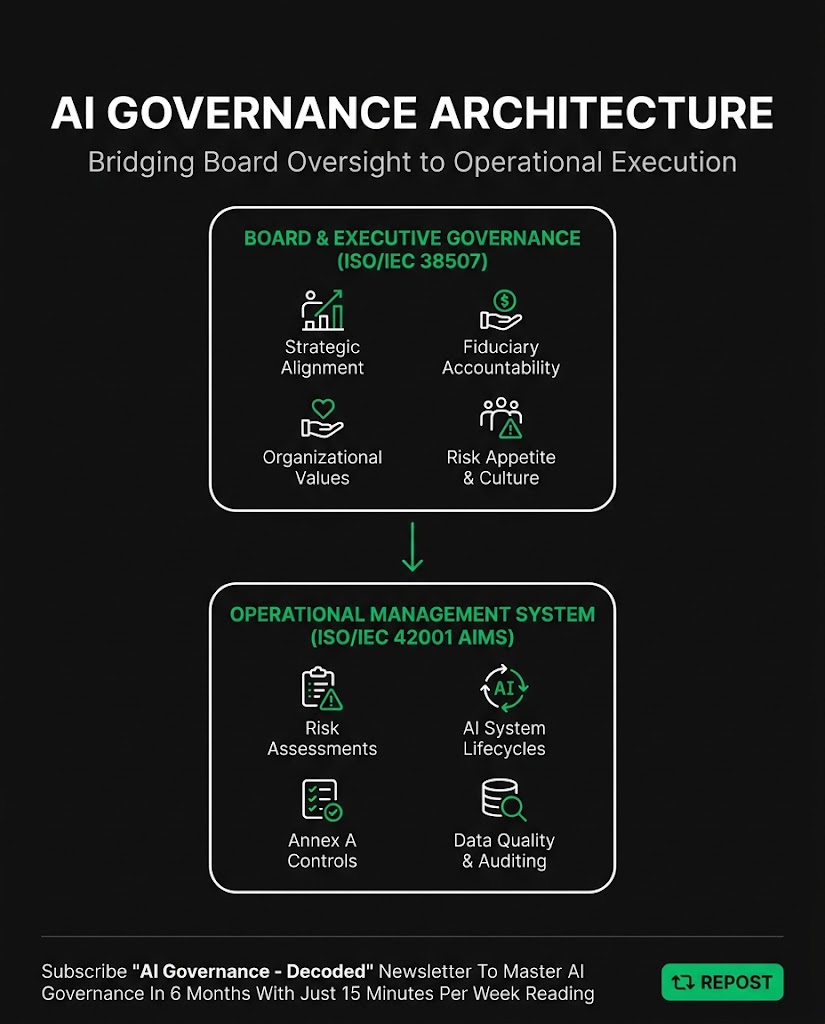
The standard is designed for:
Boards of Directors and Governing Bodies requiring strategic oversight and clear lines of liability.
C-Suite Executives (CEOs, CTOs, CDOs, CISOs) driving AI strategy without compromising data privacy.
Management Consultants and Compliance Officers establishing internal audit and control architectures.
Assessors and Auditors reviewing non-financial corporate risks, human-in-the-loop safeguards, and algorithmic reliability.
The Difference: ISO/IEC 38507 vs. ISO/IEC 42001
A common point of confusion among technology leaders is understanding where ISO/IEC 38507 fits alongside ISO/IEC 42001 (Artificial Intelligence Management System - AIMS).
While both standards work symbiotically, they operate at completely different tiers of organizational hierarchy:
| Dimension | ISO/IEC 38507 | ISO/IEC 42001 (AIMS) |
| Primary Scope | Boardroom oversight & strategic governance | Operational management system & lifecycle controls |
| Target Audience | Board members, C-level executives, policymakers | Operations leads, AI engineers, MLOps, compliance teams |
| Core Question Answered | Why are we using AI, and who is accountable? | How are we building, monitoring, and controlling AI systems? |
| Certifiable? | No (Guidance/code of practice standard) | Yes (Auditable, certifiable management system) |
| Operational Parallel | Equivalent to ISO/IEC 38500 (Corporate IT) | Equivalent to ISO/IEC 27001 (Information Security) |
The Bottom Line: Think of ISO/IEC 38507 as the steering wheel and ISO/IEC 42001 as the engine. ISO/IEC 38507 establishes corporate policy, ethical mandates, and organizational risk tolerance; ISO/IEC 42001 provides the auditable controls, documentation, and processes required to operationalize that vision.
6 Foundational Pillars of ISO/IEC 38507
ISO/IEC 38507 breaks down corporate oversight into six core governance focus areas that prevent operational silos and align technical teams with company-wide values:
1. Governance Oversight & Ultimate Accountability
Accountability for AI outcomes cannot be outsourced to a neural network or a third-party vendor. The governing body remains legally and ethically accountable for all automated decisions. The standard requires explicit roles, defined reporting cadences, and continuous evaluation of whether existing committee structures remain fit-for-purpose as model complexity scales.
2. Decision-Making Governance & Human Oversight
Full automation without safety nets introduces immense operational fragility. ISO/IEC 38507 emphasizes acceptable use parameters, defining precisely when Human-in-the-Loop (HITL) or Human-on-the-Loop (HOTL) interventions are mandatory, especially in credit approvals, automated hiring, and healthcare analytics.
3. Data Use & Stewardship
Algorithms reflect the data that feeds them. This pillar enforces sound data governance across collection, lineage, quality (referencing frameworks like ISO 19157), and bias mitigation. It protects companies against copyright infringement, unauthorized scraping, and privacy violations.
4. Organizational Culture & Ethical Values
AI tools must align with the core mission and non-financial values of the business. Governing bodies must cultivate a culture where teams feel empowered to flag anomalous algorithmic behaviors, hallucinations, or ethical drift without fear of operational friction.
5. Multi-Jurisdictional Compliance Alignment
AI regulation is accelerating globally. Adopting ISO/IEC 38507 provides a structured baseline that directly supports compliance with extraterritorial legislation like the EU AI Act, requirements outlined in the NIST AI Risk Management Framework (AI RMF 1.0), and foundational AIMS structures.
6. Dynamic Risk Management
AI introduces distinct threat vectors—including adversarial prompt injection, data poisoning, model drift, and systemic automation bias. Governance structures must treat AI risk not as an annual audit exercise, but as an ongoing operational discipline.
Strategic Benefits: Beyond Mere Compliance
Implementing ISO/IEC 38507 does not just satisfy corporate watchdogs; it provides tangible commercial leverage:
Shortened Enterprise Sales Cycles: Enterprise procurement teams often reject AI startups due to opaque security and governance profiles. Aligning with international governance standards signals maturity, removing vendor risk.
Defensible Board Oversight: When generative models drift or hallucinate, established governance policies show that directors performed due diligence and satisfied fiduciary responsibilities.
Sustainable Innovation Without Red Tape: Governance isn't about halting experiments; it’s about establishing clear guardrails so engineering teams can build quickly without fear of regulatory fines or reputational damage.
Protection Against Vendor Lock-in: By enforcing clear stakeholder and ecosystem mapping, organizations maintain control over their intellectual property and data ownership across all third-party AI APIs.
A 4-Step Roadmap to Implementing ISO/IEC 38507
Adopting ISO/IEC 38507 does not require rebuilding your corporate infrastructure from scratch. Here is a practical, phased approach:
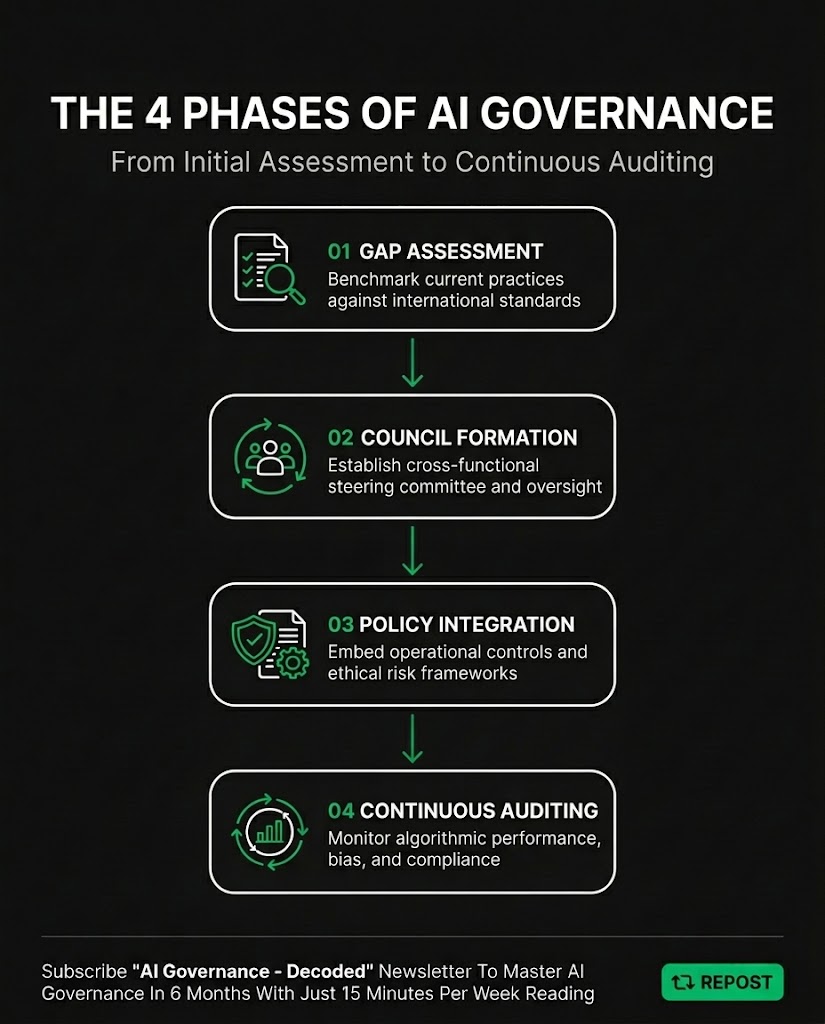
Conduct a Governance Gap Analysis: Evaluate your existing corporate and IT governance policies against ISO/IEC 38507’s oversight recommendations. Identify blind spots—such as unmonitored employee use of consumer AI tools or unvetted commercial APIs.
Form an AI Steering Committee: Establish clear reporting channels connecting technical leaders (Chief AI Officer, CTO) to the board. Ensure the committee includes multi-disciplinary voices spanning legal, engineering, HR, and business operations.
Draft Contextual Acceptable Use Policies: Create living governance policies that define risk appetite, prohibited AI use cases, human intervention requirements, and third-party vendor review workflows.
Embed Performance Metrics & Continuous Monitoring: Establish board-ready Key Risk Indicators (KRIs) and Key Performance Indicators (KPIs). Continuously assess whether new models, updates, or vendor changes shift your risk exposure.
Frequently Asked Questions (FAQ)
Can an organization get certified in ISO/IEC 38507?
No. ISO/IEC 38507 is an informational guidance standard (a code of practice), meaning it outlines principles and recommendations rather than auditable conformance requirements. However, adopting its principles directly prepares organizations for formal certification under ISO/IEC 42001.
Who is legally responsible for AI outcomes under ISO/IEC 38507?
The governing body (board of directors and executive leadership) retains ultimate accountability for decisions made by or assisted by artificial intelligence systems within the organization. Responsibility cannot be passed to algorithms, vendors, or external developers.
Does ISO/IEC 38507 apply to small startups using off-the-shelf APIs?
Yes. The standard applies to organizations of all sizes and sectors, regardless of whether you develop proprietary foundation models or simply integrate third-party APIs into your internal operations.
Future-Proof Your AI Strategy
As autonomous agents and multimodal models integrate deeper into core business operations, board-level ignorance is no longer an option. Adopting frameworks like ISO/IEC 38507 transforms governance from a bureaucratic bottleneck into your strongest competitive differentiator—building the foundation of trust required to scale AI safely and profitably.
Ready to build trust with your enterprise clients?
Connect with me today to design your governance roadmap and get your AI startup ISO 42001 certified.
Subsribe to "AI Governance - Decoded" Newsletter to Master AI Governance With Just 15 Minutes Read Per Week.

Kumail Mehdi
ISO 42001 Lead Auditor and AI strategist. 11 years in corporate leadership, 14 years running a digital agency. I help professionals, consultants and AI startups turn expertise into governed, AI-powered systems.


