ISO/IEC 27090, the landmark AI cybersecurity standard, reached Final Draft International Standard (FDIS) status on March 12, 2026. With formal publication slated for the second half of 2026, security leaders face a…
ISO/IEC 27090, the landmark AI cybersecurity standard, reached Final Draft International Standard (FDIS) status on March 12, 2026. With formal publication slated for the second half of 2026, security leaders face a critical window to align their defenses before audit pressures intensify.
If you are a security architect deploying production AI systems in regulated industries, understanding what this standard requires, and how it fits alongside existing frameworks, is essential. This guide covers the core requirements of ISO 27090, its relationship with ISO 42001 and ISO 27001, and a practical implementation roadmap for enterprise security teams.
What Is ISO/IEC 27090?
ISO/IEC 27090 ("Cybersecurity Artificial Intelligence, Addressing security threats and compromises to artificial intelligence systems") is an international guidance standard developed under ISO/IEC JTC 1/SC 27.
Crucially, the standard is informative rather than normative. It contains no strict "shall" requirements, meaning organizations cannot seek standalone third-party certification against ISO 27090. This sets it apart from requirements standards like ISO 27001 and ISO 42001.
However, a lack of certification does not dilute its value. ISO 27001's traditional Annex A controls do not adequately address the unique vulnerabilities of machine learning pipelines. ISO 27090 fills this void, providing a robust taxonomy of AI-specific attack vectors across the entire lifecycle: design, data collection, training, validation, deployment, and ongoing operation.
The Five Core AI Threat Categories in ISO 27090
To build an effective defense, security teams must understand how ISO 27001 categorizes and mitigates AI-specific vulnerabilities.
1. Data Poisoning
Data poisoning happens when malicious actors tamper with training data, fine-tuning datasets, or model parameters to degrade performance or plant behavioral backdoors.
The Risk: Research indicates that corrupting as few as 250 documents (0.00016% of a massive corpus) can successfully poison an LLM. Continuous learning models are especially vulnerable because real-time operational data ingestion opens an ongoing attack vector.
2. Evasion Attacks
Evasion attacks involve crafting inputs that cause a properly trained model to misclassify data while appearing entirely normal to human observers (such as imperceptible pixel shifts in computer vision or adversarial prompts in multimodal models).
3. Model Extraction and Theft
Attackers systematically query prediction APIs to capture input-output pairs, training a surrogate model that replicates the proprietary model's behavior. OWASP classifies this as LLM10: Model Theft, resulting in intellectual property loss and exposing vulnerabilities for further attacks.
4. Membership Inference
Membership inference attacks exploit prediction confidence scores or output distributions to determine whether a specific data record was part of a model's training set.
The Compliance Impact: In healthcare or finance, confirming that a specific individual's data was used can constitute a HIPAA or privacy breach without any file exfiltration ever occurring.
5. Prompt Injection
Ranking at the top of the OWASP LLM Top 10, prompt injection occurs via direct user inputs or indirect vectors (such as compromised web pages, retrieved documents, or external tool outputs) read by autonomous agents. Production audits reveal that prompt injection appears in over 73% of AI deployments, while fewer than 35% of organizations have dedicated defenses in place.
The Compliance Stack: ISO 27090 vs. ISO 42001 vs. ISO 27001
Organizations cannot rely on a single framework. Effective AI governance requires an integrated compliance stack:
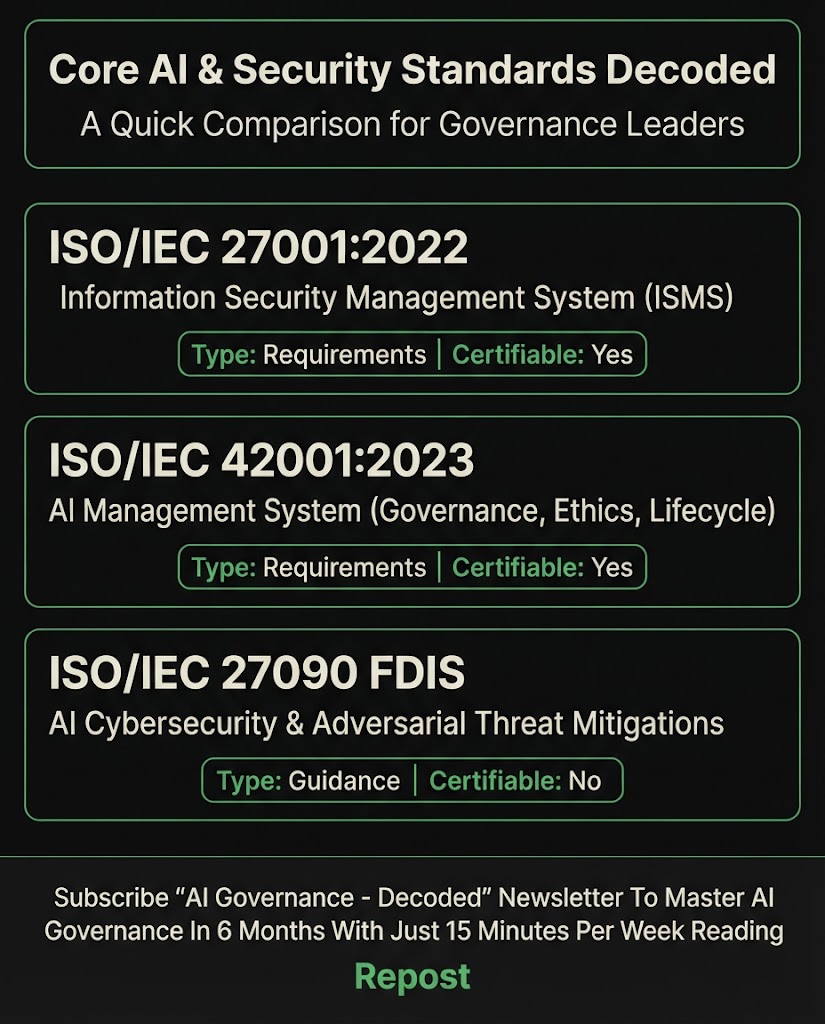
ISO 27001 forms your foundational security baseline.
ISO 42001 provides the governance overlay required for high-risk AI deployments (such as compliance mandates under the EU AI Act).
ISO 27090 delivers the technical depth needed to secure the underlying machine learning assets, data pipelines, and inference interfaces.
Practical Implementation Roadmap
While ISO 27090 does not result in a standalone certificate, adopting its guidelines prepares your organization for ISO 27001 audits, SOC 2 reviews, and EU AI Act conformity assessments. Follow this four-phase approach:
AI Asset Inventory & Risk Assessment (Weeks 1–4): Catalog all production and development models, tracing training data origins, APIs, and sensitive data flows. Apply the ISO 27090 threat taxonomy to assign risk scores.
Control Gap Analysis (Weeks 5–8): Map your existing security controls against ISO 27090 recommendations. Gaps typically appear in API rate limiting, adversarial testing, and output monitoring.
Control Implementation (Weeks 9–20): Prioritize mitigations based on residual risk. Integrate adversarial testing into your CI/CD pipelines and deploy strict input sanitization and rate-limiting rules.
Evidence Collection & Audit Readiness (Weeks 21–26): Document your security measures against ISO 27090 threat categories to support SOC 2 Processing Integrity and ISO 27001 Annex A reviews.
ISO/IEC 27090 provides the definitive baseline for securing modern AI systems against sophisticated adversarial attacks. By integrating its threat taxonomy into your existing ISMS and AI governance frameworks, you protect your organization from active, real-world exploits while future-proofing your compliance posture.
Ready to build trust with your enterprise clients and secure your machine learning models against emerging threats?
Connect with me on LinkedIn or schedule a consultation today to evaluate your AI security posture against the latest ISO standards.
Subscribe to "AI Governance - Decoded" Newsletter to Master AI Governance With Just 15 Minutes Read Per Week.

Kumail Mehdi
ISO 42001 Lead Auditor and AI strategist. 11 years in corporate leadership, 14 years running a digital agency. I help professionals, consultants and AI startups turn expertise into governed, AI-powered systems.


