Deploying artificial intelligence without a structured risk management process exposes your organization to severe liabilities—from catastrophic data leakage and algorithmic bias to regulatory penalties under the EU AI…
Deploying artificial intelligence without a structured risk management process exposes your organization to severe liabilities—from catastrophic data leakage and algorithmic bias to regulatory penalties under the EU AI Act.
ISO/IEC 23894:2023 provides organizations with a proven, structured methodology for identifying, evaluating, and mitigating AI-related risks. Adapted directly from the globally recognized ISO 31000:2018 risk management guidelines, ISO/IEC 23894 is not a generic risk model. It delivers an AI-tailored framework that protects organizational objectives, builds stakeholder trust, and serves as an essential companion standard to an ISO/IEC 42001 AI Management System (AIMS).
What is ISO/IEC 23894:2023?
Published in February 2023, ISO/IEC 23894 provides guidance on managing AI risks for organizations that develop, provide, or deploy AI technologies.
Rather than inventing methodologies from scratch, the standard translates the overarching principles of ISO 31000 into specific interventions across the entire AI engineering lifecycle.
"The standard adapts and develops the guidelines and general principles of risk management described in ISO 31000. It emphasizes the importance of constantly reviewing, identifying, and preparing for potential risks in AI systems."
— Peter Deussen, Project Leader for ISO/IEC 23894 at the International Electrotechnical Commission (IEC).
Because the standard operates as general guidance rather than a rigid set of prescriptive mandates, its framework adapts readily across diverse verticals—from clinical diagnostics and automated underwriting to smart manufacturing and public governance.
How Does ISO/IEC 23894 Relate to ISO/IEC 42001?
Understanding the difference between ISO/IEC 42001 and ISO/IEC 23894 is critical for compliance officers and consultants:
ISO/IEC 42001:2023 is a certifiable Management System Standard (MSS). It defines the governance structure, operational policies, documentation, and continuous improvement mechanisms of an AI Management System (AIMS).
ISO/IEC 23894:2023 is a guidance standard that provides the step-by-step risk assessment and treatment processes required to satisfy the risk management clauses inside ISO 42001.
| Attribute | ISO/IEC 42001:2023 | ISO/IEC 23894:2023 |
| Standard Type | Certifiable Management System Standard (MSS) | Guidance standard / Technical reference |
| Primary Scope | Complete organizational AI governance and operations | Specific AI risk assessment and mitigation processes |
| Core Parent Standard | Harmonized Structure (ISO Annex SL) | ISO 31000:2018 (Risk Management) |
| Certification Status | Third-party accredited certification available | Informative guidance (cannot be certified standalone) |
When pursuing ISO 42001 certification, adopting ISO/IEC 23894 gives auditors concrete proof that your AI risk assessment methodology adheres to international best practices.
The 4 Core Stages of the AI Risk Management Lifecycle
ISO/IEC 23894 organizes risk treatment into four continuous, iterative phases across the machine learning lifecycle:
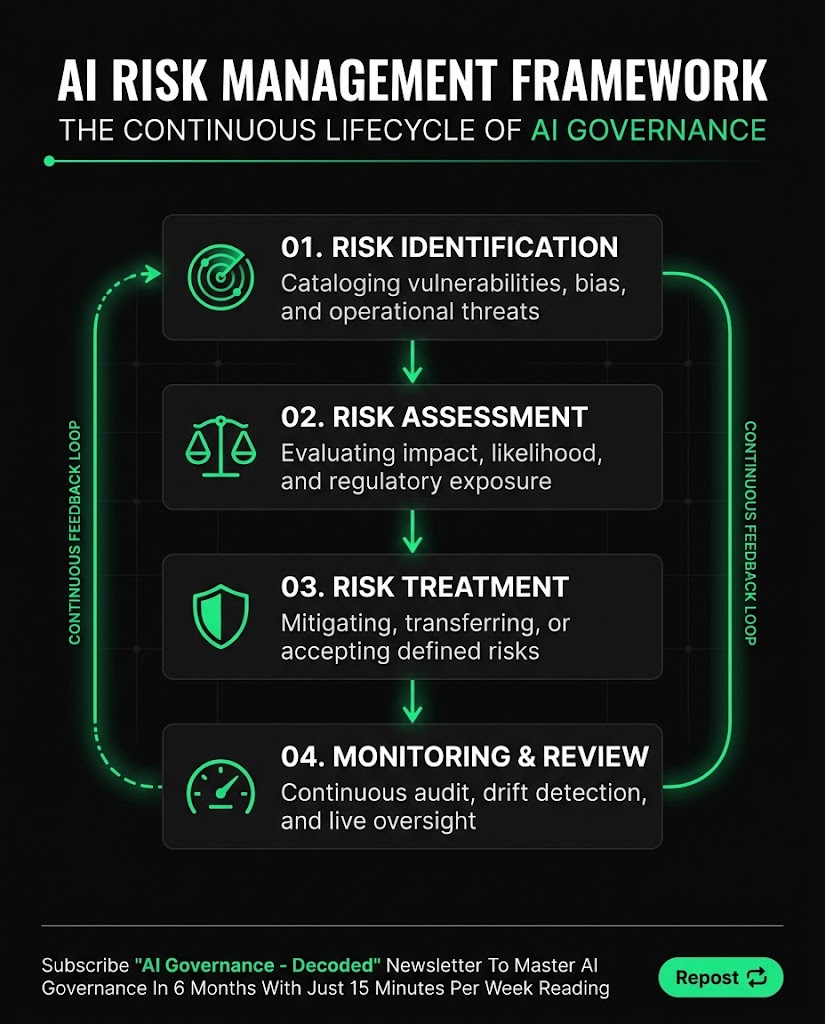
1. AI Risk Identification
AI introduces failure modes absent from legacy software systems. ISO/IEC 23894 requires organizations to examine four distinct risk categories:
Data-Related Risks: Low data fidelity, non-representative sampling, label poisoning, privacy violations, and unintended data leakage.
Algorithm-Related Risks: Hallucinations, explainability deficits, distribution drift, model instability, and lack of transparency.
Operational Risks: Deployment pipeline failures, poor integration, API degradation, access control bypasses, and unauthorized model tampering.
Societal & Ethical Risks: Disproportionate bias, human agency erosion, copyright exposure, and non-compliance with fundamental rights frameworks.
2. AI Risk Assessment and Prioritization
Once identified, risks require systematic qualification and quantification based on impact severity and occurrence likelihood:
Consequence Severity: Evaluating the blast radius on human safety, legal liability, data privacy, and operations.
Likelihood Calculations: Estimating failure rates based on empirical model testing, stress simulations, red-teaming exercises, and domain-expert evaluation.
Systemic Interconnections: Tracking cascading failures where an error in one upstream pipeline compromises multiple downstream consumer-facing models.
Stakeholder Impact Scenarios: Analyzing vulnerabilities across end users, data subjects, internal teams, and general public interests.
3. AI Risk Treatment Strategies
Organizations must select targeted remediation paths rather than treating risk management as an isolated compliance task:
Risk Modification: Modifying feature architectures, conducting fine-tuning, applying synthetic data augmentations, or implementing runtime guardrails.
Risk Avoidance: Halting development or declining production deployment for high-risk use cases lacking adequate fail-safes.
Risk Sharing: Reallocating financial or technical liabilities via third-party service-level agreements (SLAs), insurance products, or vendor covenants.
Risk Retention: Documenting reasoned business acceptance for non-critical residual risks operating within organizational tolerance thresholds.
4. Continuous Monitoring and Review
Static software audits cannot protect dynamic models. AI systems degrade over time due to covariate shift and changing user behavior. ISO/IEC 23894 establishes operational protocols for continuous supervision:
Key Risk Indicator (KRI) Tracking: Monitoring automated drift metrics, outlier frequencies, latency spikes, and toxicity flags.
Treatment Verification: Routinely validating whether current guardrails and validation steps remain effective against novel attack vectors (e.g., prompt injection).
Dynamic Context Updates: Re-evaluating operational controls when new data sources, external dependencies, or market conditions emerge.
What Does ISO/IEC 23894 Cost?
The standard is priced directly through official standardization bodies:
International Organization for Standardization (ISO): Available via the ISO store for 182 CHF (Swiss Francs).
International Electrotechnical Commission (IEC): Available as IEC ISO/IEC 23894:2023 for CHF 205.
National Standards Bodies: Regional bodies like ANSI, BSI, and DIN offer authorized local licenses and team subscription packages.
Beyond the initial document purchase, operational budgets should account for internal readiness gap assessments, external consulting, and governance tooling to operationalize the guidelines.
Key Benefits of Adopting ISO/IEC 23894
Implementing an international standard yields tangible commercial returns:
Streamlined Regulatory Harmonization: Meets the stringent risk assessment mandates of the EU AI Act, the NIST AI Risk Management Framework (AI RMF 1.0), and regional regulations.
Measurable Incident Reduction: Industry benchmark data indicates organizations with formalized AI risk processes see a 40% reduction in AI-related operational incidents.
Higher Stakeholder Trust: Companies report up to a 35% improvement in enterprise client confidence, accelerating deal cycles and reducing enterprise procurement friction.
Protection Against Brand Erosion: Defends enterprise value by catching biased outputs, unverified claims, and data leakage before deployment.
Build Enterprise Trust with Proven AI Governance
Navigating the intersection of AI innovation, regulatory oversight, and complex risk management requires structured guidance and proven compliance methodologies.
Whether you are preparing for your ISO/IEC 42001 certification audit, aligning with the EU AI Act, or deploying enterprise AI risk guardrails across your product suite, expert support accelerates your path to market.
Ready to build defensible AI systems and earn enterprise client trust?
Connect with our AI governance team today to schedule an ISO 42001 and ISO/IEC 23894 readiness assessment.
Subsribe to "AI Governance - Decoded" Newsletter to Master AI Governance With Just 15 Minutes Read Per Week.

Kumail Mehdi
ISO 42001 Lead Auditor and AI strategist. 11 years in corporate leadership, 14 years running a digital agency. I help professionals, consultants and AI startups turn expertise into governed, AI-powered systems.


