Today, I am going to break down the exact differences between ISO 42001 and the NIST AI Risk Management Framework (AI RMF): what each one covers, where they fit, and whether they complement each other or stand in…
Today, I am going to break down the exact differences between ISO 42001 and the NIST AI Risk Management Framework (AI RMF): what each one covers, where they fit, and whether they complement each other or stand in conflict.
First things first: for those of you who don't know me, my name is Kumail Mehdi. I am an ISO 42001 Lead Auditor with 11 years of corporate governance and compliance experience.
Most founders, CTOs, and risk leaders believe they must choose between ISO 42001 and NIST AI RMF. You don't. What actually matters is knowing which one to start with and when to deploy each.
NIST AI RMF is built to help you identify, assess, and manage operational AI risks. ISO 42001 delivers a comprehensive, certifiable Artificial Intelligence Management System (AIMS) that covers your entire organization.
Global AI governance is shifting rapidly:
The EU AI Act has entered full regulatory enforcement, placing strict governance mandates on high-risk AI and general-purpose AI (GPAI) systems.
Prudential regulators like Australia’s APRA are scrutinizing AI governance models across financial institutions.
Jurisdictions across the globe, from the US and the UK to Japan, South Korea, and Brazil, are implementing binding laws or national standards.
Enterprise buyers procuring AI software now demand hard proof of compliance. To deliver that proof, you need a recognized framework.
Regulations vs. Frameworks: What Is the Difference?
Before comparing individual standards, let’s clarify the distinction between a regulation and a framework:
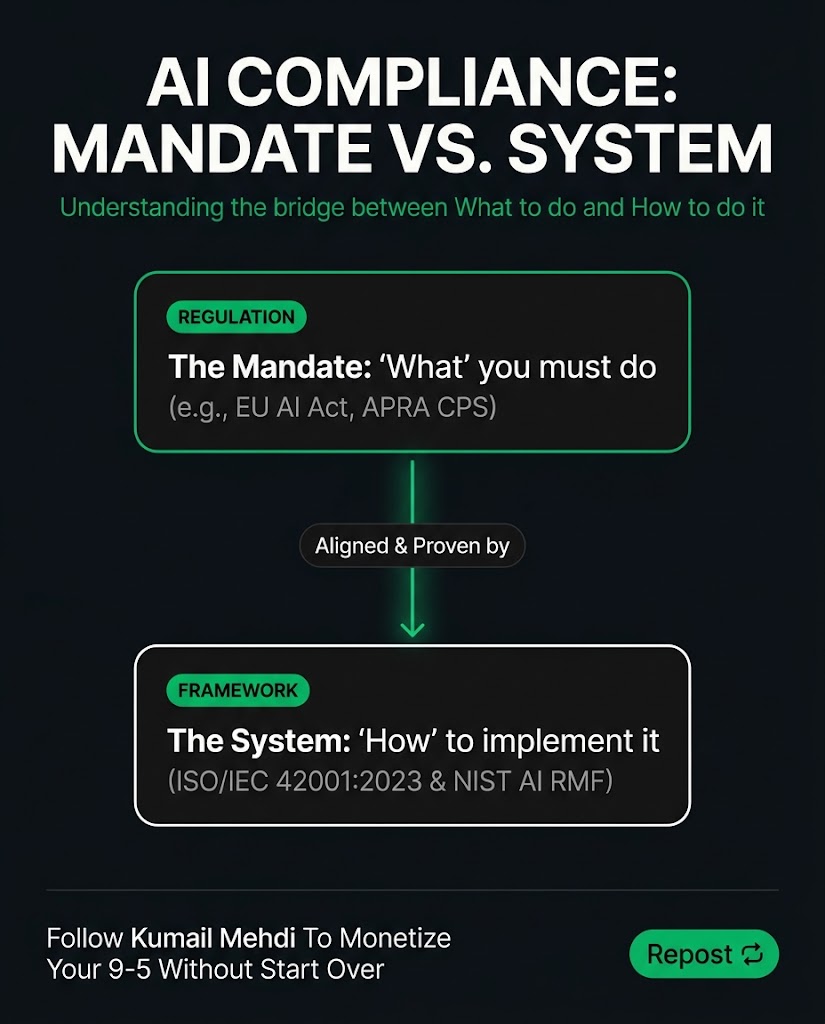
A regulation is the law. Break it, and you face steep legal penalties or operational bans. The EU AI Act is a prime example. It tells you what you must do, what you cannot do, and what outcomes you must guarantee.
A framework is a structured blueprint. It tells you how to execute responsible practices effectively. In the case of NIST AI RMF and ISO 42001, the framework provides an actionable, repeatable methodology to implement and prove governance in alignment with governing laws.
Why Do You Need a Framework if You Already Have the Law?
Regulations state what to achieve; frameworks demonstrate how to achieve it. They provide structured proof that you comply with applicable statutes.
Enterprise buyers and auditors look for recognized standards. Procuring teams cannot review raw code or internal notes; they demand structured proof via established frameworks like NIST and ISO.
One solid framework satisfies multiple cross-border jurisdictions. Applying a recognized standard helps align your AI stack with regulatory mandates across the EU, North America, and APAC simultaneously.
It creates a common operational language. Frameworks eliminate silos between technical data science teams, legal counsel, and the executive board.
It guarantees repeatable auditing. Without a framework, teams reinvent the governance wheel for every new model or feature, creating operational bottlenecks.
What Is NIST AI RMF?
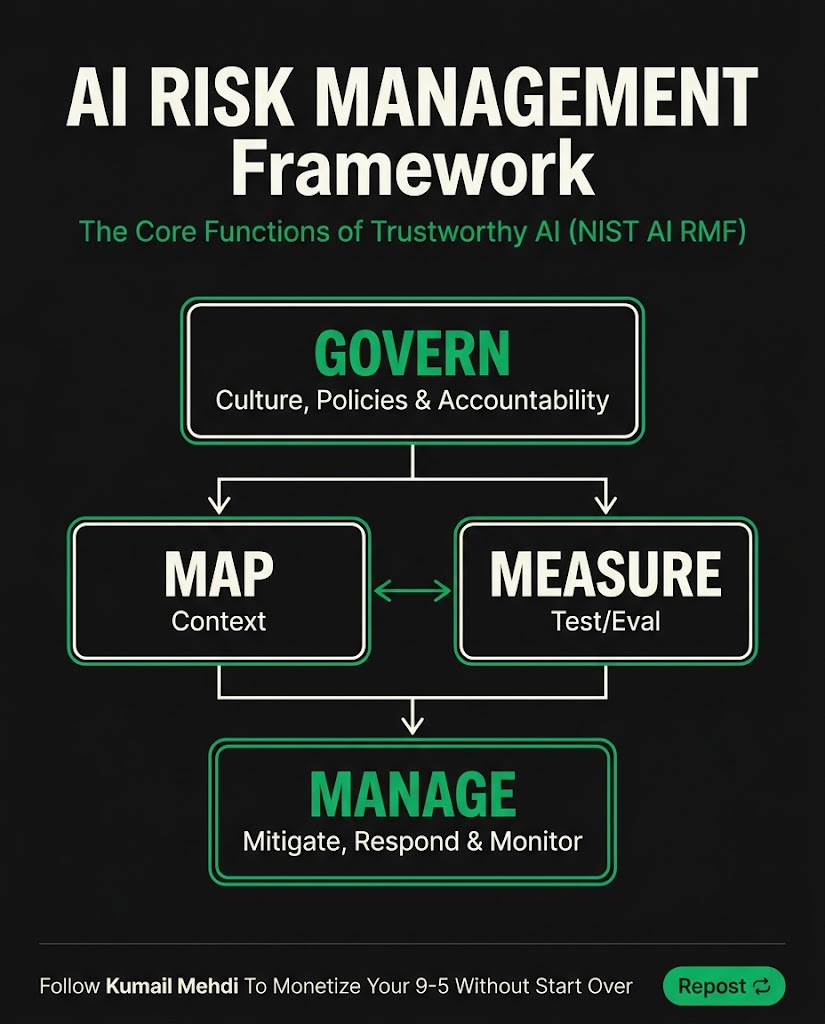
The NIST AI Risk Management Framework (AI 100-1) is a voluntary, sector-agnostic framework developed by the U.S. National Institute of Standards and Technology. It provides organizations with a practical methodology to identify, assess, and mitigate risks across the AI lifecycle.
The 4 Core Functions of NIST AI RMF
Govern: Establishes organizational culture, risk appetite, executive accountability, and ongoing oversight processes.
Map: Establishes operational context, categorizes the AI system, and evaluates potential societal and organizational impacts.
Measure: Analyzes, tests, benchmarks, and monitors technical risks, including bias, drift, security, and model explainability.
Manage: Prioritizes, responds to, and systematically mitigates identified risks while maintaining incident response procedures.
When to Choose NIST AI RMF First
You are based primarily in the US and face no immediate third-party certification mandates.
You require a zero-license-cost method to align engineering and product teams around AI safety.
You are selling to US federal agencies aligning with Executive Orders and NIST guidance.
You are in the early stages of your AI roadmap and need internal clarity before committing capital to audits.
What Is ISO/IEC 42001?
ISO/IEC 42001:2023 is the world’s first globally recognized, third-party certifiable standard specifically engineered for Artificial Intelligence Management Systems (AIMS).
What ISO 42001 Actually Delivers
Enterprise-Wide AI Management System: A complete, auditable management system governing how your entire company develops, procures, and operates AI.
Harmonized Structure: Operates on the familiar Plan-Do-Check-Act (PDCA) model shared with ISO 27001 (Information Security) and ISO 9001 (Quality).
Annex A Controls: 38 specific controls across 9 distinct control objectives, covering data quality, model transparency, third-party supplier oversight, and lifecycle governance.
Audit-Ready Documentation: Formally defines roles, system impact reviews, continuous monitoring protocols, and management review logs.
Third-Party Certification: Independent, accredited certification verified via accredited registrars under ISO/IEC 42006 guidelines.
When to Choose ISO 42001
You sell enterprise B2B SaaS solutions where procurement teams mandate formal certification in RFPs.
You operate within or sell into the European Union and need auditable baseline proof for EU AI Act Article 17 Quality Management System (QMS) requirements.
You operate within highly regulated verticals such as banking, fintech, life sciences, healthcare, or defense.
Your leadership board requires a defensible, accredited audit trail to mitigate operational and reputational exposure.
Side-by-Side Comparison: ISO 42001 vs. NIST AI RMF
| Dimension | ISO/IEC 42001:2023 | NIST AI RMF 1.0 |
| Type | Management System Standard (AIMS) | Risk Management Framework |
| Primary Focus | Organizational governance, controls, and systemic processes | Risk identification, evaluation, and mitigation |
| Issuing Body | ISO / IEC (Global Consensus) | NIST / U.S. Department of Commerce |
| Status | Voluntary, but fully third-party certifiable | Voluntary, self-assessed (no accredited certification) |
| Core Architecture | Plan, Do, Check, Act (10 Clauses + 38 Controls) | Govern, Map, Measure, Manage (4 Core Functions) |
| Cost | Paid standard license fees + external registrar audit fees | 100% free and open-source public download |
| Audit Mechanism | Accredited independent Registrar audit (Stage 1 & Stage 2) | Internal self-attestation or voluntary third-party advisory review |
| Primary Goal | Proving governance and compliance to external stakeholders | Building and refining internal risk assessment models |
Do They Work Together or Contradict Each Other?
They complement each other. NIST AI RMF sharpens your risk taxonomy, while ISO 42001 translates that risk insight into a permanent, certifiable management system.
NIST has released an official crosswalk mapping the NIST AI RMF functions directly against ISO/IEC 42001 controls. Teams that implement NIST functions can map their artifacts directly into ISO 42001 documentation without duplicating work.
5 Real-World Scenarios: Which One Would You Pick?
Use Case 1: A Sydney Bank with Credit Decision Systems Under APRA Scrutiny
Verdict: ISO 42001
Why: APRA expects operationalized, verifiable governance. Financial institutions require a recognized, certifiable management system that external regulators and auditors trust without reservation.
Use Case 2: A US HealthTech Startup (Pre-Series B) Building a Clinical Co-Pilot
Verdict: NIST AI RMF First, Then ISO 42001
Why: Start with NIST AI RMF to map clinical risks and establish guardrails at low cost while moving quickly. As enterprise hospital procurement and Series B enterprise contracts require formal compliance, layer on ISO 42001 certification.
Use Case 3: A SaaS Vendor with European Customers and EU AI Act Exposure
Verdict: ISO 42001
Why: ISO 42001 maps cleanly to Article 17 of the EU AI Act (Quality Management System obligations). It equips international vendors with auditable compliance artifacts for European clients.
Use Case 4: A US Federal Contractor Supplying AI Tools to Agencies
Verdict: NIST AI RMF
Why: Federal procurement rules heavily emphasize alignment with NIST standards. Certification is not typically mandated for early pilot contracts, making NIST the most direct path forward.
Use Case 5: A 12-Person Engineering Team Adding AI to an Existing Web App
Verdict: NIST AI RMF
Why: ISO 42001 is excessive overhead for a small team still determining product-market fit. Use NIST's free framework to establish data controls, mitigate hallucinations, and log risks responsibly.
Frequently Asked Questions (FAQ)
Do I need to implement both frameworks?
Most mature organizations eventually use both. Begin with the NIST AI RMF to build your risk foundation flexibly and cost-effectively. When enterprise RFPs demand audited proof, transition to ISO 42001. Because of NIST's official crosswalk, your initial mapping translates directly into ISO audit evidence.
Is ISO 42001 certification mandatory?
Technically, no. ISO 42001 is a voluntary standard. However, enterprise procurement departments are increasingly writing ISO 42001 into vendor security questionnaires and RFPs. What is voluntary today quickly becomes a commercial requirement for enterprise deals.
How much does ISO 42001 cost, and how long does it take?
Implementation generally spans 6 to 12 months:
Small Organizations: $15,000 – $40,000 total (audit fees + remediation).
Mid-Sized Businesses: $40,000 – $90,000.
Large Enterprises: $90,000 – $200,000+.
Certificates run on a 3-year cycle with annual surveillance audits. If you already maintain an active ISO 27001 Information Security Management System, your timeline and costs can drop by 30% to 50% due to shared structural clauses.
Where should our team actually start?
Inventory every AI system: Catalog internal models, vendor-provided AI features, and developer APIs across the company.
Review the NIST AI RMF: Read through the free framework to establish your internal risk taxonomy.
Conduct an ISO 42001 Gap Assessment: Identify missing governance controls across leadership, data governance, and impact assessments.
Train internal teams: Ensure product managers, engineers, and legal leads understand core AI risk obligations.
Choose your operational model: Decide whether to execute entirely in-house or engage certified lead auditors for readiness reviews.
If we already have ISO 27001, do we still need ISO 42001?
Yes, if AI is core to your product or operations. ISO 27001 protects information confidentiality, integrity, and availability. It does not address AI-specific failure modes: model drift, algorithmic bias, training data provenance, halluncinations, or autonomous decision impacts. Because both share the ISO Harmonized Structure, your existing ISMS policies cover roughly 40% of the baseline requirements.
We only use third-party APIs (like OpenAI ChatGPT). Does this apply to us?
Yes. Both NIST and ISO 42001 distinguish between AI Producers (builders) and AI Customers/Deployers (users). As an AI Deployer, you do not train foundation models, but you still need an acceptable use policy, third-party vendor due diligence, data leakage safeguards, and output validation protocols.
Can we certify a single AI product, or must we certify the entire company?
You define the operational scope in your Statement of Applicability (SoA). You can scope your AIMS strictly to a single customer-facing AI tool or product line. Narrow scopes reduce cost and speed up initial certification. You can expand the scope across other departments during annual surveillance audits.
What is an AI Impact Assessment (AIIA)?
An AIIA is a formal risk review required under ISO 42001 Clause 8 that assesses how an AI system affects individuals, organizations, and society. Unlike standard cybersecurity risk reviews, an AIIA evaluates fairness, potential bias, transparency, explainability, and societal disruption. It is guided by supplementary standards like ISO/IEC 42006 for audit consistency.
Can we achieve ISO 42001 compliance without external consultants?
Yes, especially if your compliance team has already implemented ISO 27001 or ISO 9001. However, expect to allocate 0.5 to 2 full-time equivalent (FTE) internal staff members across the implementation lifecycle. Most organizations opt for a hybrid model: internal leads run day-to-day operations, while external lead auditors perform formal gap assessments and pre-audit dry runs.
If your goal is to build internal maturity, start with NIST AI RMF. If your goal is to prove compliance to enterprise customers and global regulators, pursue ISO 42001.
Ready to build unshakeable trust with your enterprise buyers? Connect with me today on LinkedIn to assess your compliance gaps and get your AI startup audit-ready for ISO 42001.

Kumail Mehdi
ISO 42001 Lead Auditor and AI strategist. 11 years in corporate leadership, 14 years running a digital agency. I help professionals, consultants and AI startups turn expertise into governed, AI-powered systems.


