If you don’t know how ISO 42001 is structured or what its requirements actually entail, this guide is for you.Artificial Intelligence is scaling faster than enterprise compliance playbooks can keep up. Between…
If you don’t know how ISO 42001 is structured or what its requirements actually entail, this guide is for you.
Artificial Intelligence is scaling faster than enterprise compliance playbooks can keep up. Between algorithmic hallucinations, intellectual property issues, and new global regulations like the EU AI Act, organizations can no longer deploy models without a structured safety net.
That is where ISO/IEC 42001:2023 comes in.
In this guide, we will unpack how this standard links directly to operational AI governance, break down mandatory Clauses 4 through 10, dissect the 38 controls in Annex A and B, and examine the strategic guidance laid out in Annexes C and D. By the end of this article, you will have a crystal-clear roadmap of what this global benchmark looks like and how to implement it.
What Is the Connection Between AI Governance and ISO 42001?
At its core, AI Governance is the framework of rules, practices, and technical safeguards that ensure AI systems are ethical, safe, transparent, and compliant.
ISO/IEC 42001 is the world’s first certifiable standard for an Artificial Intelligence Management System (AIMS). Rather than inspecting a single algorithm in isolation, the standard sets up processes, documentation, and safeguards to govern your entire AI portfolio.
Implementing an AIMS makes your AI systems trustworthy. That trust serves two distinct stakeholder groups:
Internal Stakeholders: Equips leadership, product managers, and developers with clear operational boundaries, risk thresholds, and resource allocations.
External Stakeholders: Assures enterprise clients, partners, auditors, and regulators that you build or consume AI responsibly, drastically reducing adoption friction.
How Is ISO 42001 Structured?
ISO 42001 uses the standard ISO Harmonized Structure (formerly High-Level Structure / HLS), making it immediately familiar if you have worked with ISO 9001, ISO 14001, or especially the information security standard ISO/IEC 27001.
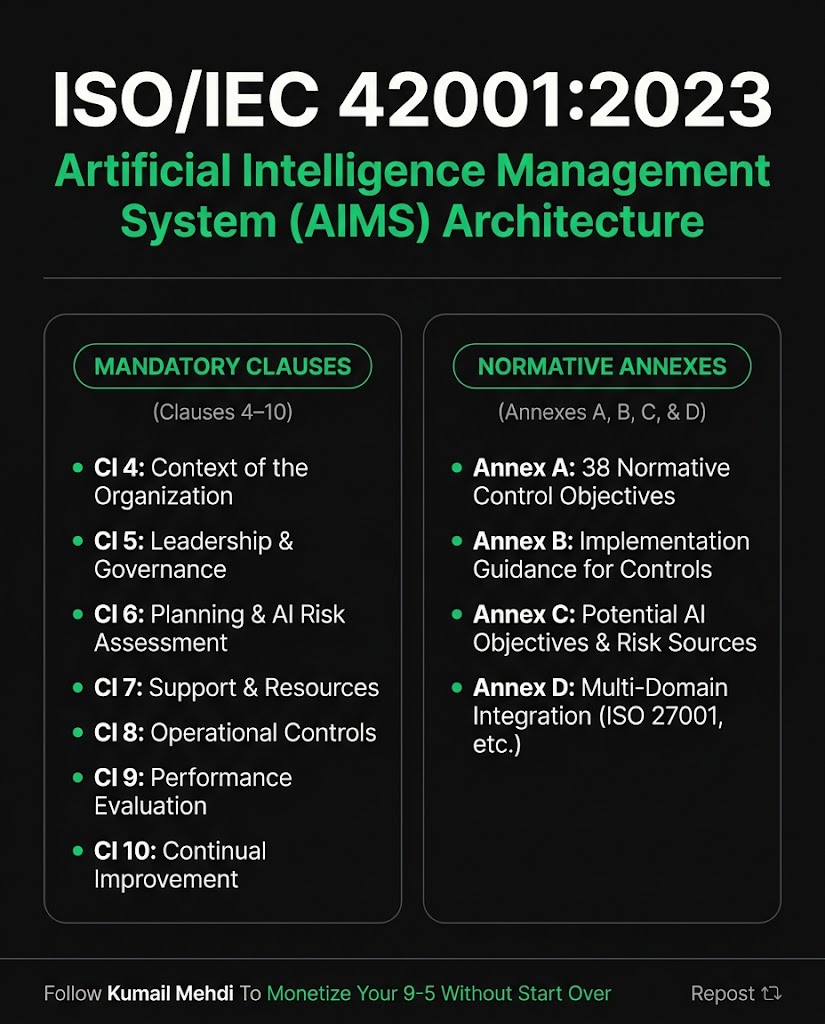
The standard is split into two primary components:
Main Body (Clauses 4 to 10): Mandatory requirements defining how to govern, monitor, assess risk, and run the management system.
Annexes (A, B, C, and D): The actionable control catalogs, implementation guidance, objective libraries, and multi-domain integration mappings.
The Core Engine: Deep Dive into Clauses 4 to 10
Clauses 4 through 10 form the operational core of the standard. Every organization pursuing certification must comply with all requirements in this section.
Clause 4 – Context of the Organization
Setting the boundaries of your AI footprint.
4.1 Understanding the Organization and Its Context: You must define your explicit operational role regarding AI systems—whether you are an AI Provider (building foundation models/products), an AI Producer/Integrator (fine-tuning or embedding models), or an AI Customer/User (deploying third-party AI internally). You must also analyze external factors (emerging regulations, market dynamics, tech shifts) and internal factors (infrastructure readiness, staff skills, strategic goals).
4.2 Understanding Needs & Expectations of Interested Parties: Map out key stakeholders and their requirements. For example, enterprise clients demand zero data leakage and minimal hallucinations; regulators demand auditability; employees may have valid concerns around automation and workforce impact.
4.3 Determining the Scope of the AIMS: Define where the management system applies. Small-to-midsize startups typically apply ISO 42001 across the entire organization, while large enterprises often scope it to specific business units, products, or AI pipelines.
4.4 AI Management System: A baseline mandate requiring organizations to establish, implement, maintain, and continually improve the AIMS in day-to-day operations.
Clause 5 – Leadership
Governance without executive buy-in is just paperwork.
5.1 Leadership and Commitment: Executive leadership must demonstrate accountability by allocating budget, engineering resources, and strategic direction to the AIMS.
5.2 AI Policy: Management must draft and authorize a top-level AI Policy. This document sets high-level organizational commitments (e.g., fairness, data privacy, safety) and provides the parent framework for sub-policies like Acceptable AI Use and Secure AI Development.
5.3 Roles, Responsibilities, and Authorities: Leadership must clearly assign who manages AI governance tasks, who signs off on model deployments, and how AI risk status reports flow back up to executive leadership.
Clause 6 – Planning
The analytical backbone of the standard.
6.1 Actions to Address Risks and Opportunities: The most detailed sub-clause in the standard. Organizations must systematically identify both potential harms and operational benefits of AI usage.
Control Selection & Statement of Applicability (SoA): Once risks are scored, you select appropriate safeguards from Annex A. You must produce a Statement of Applicability (SoA) documenting which of the 38 controls apply, which are excluded, and the business or technical justification for each decision.
Risk Treatment Plan (RTP): A concrete document assigning owners, deadlines, and allocated resources for implementing the chosen controls.
AI System Impact Assessment (AI SIA): Distinct from a standard enterprise risk assessment. While business risk focuses on threats to the company (financial loss, reputation, lawsuits), the AI SIA evaluates the consequences of system output, performance, or misuse on individuals, communities, and society (e.g., bias, safety, human rights).
6.2 AI Objectives and Planning to Achieve Them: Organizations must set measurable, time-bound AI objectives (e.g., "reduce critical bias metrics below 2% across production models by Q4") supported by dedicated execution plans.
6.3 Planning of Changes: Any modification to your models, data pipelines, architecture, or governance team must be planned systematically to avoid chaotic production drift.
Clause 7 – Support
The operational enablers.
7.1 Resources: Senior leadership must supply adequate computing infrastructure, tooling, budget, and specialized talent.
7.2 Competence: Employees building or operating AI systems must possess the necessary education, training, and experience to carry out their duties responsibly.
7.3 Awareness: Staff must understand the AI policy, their personal obligations, and the risks associated with rogue, ungoverned AI use (such as pasting proprietary code or customer PII into public LLMs).
7.4 Communication: You must establish internal reporting loops (e.g., incident reporting) and external disclosures (e.g., telling customers when they are interacting with synthetic media or an AI system).
7.5 Documented Information: Mandates structured document control across versioning, classification, retention, and access management for all AIMS artifacts.
Clause 8 – Operation
Putting governance into production.
8.1 Operational Planning and Control: Execute and document the processes designed in Clause 6. This includes governing third-party model dependencies and managing technical change controls.
8.2 AI Risk Assessment: Run risk assessments at regular, planned intervals or whenever major architectural updates occur.
8.3 AI Risk Treatment: Continuously execute, review, and update your Risk Treatment Plan as model behavior shifts.
8.4 AI System Impact Assessment: Re-evaluate social, ethical, and end-user impacts whenever you expand system capabilities, enter new user segments, or adapt downstream use cases.
Clause 9 – Performance Evaluation
Auditing and monitoring system health.
9.1 Monitoring, Measurement, Analysis, and Evaluation: Establish concrete metrics to evaluate whether your AI systems operate as intended, meet baseline performance levels, and adhere to governance thresholds.
9.2 Internal Audit: Conduct structured, independent internal audits at planned intervals to verify whether operations conform to your policies, ISO 42001 requirements, and organizational objectives.
9.3 Management Review: Executive leadership must regularly review audit findings, risk metrics, incident logs, and resource allocations to make executive decisions on system improvements.
Clause 10 – Improvement
Iterative refinement and remediation.
10.1 Continual Improvement: An organization-wide requirement to refine the AIMS over time, closing operational gaps as AI technology evolves.
10.2 Nonconformity and Corrective Action: When a control fails, an audit uncovers an unmanaged risk, or a production incident happens, you must identify the root cause, remediate the issue, and document the corrective action taken to ensure it cannot recur.
Deconstructing the Annexes (A, B, C, and D)
While Clauses 4–10 lay out the management system mechanics, the Annexes provide the direct AI controls and sector-specific guidance.
Annex A: The 38 AI Controls
Annex A contains 38 specific controls organized across 9 operational domains (interestingly, numbering starts at A.2, with no A.1):
| Domain | Control Area | Key Focus & Implementation Objective |
| A.2 | Policies Related to AI | Establishes top-level AI policies aligned with organizational strategy and acceptable use. |
| A.3 | Internal Organization | Assigns internal roles, duties, separation of authority, and reporting mechanisms. |
| A.4 | Resources for AI Systems | Governs computing hardware, specialized processors (GPUs/TPUs), software tooling, and human data labelers. |
| A.5 | Assessing AI System Impacts | Standardizes processes to document and assess real-world impacts on individuals and society. |
| A.6 | AI System Lifecycle | Defines control gates across all lifecycle stages: design, data acquisition, training, verification, deployment, and decommissioning. |
| A.7 | Data for AI Systems | Governs training, validation, and testing data quality, lineage, provenance, labeling integrity, and data cleansing. |
| A.8 | Information for Interested Parties | Provides external documentation, model system cards, user notifications, and disclosure protocols. |
| A.9 | Use of AI Systems | Implements operational safeguards for end-users, runtime monitoring, and prompt oversight. |
| A.10 | Third-Party & Customer Relationships | Manages third-party foundational APIs, external suppliers, customer obligations, and shared-responsibility matrices. |
Annex B: Implementation Guidance for Annex A
Annex B mirrors Annex A control-by-control. While Annex A states what control objective must be satisfied, Annex B provides actionable guidance on how to implement and audit each specific control in real-world environments.
Annex C: Potential Organizational Objectives and Risk Sources
Annex C is an informative reference library designed to support Clause 6.1 (Risk Planning) and Clause 6.2 (AI Objectives). It is split into two major sections:
C.2 Potential Organizational Objectives (Clauses C.2.1 – C.2.11): 11 core targets organizations use to guide their governance posture:
Accountability: Traceability for automated or augmented decisions.
AI Expertise: Maintaining relevant technical and operational competence.
Data Quality: Ensuring data sets are complete, representative, and fit-for-purpose.
Environmental Impact: Reducing compute energy footprints and carbon emissions.
Fairness: Minimizing discriminatory bias across protected classes.
Maintainability: Ensuring models can be debugged and modified without performance degradation.
Privacy: Protecting PII across all data pipelines and inference requests.
Robustness: Maintaining stability against noisy data and edge-case inputs.
Safety: Guarding against physical hazards, system errors, or psychological harm.
Security: Mitigating prompt injection, model inversion, and data poisoning.
Transparency & Explainability: Providing stakeholders with visibility into how predictions are made.
C.3 Potential AI Risk Sources (Clauses C.3.1 – C.3.7): 7 common vectors for AI failure:
Complexity of Environment: Dynamic or multi-agent operating domains.
Lack of Transparency: "Black-box" architectures hiding inference logic.
Level of Automation: Automation bias or missing human-in-the-loop (HITL) checkpoints.
Machine Learning Vulnerabilities: Data/concept drift, overfitting, and hallucination.
System Hardware Issues: Memory/GPU latency bottlenecks and sensor decay.
System Lifecycle Issues: Untracked model versions and ungoverned retirement.
Technology Readiness: Reliance on experimental frameworks or volatile third-party APIs.
Annex D: Cross-Domain Adaptation and MSS Integration
Annex D outlines how to scale an AIMS across regulated industries (healthcare, autonomous vehicles, fintech) and integrate it with existing ISO management standards:
Integration with ISO/IEC 27001 (Information Security): Shares unified risk management frameworks, asset inventories, and access controls while adding AI-specific security requirements (e.g., adversarial prompt protection, model extraction defense).
Integration with ISO/IEC 27701 (Privacy Information Management): Links data protection impact assessments (DPIAs) directly to your AI System Impact Assessments (AI SIA).
Integration with ISO 9001 (Quality Management): Ties AI development lifecycles directly into enterprise quality assurance, continuous verification, and client delivery standards.
Sector Safety Standards: Harmonizes system-level controls with functional safety standards like ISO 26262 (Automotive) and IEC 62304 (Medical Device Software).
Frequently Asked Questions (FAQ)
Is ISO 42001 mandatory for AI companies?
No, it is a voluntary international standard. However, enterprise procurement teams, risk officers, and venture partners increasingly treat ISO 42001 certification as a baseline requirement to prove responsible AI development, similar to how SOC 2 and ISO 27001 became table-stakes for enterprise SaaS.
How does ISO 42001 compare to ISO 27001?
ISO 27001 focuses broadly on securing information assets (Confidentiality, Integrity, and Availability). ISO 42001 focuses specifically on managing the unique lifecycle risks of Artificial Intelligence—including algorithmic bias, training data lineage, model drift, transparency, and societal impact. They share the same Harmonized Structure and are built to run as an integrated management system.
Ready to turn AI governance into your enterprise competitive advantage?
Connect with our advisory team today to build, audit, and certify your AI Management System under ISO/IEC 42001.

Kumail Mehdi
ISO 42001 Lead Auditor and AI strategist. 11 years in corporate leadership, 14 years running a digital agency. I help professionals, consultants and AI startups turn expertise into governed, AI-powered systems.


