Artificial intelligence adoption has outpaced internal governance. Engineering and product teams roll out machine learning models, autonomous workflows, and LLM-powered features faster than risk teams can evaluate them.…
Artificial intelligence adoption has outpaced internal governance. Engineering and product teams roll out machine learning models, autonomous workflows, and LLM-powered features faster than risk teams can evaluate them. As a result, businesses face acute concerns around algorithmic bias, data lineage, hallucination risks, and vendor transparency.
ISO/IEC 42001:2023 is the world’s first certifiable international standard designed to solve this governance sprawl. Developed jointly by ISO and IEC (under committee ISO/IEC JTC 1/SC 42), it establishes an actionable framework for building, implementing, and continually improving an Artificial Intelligence Management System (AIMS).
Whether your organization builds proprietary models from scratch or embeds third-party API integrations, ISO 42001 turns ethical aspirations into verifiable, auditable compliance.
What Is an AI Management System (AIMS)?
An Artificial Intelligence Management System (AIMS) is a unified structure of policies, procedural controls, and risk-management workflows that govern the design, development, deployment, and monitoring of AI systems throughout their lifecycle.
Just as ISO 27001 standardizes information security via an ISMS, ISO 42001 establishes operational guardrails tailored specifically to artificial intelligence.
A functioning AIMS requires:
An overarching AI Policy signed and sponsored by executive leadership.
Structured AI risk assessments and impact assessments covering societal, ethical, and organizational implications.
Defined roles and governance bodies (such as algorithm auditors, risk officers, and data stewards).
A formalized Statement of Applicability (SoA) documenting control selections and justifications.
Continuous monitoring, internal auditing, and management reviews to address model drift, edge cases, and evolving regulation.
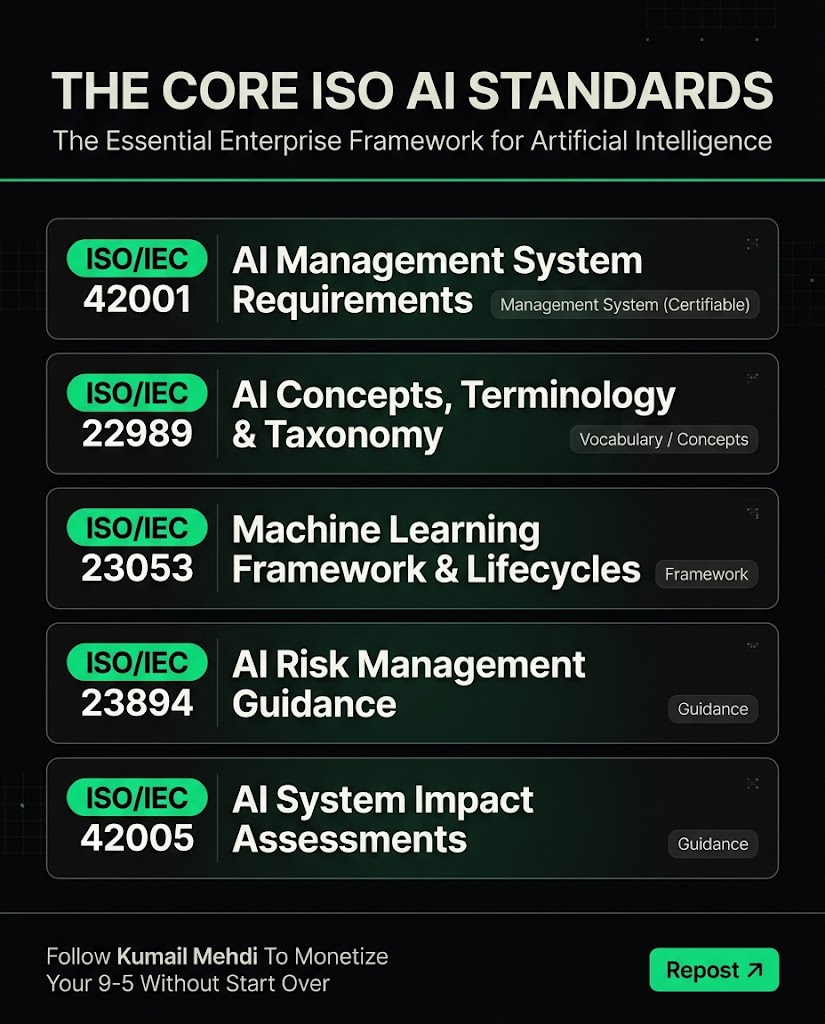
ISO 42001 vs. Other AI Standards in the ISO Family
While several technical guidance documents exist, only ISO 42001 is an independently certifiable management system.
Why Pursue ISO 42001? Key Business Benefits
With global enterprise generative AI adoption accelerating rapidly, enterprise buyers demand documented proof that their data will not be compromised, mishandled, or fed into unvetted training loops.
According to Deloitte's State of Generative AI market research, 35% of leaders identify real-world mistakes or catastrophic operational failures as their top hurdle to adopting AI. ISO 42001 directly addresses these enterprise concerns:
Shorten Enterprise Sales Cycles: Security and vendor-procurement questionnaires now routinely feature dedicated AI governance sections. Independent certification pre-emptively answers these inquiries.
Early-Mover Market Advantage: Relatively few organizations hold ISO 42001 credentials, making early certification a high-trust commercial differentiator.
Systematized Risk Governance: Replaces fragmented internal spreadsheets with a standardized Plan-Do-Check-Act (PDCA) lifecycle covering bias detection, adversarial vulnerabilities, and data poisoning.
Operational Alignment with the EU AI Act: Although voluntary, ISO 42001 implements the technical controls, human oversight protocols, and documentation lifecycles required across European and North American regulatory environments.
Who Needs ISO 42001? (Builders vs. Deployers)
A frequent misconception is that ISO 42001 is only relevant for foundational model developers or machine learning research labs.
In reality, ISO 42001 applies equally to AI developers and AI deployers:
AI & ML Product Vendors: Teams engineering custom models, algorithms, or platforms sold to commercial clients.
Cloud & SaaS Providers: Platforms embedding automated decision-making, predictive analytics, or generative copilots into existing software suites.
Enterprise Deployers: Organizations that rely on third-party AI APIs (such as OpenAI, Anthropic, or AWS Bedrock) to process customer data, streamline financial reviews, or automate internal operations.
Regulated Entities: Healthcare networks, FinTechs, insurance companies, and public-sector vendors that face heightened institutional scrutiny regarding data handling and automated fairness.
The Structure of ISO 42001: The Harmonized Structure & Annex A
ISO 42001 uses the standard ISO Harmonized Structure (Clauses 4 through 10), ensuring straightforward integration alongside existing ISO 27001 (Information Security) or ISO 9001 (Quality) programs.
The PDCA Lifecycle
Governance under ISO 42001 runs on the standard Plan-Do-Check-Act (PDCA) methodology:
Plan: Define the scope of your AIMS, document the AI policy, establish quantifiable governance objectives, and conduct systematic risk and impact assessments.
Do: Implement risk-treatment workflows, train staff, deploy data validation steps, and operate systems within defined guardrails.
Check: Monitor algorithmic output performance, track data drift, execute internal audits, and assess metrics during executive management reviews.
Act: Remediate nonconformities, update model weights or training pipelines, and adjust governance controls iteratively.
Overview of Annex A Controls (9 Objectives, 38 Controls)
Annex A outlines 38 reference control mechanisms divided across 9 core domains. Organizations define which controls apply within their mandatory Statement of Applicability (SoA).
A.2 Policies Related to AI: Aligning organizational strategy with formal, documented AI ethics and governance frameworks.
A.3 Internal Organization: Defining cross-functional AI responsibilities, accountability structures, and reporting channels.
A.4 Resources for AI Systems: Managing human talent, high-performance computing hardware, and foundational software dependencies.
A.5 Assessing Impacts of AI Systems: Assessing potential consequences for individuals, protected demographics, labor forces, and societal structures.
A.6 AI System Life Cycle: Managing design, architecture, validation, deployment, maintenance, and secure model decommissioning.
A.7 Data for AI Systems: Enforcing training data quality, copyright validation, lineage, bias prevention, and hygiene.
A.8 Information for Interested Parties: Delivering transparent documentation, explainable AI (XAI) outputs, and model cards.
A.9 Use of AI Systems: Maintaining runtime human-in-the-loop (HITL) oversight, acceptable-use monitoring, and anomaly detection.
A.10 Third-Party and Customer Relationships: Performing supplier due diligence on model APIs, proprietary training sets, and data contractors.
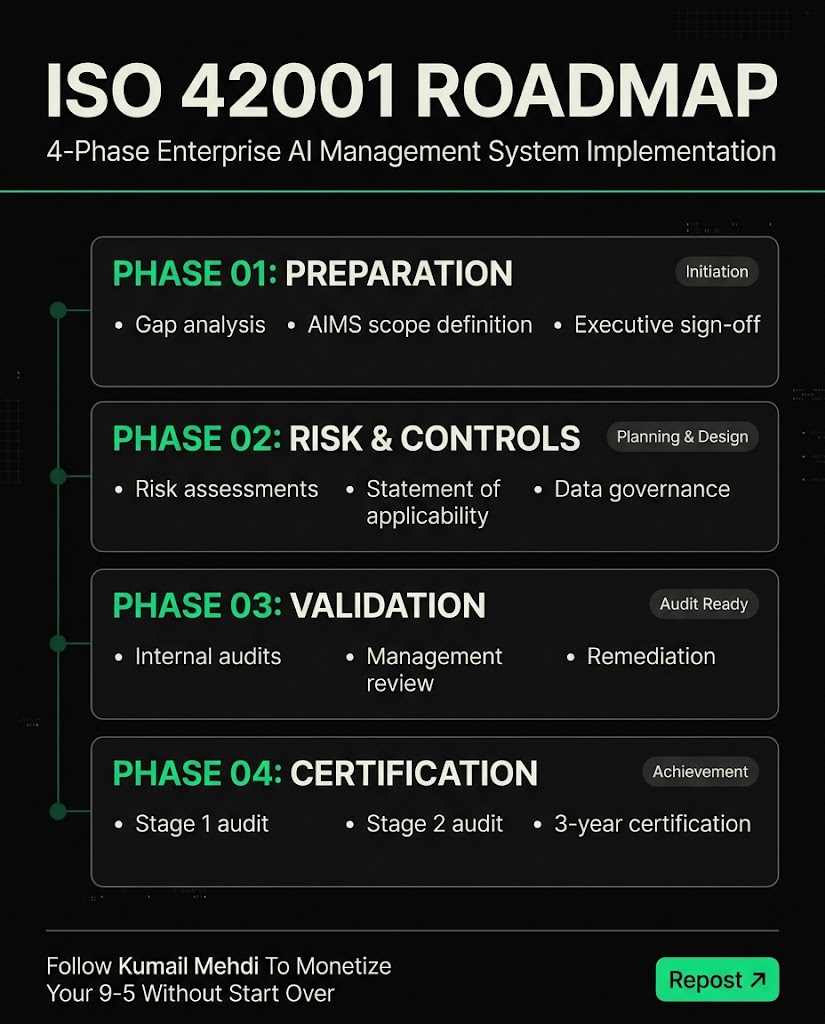
How to Get ISO 42001 Certified: A Step-by-Step Implementation Roadmap
A complete implementation typically requires between 3 and 9 months, depending on scope complexity and pre-existing ISO 27001 maturity.
1. Define the AIMS Scope and Context
Clearly specify the boundaries. Avoid overextending scope across experimental R&D sandboxes during an initial audit. Focus on production AI tools, client-facing software features, or revenue-critical third-party integrations.
2. Conduct Risk and Impact Assessments
Identify failure modes across your model portfolio:
Technical vulnerabilities: Prompt injections, data poisoning, model evasion.
Operational failures: Hallucinations, dataset biases, algorithmic drift.
Societal harms: Privacy infringements, unlawful discrimination, opaque user decisions.
3. Draft the Statement of Applicability (SoA)
Map your identified risks directly to Annex A’s 38 controls. For every control, state whether it is included or excluded, along with technical and business justifications.
4. Implement Controls and Gather Evidence
An auditor will not rely solely on policy documents. You must demonstrate real-world enforcement through version-controlled model registries, bias evaluation scripts, data lineage records, vendor questionnaires, and team training logs.
5. Execute Internal Audits & Management Review
Before bringing in external auditors, perform an end-to-end internal audit using trained personnel independent of the operational workflows. Surface nonconformities early and document mitigation decisions in your formal management review.
6. The External Audit Process
Accredited Certification Bodies (operating under ISO/IEC 42006 guidelines for AIMS auditor competence) conduct the certification:
Stage 1 Audit (Readiness Review): The auditor reviews policies, SoA documentation, scope definitions, and internal audit logs.
Stage 2 Audit (Effectiveness Verification): The auditor inspects live engineering pipelines, interviews model owners, examines system telemetry, and checks operating evidence.
Certification is granted for three years, maintained via annual surveillance audits.
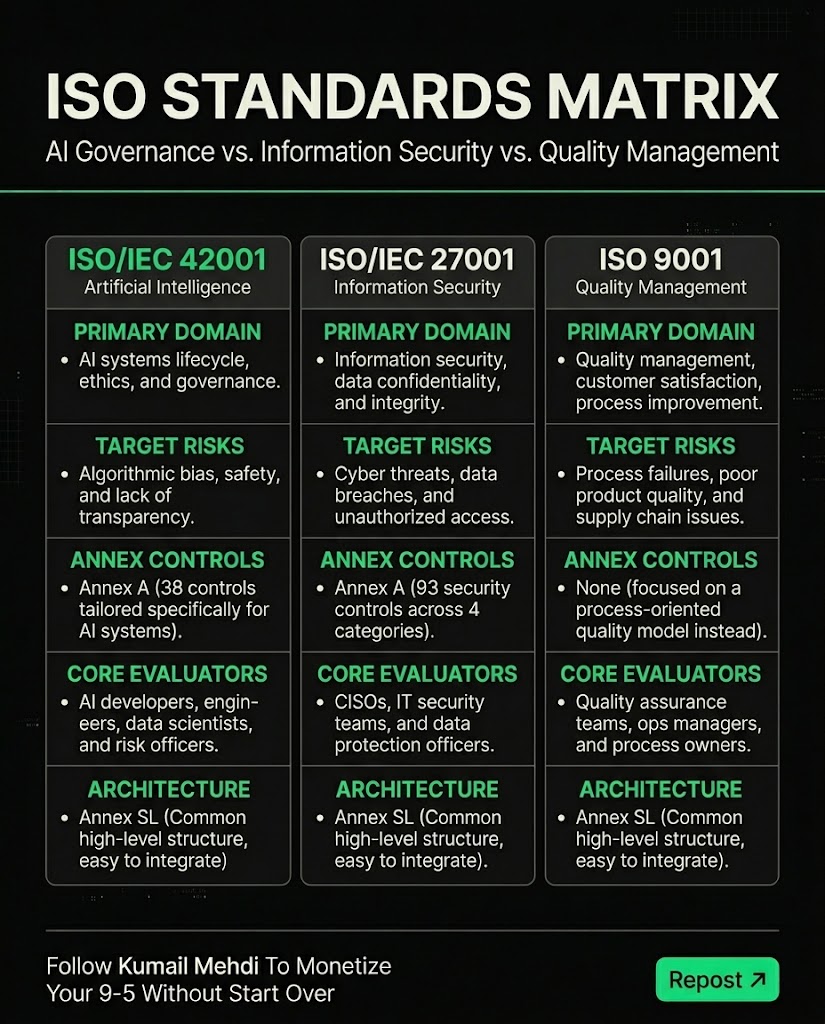
ISO 42001 vs. ISO 27001 vs. ISO 9001
Many teams wonder whether an existing ISO 27001 certification makes ISO 42001 redundant. Information security frameworks protect systems against unauthorized data disclosure or service interruption; they are not designed to assess whether an automated algorithm makes ethical, unbiased, or explainable decisions.
ISO 42001 and the EU AI Act: What You Need to Know
A critical legal nuance must be noted: ISO/IEC 42001 is a voluntary international standard; it does not grant automatic presumption of conformity with the EU AI Act (Regulation (EU) 2024/1689).
Presumption of conformity under Article 40 requires European Harmonized Standards officially cited in the Official Journal of the European Union. However, the European standard (EN ISO/IEC 42001) was adopted identically by CEN-CENELEC.
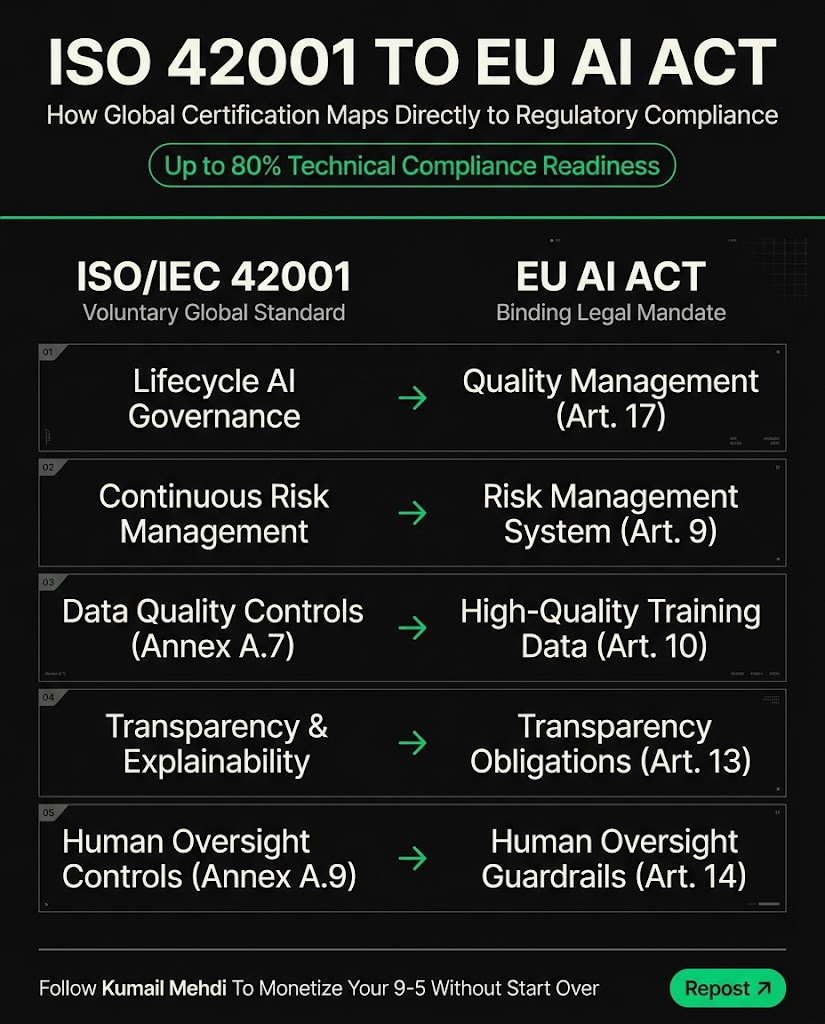
Implementing ISO 42001 builds the operational foundation for the EU AI Act. Organizations that build an AIMS now can readily meet emerging requirements for high-risk AI systems without having to re-architect their compliance programs later.
Frequently Asked Questions (FAQ)
What is the typical cost of ISO 42001 certification?
Total costs depend on organizational headcount, the number of AI models in scope, deployment complexity, and external advisory support. Direct certification body audit fees generally range from $15,000 to $35,000 for small to mid-market firms, alongside internal remediation costs.
Can our organization certify both ISO 27001 and ISO 42001 together?
Yes. Because both standards utilize the ISO Harmonized Structure, management reviews, leadership clauses, internal audit routines, and supplier due-diligence processes can be managed through a single integrated audit program.
How long does it take to achieve ISO 42001 certification?
Most organizations take between 3 and 9 months. Teams with a mature ISO 27001 baseline and clear data registries move significantly faster than organizations building compliance programs from the ground up.
Establish Trust with Enterprise-Grade AI Governance
Enterprise clients are scrutinizing third-party AI features and machine learning vendors more rigorously than ever. An accredited ISO 42001 certification removes sales friction, satisfies vendor risk reviews, and protects your brand from algorithmic liabilities.
Ready to build trust with your enterprise clients?
Connect with me on LinkedIn today to scope your AIMS roadmap and fast-track your startup's ISO 42001 certification.
Master AI governance in just 6 months, without starting from scratch. Join my free AI Governance Decoded newsletter and get actionable insights delivered to your inbox in a 15-minute weekly read.

Kumail Mehdi
ISO 42001 Lead Auditor and AI strategist. 11 years in corporate leadership, 14 years running a digital agency. I help professionals, consultants and AI startups turn expertise into governed, AI-powered systems.


