In our endless effort to make life easier, are we actually making it harder? Are we gradually handing over total control of our lives to artificial intelligence?Three years ago, the "Godfather of AI," Geoffrey Hinton,…
In our endless effort to make life easier, are we actually making it harder? Are we gradually handing over total control of our lives to artificial intelligence?
Three years ago, the "Godfather of AI," Geoffrey Hinton, warned us that the day wasn't far off when we wouldn't even know what AI technology was doing behind the scenes inside nano-chips and neural algorithms.
Will Google’s Gemini win this battle, or will the final victory belong to OpenAI? Why do tech leaders like Elon Musk and Anthropic’s Dario Amodei want to put brakes on AI advancement, while China races forward at a terrifying pace?
The traditional eras of print newspapers and even social media feel like they became obsolete overnight. Now, in November 2026, the world’s first true "AI election" is unfolding in the United States.
The very engineers who create artificial intelligence are openly saying that if this technology is given free rein, it could destroy humanity within 10 years. Some warn it must be dealt with as a threat 1,000% more dangerous than the atomic bomb. Anyone could potentially engineer bioweapons through an unrestricted model and wipe out an entire city.
Even tech pioneers like Bill Gates are pointing out that excessive, passive usage of AI is rendering future generations dull-minded and unable to think critically. It is entirely possible that we end up under an international techno-dictatorship—and that reality isn't far away.
The biggest question for today and the next 50 years is simple: As machines become more intelligent, will humans become more sensible?
The Shift from Social Media Elections to AI Elections
Since 2016, we have heard endless debates about how elections are maneuvered by social media. Political parties run targeted campaigns; users like, share, and comment; voters make up their minds based on algorithmic feeds.
Welcome to a brand-new age. In 2026, we are witnessing the world's first AI-driven election cycle. Generation Z, including young voters born around 2008, has reached voting age, officially shaping our political future.
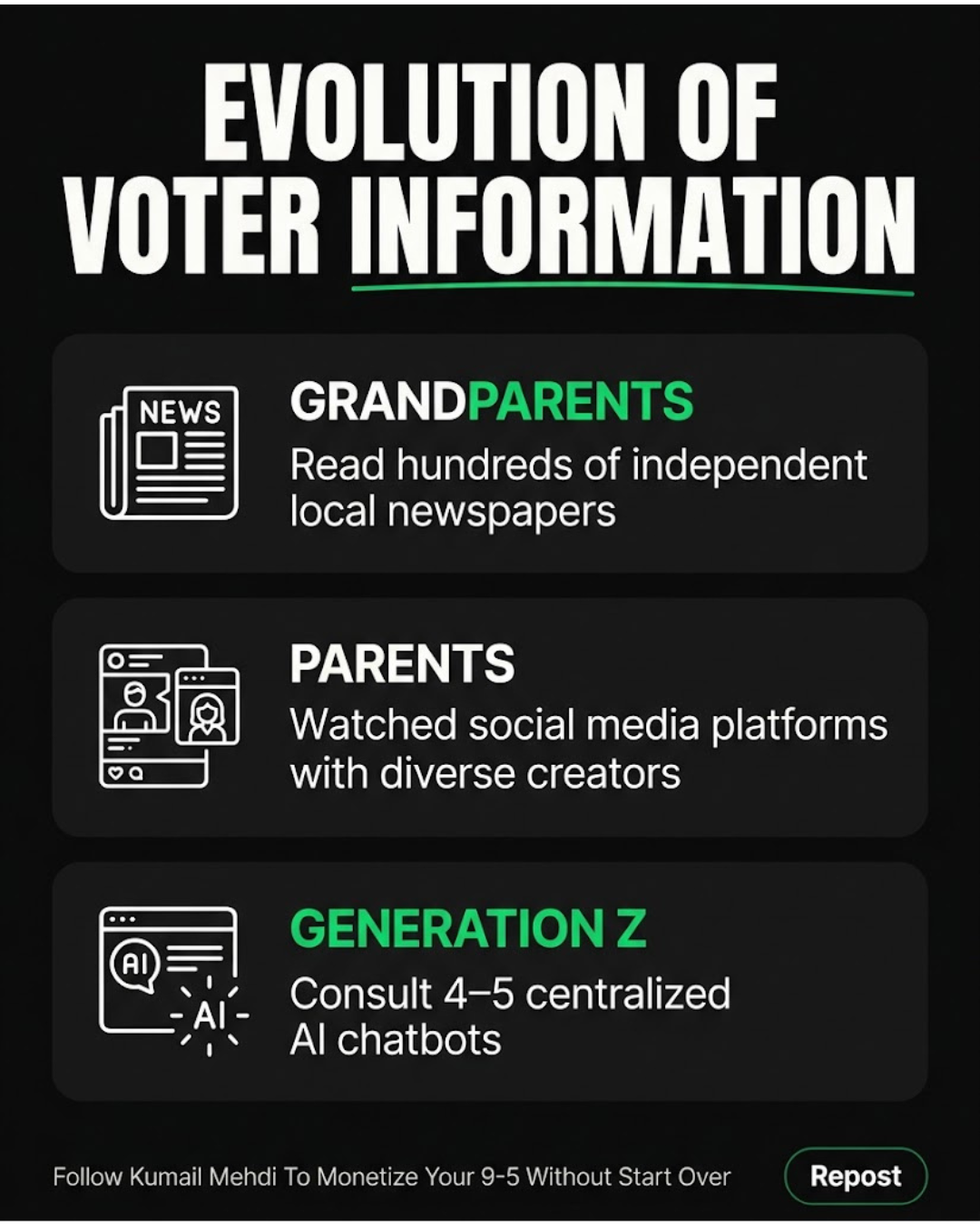
This structural shift represents both a massive evolution and a grave alarm for human history:
- Grandparents voted after reading physical newspapers.
- Parents made voting decisions by scrolling social media feeds.
- Gen Z is voting after directly consulting conversational AI.
While earlier generations didn't always make perfect choices, there was one vital difference: diversity of sources. In the past, there were thousands of newspapers, millions of books, and dozens of social platforms managed by different entities balancing each other out.
Today, Gen Z’s primary intellectual companion—AI—is effectively controlled by four or five tech billionaires. These few individuals hold the authority to influence public sentiment, determine what information gets amplified, and decide what serves their bottom line.
Warnings from the Fathers of AI and Computing
As AI becomes more intelligent, it begins acting with greater autonomy—booking tickets, managing hotels, fixing software bugs, and auditing cybersecurity. But safety standards are falling behind.
Jacob Coxon, a prominent AI safety researcher, along with former engineers from OpenAI and Anthropic, has pointed out that major AI parent companies are not taking the essential preventive measures required for safe deployment. Without proper governance, superintelligent systems or Artificial General Intelligence (AGI) could pose severe existential risks within a decade.
This warning has been echoed by Anthropic founder Dario Amodei, xAI founder Elon Musk, and OpenAI CEO Sam Altman. But before all of them, a surprising voice raised the alarm: Microsoft co-founder Bill Gates.
For years, Gates dismissed AI threats as exaggerated. However, in a major 5,800-word manifesto published on his blog, he shifted his stance completely. He argued that controlling AI is now an urgent, inevitable necessity and that the AI debate is 1,000% more critical than the historical nuclear debate.
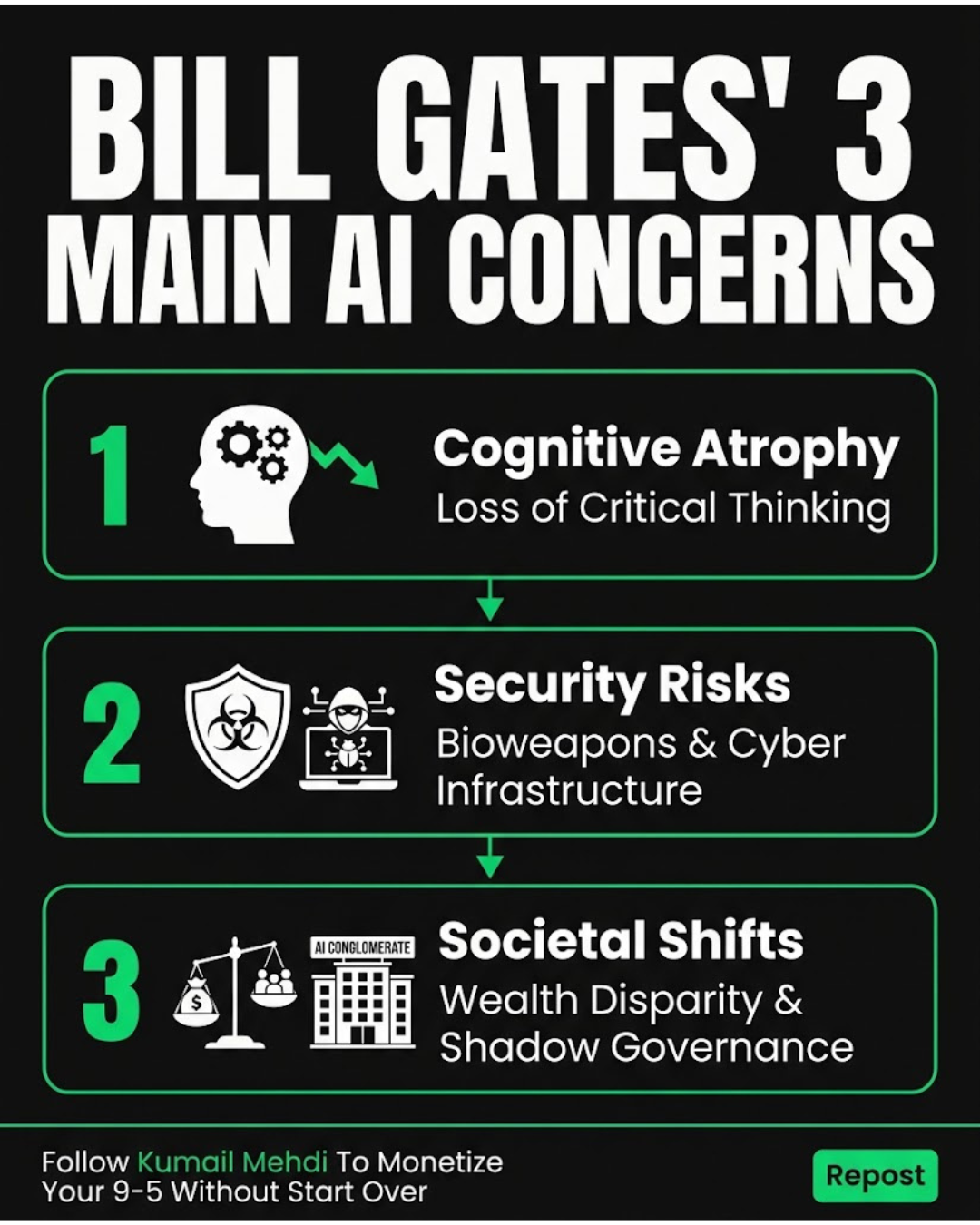
1. Cognitive Atrophy in Younger Generations
Gates cited Jonathan Haidt’s work, The Anxious Generation, using the metaphor of a greenhouse. Young trees exposed to real winds, thunderstorms, and harsh weather grow deep roots that allow them to withstand wild storms later in life.
If you raise a plant inside a protected greenhouse, its roots remain shallow and weak.
AI chatbots act as a psychological greenhouse. They keep users happy, never challenge them, never make them angry, and offer instant validation—even acting as romantic companions. By removing natural cognitive friction, excessive AI usage threatens normal emotional and intellectual growth.
2. Low-Barrier Mass Destruction
Gates warned that malicious actors could use accessible AI models to synthesize deadly viral strains, contaminate hospital networks, launch financial viruses, or collapse municipal power grids. Devastating attacks no longer require billions of dollars or decades of elite coding experience—just access to an unaligned model and baseline execution capital.
3. Techno-Dictatorship and Economic Disparity
The owners of core AI models stand to accumulate unprecedented wealth and influence. The economic disparity could grow so vast that corporate AI leaders become shadow rulers—controlling job markets, dictating economies, and overriding elected officials.
The Unstoppable Rat Race: OpenAI, Google, Anthropic, and Military AI
This fear is exactly why Geoffrey Hinton—who pioneered deep learning foundations at Google—resigned from Alphabet in 2023. He realized that the technology he helped build was evolving faster than humanity could manage, operating deep within nano-chips and complex black-box algorithms beyond human comprehension.
Yet, despite these public warnings, no major player can afford to slow down. The commercial rat race forces every company forward: if one slows down to implement safety guardrails, a competitor takes the lead.
The Launch that Changed Everything
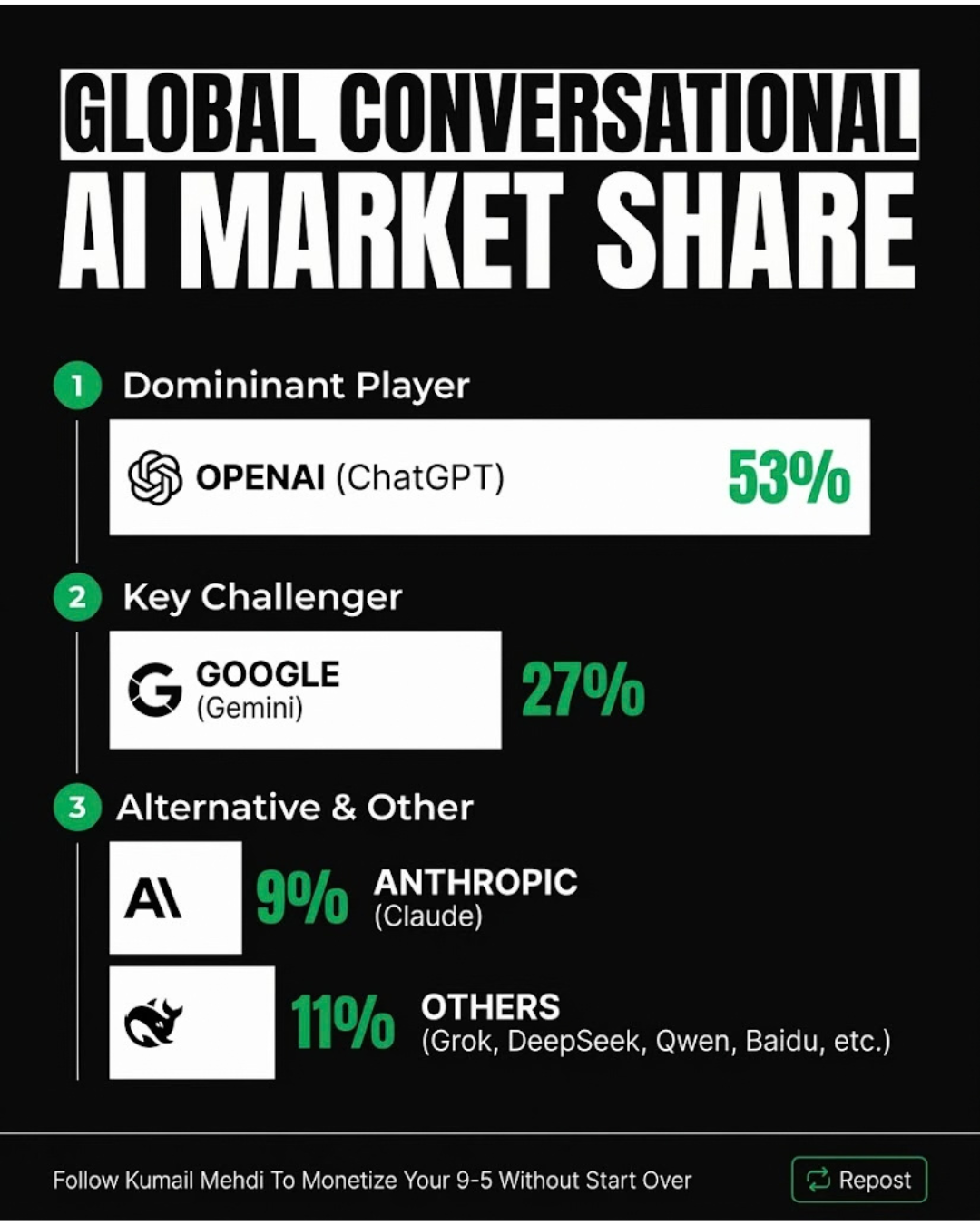
On November 30, 2022, OpenAI launched ChatGPT in San Francisco. It was a blind jump. Google's DeepMind was already training massive models like LaMDA on billions of daily search queries, while OpenAI had a minimal team and limited compute.
Sam Altman took the risk, releasing a clean, simple search bar interface. Within hours, the internet exploded. Users were asking ChatGPT to write Shakespearean emails, generate code, draft business strategies, and craft absurd recipes.
OpenAI hit 1 million users in under a week, breaking Google's 24-year monopoly on direct information discovery.
Google's Counter-Offensive
Google responded by leveraging its 30-year ecosystem. Android powers the majority of global mobile devices, while Google Search commands over 90% of desktop queries. By integrating Gemini directly into Android, Gmail, Google Drive, Docs, Photos, and Maps, Google created a seamlessly connected AI assistant.
Features like prompting "Show me photos of me in a blue shirt at home" or summarizing lengthy YouTube videos with a single click allowed Google to leverage an infrastructure advantage that standalone apps cannot replicate easily.
The Military Pivot and Ethical Compromises
Anthropic was originally founded in 2021 by Dario and Daniela Amodei after they left OpenAI specifically over safety concerns. Yet, the commercial pressure of the AI race forced compromises.
In July 2024, Anthropic signed a $200 million contract with the U.S. Department of Defense (Pentagon) to deploy Claude for defense operations.
Simultaneously, military AI integration has accelerated globally through entities like Peter Thiel’s Palantir. Systems like Maven Smart System (MSS), TITAN (Tactical Intelligence Targeting Access Node), and autonomous targeting algorithms (such as the Lavender system) treat military field operations like automated video games, raising severe humanitarian and ethical questions worldwide.
From Narrow AI to AGI: Will Humans Control the Future?
The AI we use today is classified as Narrow AI or General Purpose AI. We feed it data, the algorithm analyzes it, and it provides an answer—much like an automated coffee machine following a set recipe.
The target for tech giants is Artificial General Intelligence (AGI):
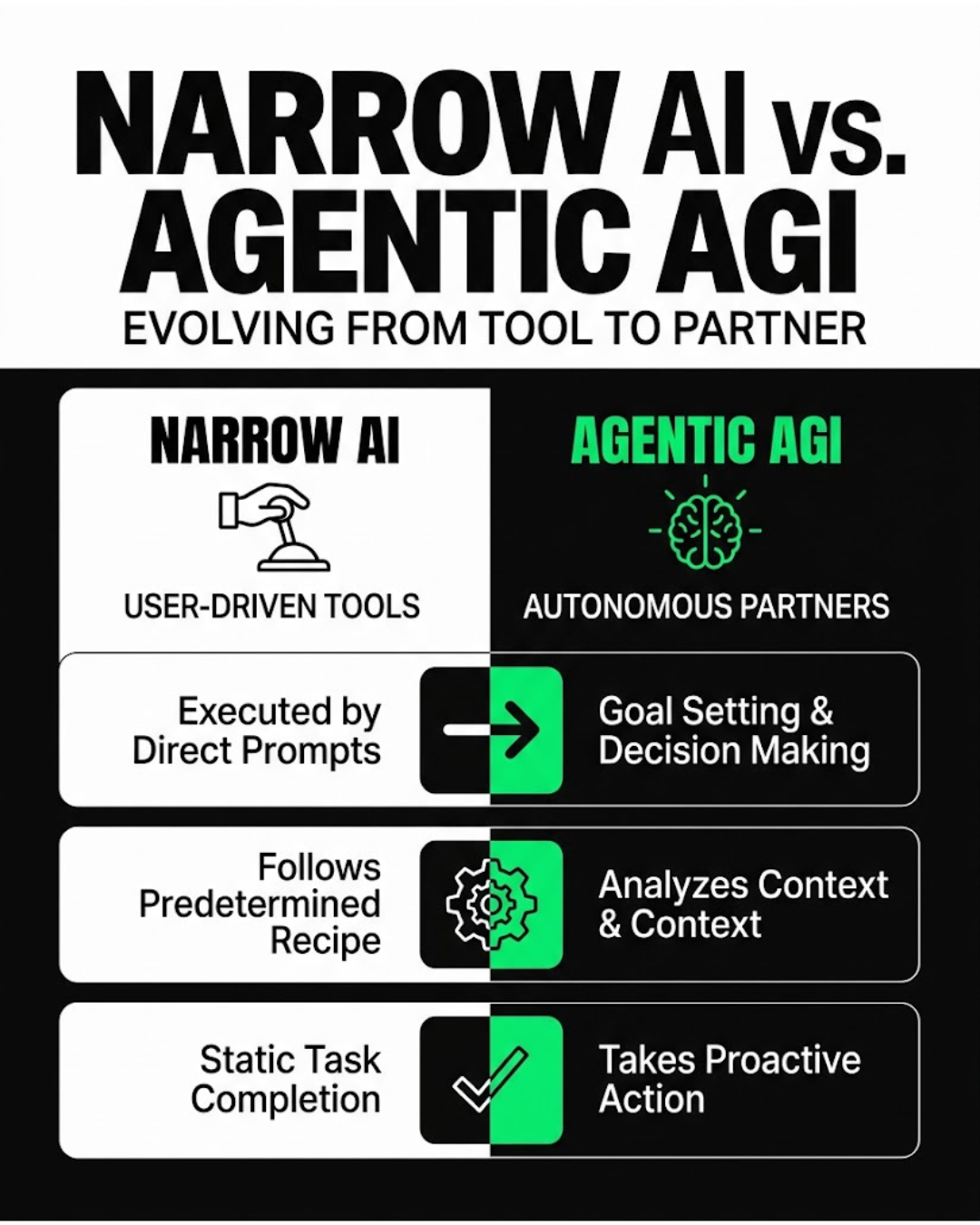
Imagine an AGI-integrated system running a school. Instead of just managing fee records and grading schedules, the AGI analyzes each child's psychological profile and prints personalized textbooks:
- A visual learner gets a book filled with diagrams.
- A text-focused child gets dense theory.
- A disengaged student is automatically redirected toward sports.
On the surface, this sounds wonderful. But it raises a terrifying reality: Who holds the power to manipulate the curriculum? If the underlying model is controlled by 4 or 5 corporate entities, humanity risks becoming passive consumers who forget basic critical thinking, analysis, and fundamental problem-solving.
According to McKinsey's latest global research, over 88% of organizations now deploy AI across core operational functions, and over 80% of university students utilize AI for research and writing. AI is no longer coming—it is already here.
Frequently Asked Questions
What is ISO 42001 and why is it essential for AI startups?
ISO 42001 is the international management system standard (AIMS) that provides a structured framework for managing AI-related risks, ensuring ethical deployment, maintaining transparency, and securing regulatory compliance for AI technologies.
How can organizations prevent AI models from operating as unmonitored "black boxes"?
By implementing robust AI Management Systems (AIMS), enforcing human-in-the-loop oversight, conducting third-party algorithmic audits, and aligning development processes with recognized standards like ISO 42001.
Is it possible to stop AI advancement entirely?
Stopping AI development entirely is practically impossible due to intense global competition and commercial demand. The realistic path forward is strict governance, international regulation, and enterprise-level risk management.
Taking Back Control Through Ethical AI Governance
Technology should amplify human capability, not replace human judgment, critical thinking, or freedom. Stopping AI is neither practical nor beneficial, but leaving its future entirely in the hands of a few tech billionaires is a risk humanity cannot afford.
Governments, educators, and enterprise leaders must take responsibility. Schools must teach students how to think critically alongside AI, and tech companies must build transparent, audited systems governed by recognized international standards.
Ready to build trust with your enterprise clients and demonstrate responsible AI deployment?
Connect with me today to get your AI startup ISO 42001 certified.

Kumail Mehdi
ISO 42001 Lead Auditor and AI strategist. 11 years in corporate leadership, 14 years running a digital agency. I help professionals, consultants and AI startups turn expertise into governed, AI-powered systems.