Building artificial intelligence systems that perform well technically is no longer enough. As generative AI and autonomous systems weave deeper into daily life, enterprises and startups face a growing pressure to prove…
Building artificial intelligence systems that perform well technically is no longer enough. As generative AI and autonomous systems weave deeper into daily life, enterprises and startups face a growing pressure to prove their technologies actually benefit society.
Enter IEEE Standard 7010-2020 (Recommended Practice for Assessing the Impact of Autonomous and Intelligent Systems on Human Well-Being). While frameworks like the ISO/IEC 42001 Artificial Intelligence Management System (AIMS) establish the operational and governance backbone for responsible AI, IEEE 7010 provides the exact metrics needed to measure human impact.
Let's break down how this standard works and why forward-thinking AI startups are integrating well-being metrics into their compliance strategies.
What is IEEE 7010?
Published by the IEEE Standards Association, IEEE 7010-2020 offers a structured approach to conducting a Well-Being Impact Assessment (WIA). Instead of treating ethics as an abstract philosophical debate, the standard provides scientifically validated indicators to measure how an AI product affects people across five key dimensions:
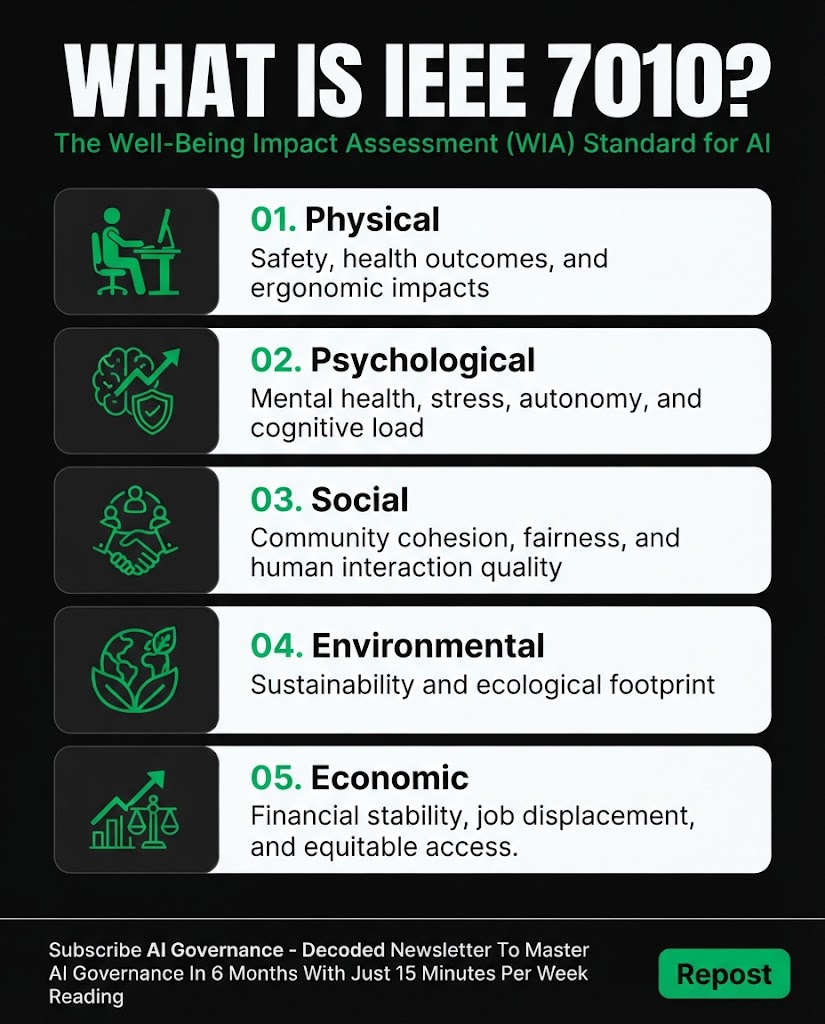
Physical Well-Being: Safety, health outcomes, and ergonomic impacts.
Psychological Well-Being: Mental health, stress, autonomy, and cognitive load.
Social Well-Being: Community cohesion, fairness, and human interaction quality.
Environmental Well-Being: Sustainability and ecological footprint.
Economic Well-Being: Financial stability, job displacement, and equitable access.
By embedding these factors into the system lifecycle, product managers and developers can proactively catch unintended negative consequences before deployment.
Why ISO 42001 Aspirants Need to Care
If you are pursuing or advising on ISO 42001 certification, you already know that Clause 6 (Planning) and Clause 8 (Operation) require rigorous risk assessment, impact evaluation, and stakeholder engagement.
However, many technical teams struggle to operationalize vague requirements around "societal impact" and "ethical risk." This is where IEEE 7010 bridges the gap:
Quantifiable Metrics: It translates subjective human experiences into trackable data points.
Stakeholder Engagement: It embeds feedback loops directly into product development cycles.
Enterprise Trust: Enterprise procurement teams increasingly demand proof of responsible AI design beyond basic security compliance.
Key Steps to Implement a Well-Being Impact Assessment
Integrating a WIA into your engineering workflow doesn't have to slow down your release cycle. Follow this phased approach:
Step 1: Metric Selection: Identify which of the five well-being dimensions are most relevant to your specific AI use case (e.g., psychological safety for conversational agents, or economic impact for workplace automation tools).
Step 2: Data Collection: Establish baseline methodologies, user surveys, and telemetry to gather qualitative and quantitative feedback.
Step 3: Analysis Framework: Review the collected data against anticipated outcomes during regular risk-management reviews.
Step 4: Continuous Reporting: Document findings to demonstrate ethical due diligence to auditors, internal stakeholders, and enterprise clients.
Conclusion
Compliance is ultimately about building trust. While ISO 42001 gives you the management framework to govern your AI systems, standards like IEEE 7010 give you the precise tools to ensure those systems actually improve human lives.
Ready to build trust with your enterprise clients and future-proof your governance framework?
Connect with me today to get your AI startup ISO 42001 certified.
Subscribe to "AI Governance - Decoded" Newsletter to Master AI Governance With Just 15 Minutes Read Per Week.

Kumail Mehdi
ISO 42001 Lead Auditor and AI strategist. 11 years in corporate leadership, 14 years running a digital agency. I help professionals, consultants and AI startups turn expertise into governed, AI-powered systems.