Autonomous products and artificial intelligence touch nearly every corner of modern life. From self-guided robotic vacuum cleaners and automated logistics systems to robotic surgical tools and driverless vehicles,…
Autonomous products and artificial intelligence touch nearly every corner of modern life. From self-guided robotic vacuum cleaners and automated logistics systems to robotic surgical tools and driverless vehicles, systems are making high-stakes decisions independently.
Yet, this rapid automation brings a critical challenge: the potential for unexpected, unwanted, or dangerous outcomes. When things go wrong, society needs more than just a vague error log—we need to know why a system behaved the way it did.
For AI startups and emerging tech companies, navigating this landscape requires more than just innovative code; it demands systematic compliance and rigorous ethical standards. Enter frameworks like ISO 42001 for Artificial Intelligence Management Systems (AIMS) and the IEEE 7001-2021 standard for autonomous transparency.
Why Transparency is the Bedrock of AI Trust
Transparency cannot be an afterthought; it must be an explicit design focus from the outset. Greater transparency enables operators and developers to understand decision-making processes, prevent inappropriate actions, and conduct accurate root-cause analysis after an incident.
Public skepticism remains a major barrier to widespread adoption. For instance, while a poll found that 70 percent of people expect autonomous vehicles to be a permanent fixture, 59 percent stated they believe autonomous cars are no safer than human-driven vehicles.
Unlike jet planes equipped with "black boxes" that log critical investigative data, many autonomous systems rely on basic event data recorders. These logs often reveal only what went wrong, not why. Without understanding the root cause, building absolute trust in high-risk autonomous systems remains difficult.
Raising the Bar with IEEE 7001-2021
To bridge this trust gap, the IEEE Standards Association published IEEE 7001-2021 (Standard for Transparency of Autonomous Systems). Co-sponsored by the IEEE Vehicular Technology Society, Intelligent Transportation Systems Society, and Robotics and Automation Society, this standard outlines specific, measurable, and testable levels of transparency.
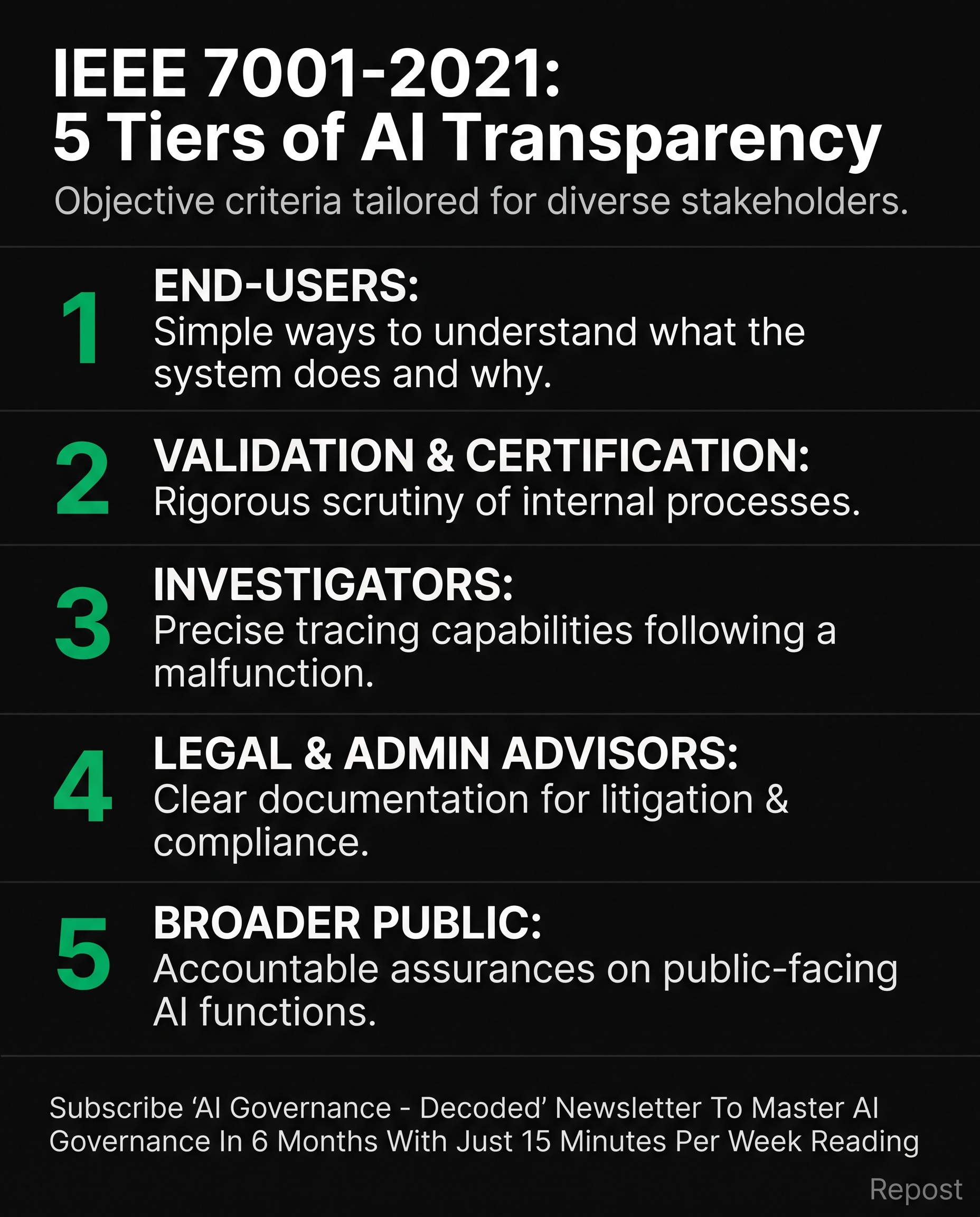
Instead of subjective claims, IEEE 7001-2021 provides objective criteria across five distinct tiers, ranging from minimally acceptable to stringent, tailored for various stakeholders:
End-Users: Requiring straightforward ways to understand what a system is doing and why.
Validation & Certification Professionals: Needing to rigorously scrutinize internal processes.
Investigators: Requiring precise tracing capabilities following an accident or malfunction.
Legal and Administrative Advisors: Needing clear documentation to inform litigation or compliance advice.
The Broader Public: Demanding accountable assurances on how public-facing AI functions.
This standard forms a core pillar of the broader IEEE Ethically Aligned Design framework, complementing other key benchmarks like the IEEE 7000 series on data privacy, algorithmic bias, and ethical engineering.
Aligning Transparency with ISO 42001 (AIMS)
While technical standards like IEEE 7001 define system-level transparency, organizations deploying AI need a macro-level governance framework. This is where ISO 42001 (Artificial Intelligence Management System - AIMS) comes into play.
ISO 42001 provides the organizational structure required to manage risk, ensure ethical oversight, and continuously monitor AI lifecycles. Integrating technical explainability standards like IEEE 7001 directly into an ISO 42001 management framework allows AI startups and boutique firms to demonstrate comprehensive compliance to enterprise clients and regulatory bodies alike.
Frequently Asked Questions About AI Transparency and Standards
What is IEEE 7001-2021?
IEEE 7001-2021 is an international standard that defines measurable and testable levels of transparency for autonomous systems, ensuring that their decision-making processes can be objectively assessed and understood.
How does ISO 42001 relate to AI transparency?
ISO 42001 establishes an Artificial Intelligence Management System (AIMS) framework. It helps organizations systematically manage AI-related risks, accountability, and transparency across the entire development and deployment lifecycle.
Why is system transparency critical for safety-critical AI?
Safety-critical systems (such as medical diagnosis tools or autonomous vehicles) can directly cause physical, economic, or psychological harm. Transparent design ensures that developers and investigators can trace system failures to prevent future accidents.
Ready to build trust with your enterprise clients?
Navigating complex AI standards like ISO 42001 and embedding technical transparency frameworks doesn't have to slow down your innovation.
Connect with me today on LinkedIn or via our contact form to get your AI startup audit-ready and certified.
Subscribe to "AI Governance - Decoded" Newsletter to Master AI Governance With Just 15 Minutes Read Per Week.

Kumail Mehdi
ISO 42001 Lead Auditor and AI strategist. 11 years in corporate leadership, 14 years running a digital agency. I help professionals, consultants and AI startups turn expertise into governed, AI-powered systems.