If you are currently rolling out an Artificial Intelligence Management System (AIMS) under ISO 42001, you are likely wondering what exact steps are required to tick the training and awareness boxes. Getting this right…
If you are currently rolling out an Artificial Intelligence Management System (AIMS) under ISO 42001, you are likely wondering what exact steps are required to tick the training and awareness boxes. Getting this right is non-negotiable for a smooth audit and long-term compliance.
This guide breaks down ISO 42001 training requirements, bridges the gap with emerging regulatory duties like the EU AI Act, and outlines the most effective methods to move forward with your compliance journey.
ISO 42001 Training & Awareness Requirements: Clauses 7.2 and 7.3
Understanding the baseline criteria set out by the standard helps structure your internal roadmap. ISO 42001 handles competence and awareness across two specific clauses under Section 7 (Support):
1. Clause 7.2: “Competence”
Clause 7.2 dictates that organizations must:
Define competencies required for particular roles impacting your AIMS.
Evaluate employees to check whether they possess those required competencies based on their education, training, or prior experience.
Acquire necessary competencies if gaps exist (e.g., through targeted courses, external certifications, or mentorship).
Example: If you designate an internal ISO 42001 auditor, they need a thorough understanding of the standard and auditing techniques. You verify this via credentials or experience, and if they fall short, you enroll them in a professional course.
2. Clause 7.3: “Awareness”
While competence targets specific job functions, Clause 7.3 applies to everyone working under the organization's control. It mandates that staff must be aware of:
The organization's formal AI policy.
Their individual contribution to the effectiveness of the AIMS (including performance benefits).
The implications of non-compliance with AI policies and procedures.
How to Choose the Right ISO 42001 Training Methods
Different roles require distinct pathways to fulfill competency requirements. Common training formats include:
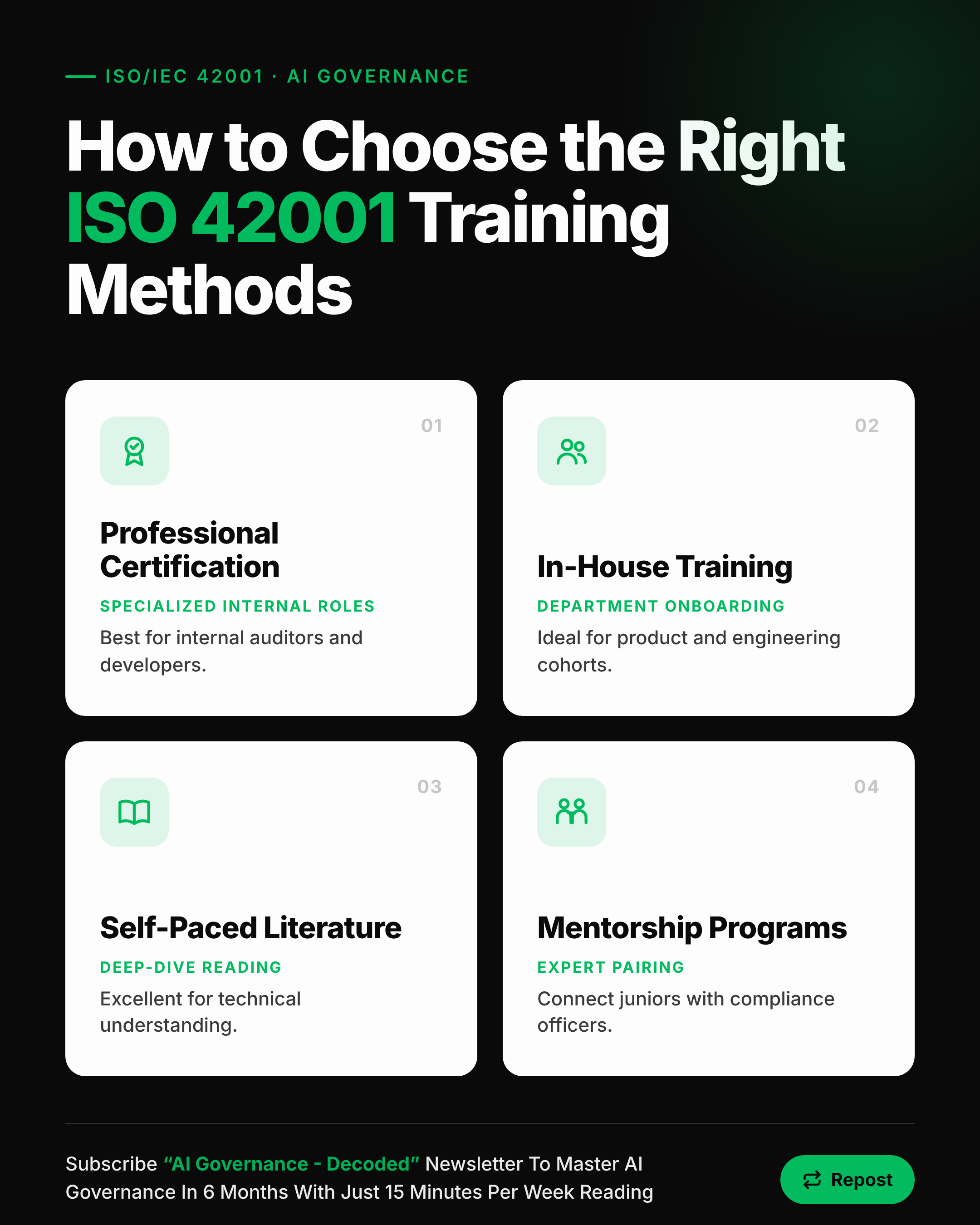
Professional Certification Courses: Best for specialized internal roles, such as internal auditors, legal advisors, or software developers interacting directly with machine learning pipelines.
In-House Training Sessions: Ideal when onboarding a cohort or department (e.g., training the entire product or engineering division on internal AI risk thresholds).
Self-Paced Literature & Reading: Excellent for deep-dive technical understanding, though best paired with interactive sessions as an add-on.
Mentorship Programs: Highly effective for pairing junior team members with seasoned AI compliance officers.
Essential ISO 42001 Course Categories
Foundations Course: Tailored for AI governance project teams, mid-to-senior management, and stakeholders seeking core familiarity.
Internal Auditor Course: Built for personnel managing internal compliance checks.
Lead Implementer & Lead Auditor Courses: Ideal for compliance officers and consultants scaling their service offerings.
Structuring In-House Training and the "AI Literacy" Mandate
When structuring company-wide education, segment your audience carefully. Group employees by department (e.g., software engineering, marketing, HR), hierarchy level (middle management vs. executives), or process involvement (such as AI vendor procurement). Tailor the depth, tone, and duration to each segment.
Note on the EU AI Act: While ISO 42001 uses the term “awareness,” Article 4 of the EU AI Act introduces a mandatory “AI literacy” obligation for providers and deployers of AI systems. In practice, regulators look at AI literacy as a practical expansion of awareness—ensuring staff understand basic AI capabilities, risks, and ethical considerations.
Effective Formats for Delivering Awareness & Literacy Programs
Pre-recorded LMS Modules: Uploading structured video content via Learning Management System software ensures completion tracking, audit readiness, and scalability.
Internal Newsletters & Intranet Stories: Sharing real-world case studies keeps AI governance top-of-mind without causing meeting fatigue.
Interactive Town Halls & Forums: Hosting open discussions allows employees to voice questions regarding new policies or emerging internal tool usage.
Do It Properly: Setting Your Organization Up for Success
Ultimately, the success of your ISO 42001 implementation depends on how well your team understands not just the rules, but the why behind them. Robust documentation, regular progress tracking, and targeted awareness initiatives will significantly reduce audit stress and long-term compliance risks.
Let’s Connect: Ready to build trust with your enterprise clients or streamline your compliance framework? Connect with me today on [LinkedIn / Twitter] or via the Contact Form to get your AI startup ISO 42001 certified.
Subscribe to the Newsletter: Want weekly, actionable insights on AI governance, compliance, and management frameworks straight to your inbox?
Join over 20,000 professionals staying ahead of the regulatory curve!

Kumail Mehdi
ISO 42001 Lead Auditor and AI strategist. 11 years in corporate leadership, 14 years running a digital agency. I help professionals, consultants and AI startups turn expertise into governed, AI-powered systems.