As artificial intelligence systems become central to modern business operations, organizations face a critical challenge: how to govern emerging AI technologies without compromising existing cybersecurity frameworks.…
As artificial intelligence systems become central to modern business operations, organizations face a critical challenge: how to govern emerging AI technologies without compromising existing cybersecurity frameworks. Because both ISO 27001 (Information Security Management Systems - ISMS) and ISO 42001 (Artificial Intelligence Management Systems - AIMS) share a structural foundation rooted in the ISO High-Level Structure (HLS), many companies are exploring how to merge data protection with ethical AI governance.
Can these two standards be successfully combined into a single, unified management system? This guide explores the similarities, differences, and practical strategies to integrate ISO 27001 and ISO 27001 seamlessly, helping your organization eliminate audit fatigue and build a robust, comprehensive compliance posture.
Why Integrate ISO 27001 and ISO 42001?
Both standards are fundamentally built around risk management, leadership commitment, continuous improvement, and the Plan-Do-Check-Act (PDCA) cycle. Merging them allows organizations to streamline compliance workflows, optimize resources, and address overlapping operational controls.
Key steps to kick off your integration journey include:
Leverage Shared Clauses: Implement an integrated management system for administrative and high-level structural clauses that are identical across both standards.
Harmonize Risk Workflows: Utilize a uniform risk management methodology, even though the specific risk assessments for information security will differ from those for AI governance.
Align Security and AI Controls: Cross-reference Annex A controls to see where information security practices naturally support AI trustworthiness.
What Can Be Merged: Shared Elements
Because ISO 42001 follows the same High-Level Structure as ISO 27001, several core organizational frameworks can be completely unified:
Context and Leadership (Clauses 4 & 5): You can merge organizational context, stakeholder identification, and leadership commitment into a single overarching governance framework. This includes unified top-level policies, consolidated leadership commitment statements, and shared organizational roles.
Support (Clause 7): Administrative documentation systems, resource management, and company-wide communication plans can easily be shared across both frameworks.
Performance and Improvement (Clauses 9 & 10): Combining internal audits, management reviews, and a single corrective action workflow for both security incidents and AI failures significantly reduces "audit fatigue" for internal teams.
What Must Be Kept Separate: Key Differences
Despite their structural similarities, ISO 27001 and ISO 42001 have distinct objectives that require separate, specialized handling:
Risk Focus and Objectives: ISO 27001 focuses on protecting information assets against the compromise of Confidentiality, Integrity, and Availability (CIA). In contrast, ISO 42001 focuses on protecting individuals and society from the improper use of AI, addressing issues like algorithmic bias, opacity in automated decision-making, and societal impact.
Annex A Controls: ISO 27001 features 93 controls organized into four domains, whereas ISO 42001 features 38 controls across nine domains. While overlaps exist, ISO 42001 mandates specific controls that have no direct parallel in traditional security frameworks.
Documentation and Evidence: Traditional ISO 27001 audits require technical evidence of operational runtime (e.g., access logs, firewall configurations, and backup records). ISO 42001, however, demands records explaining why an AI system behaves the way it does—such as model design rationales, transparency logs, and documented human-in-the-loop oversight.
Data Governance Scope: ISO 27001 governs data protection throughout its entire lifecycle (from acquisition to disposal), while ISO 42001 specifically addresses the proper use, context, and quality of data utilized for AI model training and enhancement.
Bridging Cybersecurity and AI Risks
Because AI systems rely heavily on data infrastructure, many AI vulnerabilities directly intersect with traditional information security threats. Common risks include:
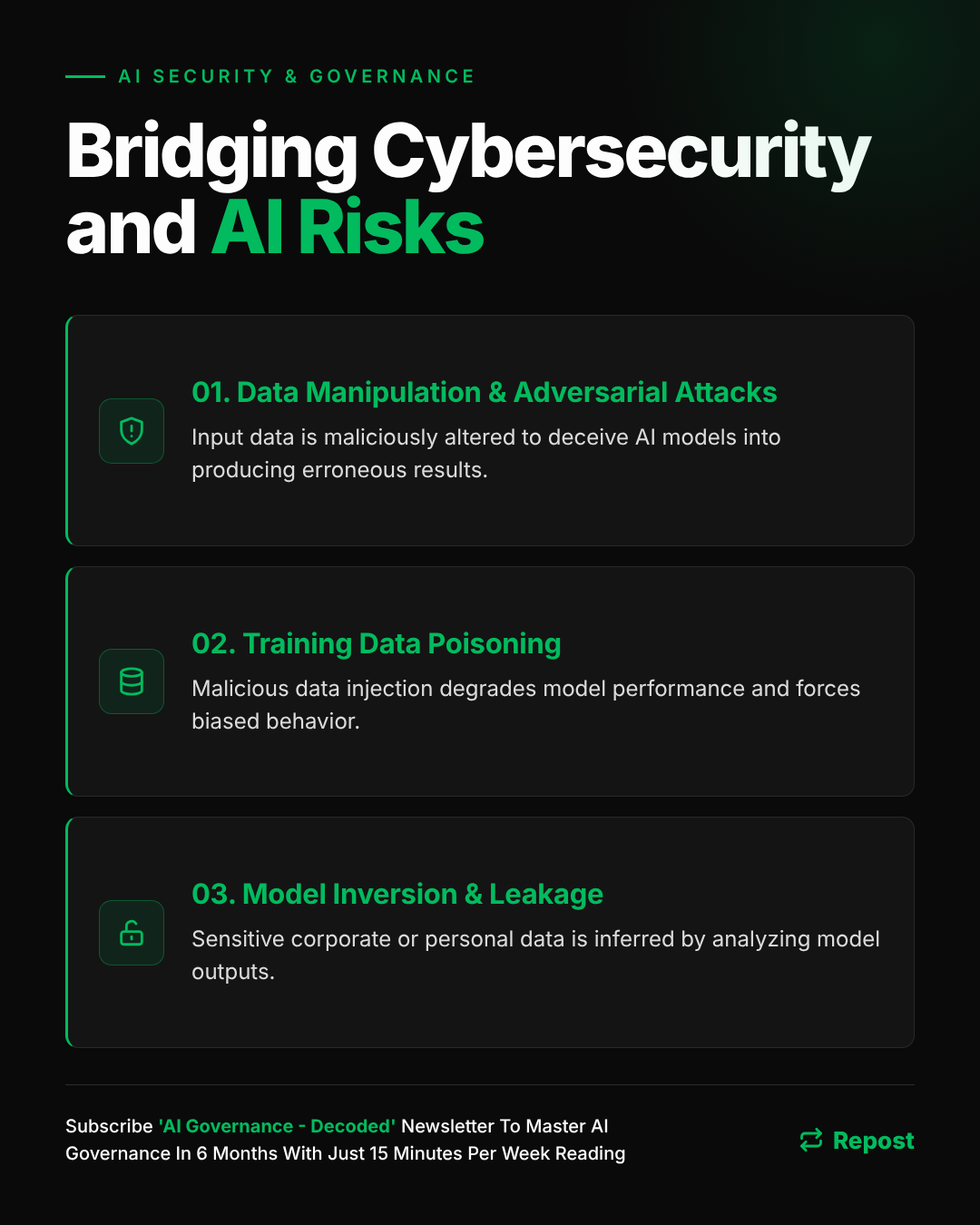
Data Manipulation & Adversarial Attacks: Input data can be maliciously altered to deceive AI models into producing erroneous results (compromising information integrity).
Training Data Poisoning: Injecting malicious data into training datasets degrades model performance or forces biased behavior that benefits an attacker (compromising integrity and availability).
Model Inversion & Leakage: Sensitive corporate or personal data can sometimes be inferred by analyzing a model's outputs (compromising information confidentiality).
As a notable real-world example, in 2023, corporate employees pasted sensitive source code and proprietary internal notes into public generative AI chatbots. This data was inadvertently ingested into public training sets, illustrating the severe intersection between data security failures and AI governance gaps.
Potential Overlap: Aligning ISO 27001 and ISO 42001 Controls
While direct mapping isn't always possible due to distinct control structures, several controls can be effectively aligned in an integrated environment:
| ISO 27001 Control | ISO 42001 Related Controls | Integration Rationale |
| A.5.1 Policies for information security | ISO 42001 A.2 (AI Policy, Alignment, and Review) | Expand existing security policies into a unified "Information Security and AI Governance Policy." |
| A.5.9 Inventory of information & assets | ISO 42001 A.4 (Resources for AI Systems) | Integrate AI-specific data, tooling, and computing resources into your broader asset inventory. |
| A.5.10 Acceptable use of assets | ISO 42001 A.9 (Use of AI Systems) | Update Acceptable Use Policies (AUP) with an AI Annex to penalize unauthorized or out-of-scope AI usage. |
| A.8.15 Logging & A.8.16 Monitoring | ISO 42001 A.6.2.8 Logs & A.6.2.6 Operation & Monitoring | Combine infrastructure metrics (server load) with AI metrics (model drift and accuracy drops) for unified alerting. |
| A.8.25 Secure development life cycle (SDLC) | ISO 42001 A.6.1 & A.6.2 (AI Lifecycle & Development) | Expand software development guidelines to incorporate ethical AI considerations, bias testing, and transparency checks. |
Build Trust with an Integrated Management System
Integrating ISO 27001 and ISO 42001 allows organizations to create a self-supporting ecosystem: security controls protect the underlying infrastructure and data confidentiality, while AI controls ensure trustworthiness, transparency, and ethical compliance across all algorithmic deployments.
Ready to scale your consulting services or streamline compliance for your enterprise clients?
Connect with me today to learn how to expertly implement ISO 42001 alongside ISO 27001.
Subscribe to the Newsletter: Want weekly, actionable insights on AI governance, compliance, and management frameworks straight to your inbox?
Join over 20,000 professionals staying ahead of the regulatory curve!

Kumail Mehdi
ISO 42001 Lead Auditor and AI strategist. 11 years in corporate leadership, 14 years running a digital agency. I help professionals, consultants and AI startups turn expertise into governed, AI-powered systems.


