"Should I get certified in AI governance?"I hear this question constantly, and I understand why. You browse job listings and get hit with alphabet soup: CIPP preferred, CISSP required, ISO 42001 Lead Implementer a plus.…
"Should I get certified in AI governance?"
I hear this question constantly, and I understand why. You browse job listings and get hit with alphabet soup: CIPP preferred, CISSP required, ISO 42001 Lead Implementer a plus. Before you know it, you are staring at thousands of dollars in training fees and wondering: Do I actually need these to break into AI governance?
Certifications alone will not get you an AI governance job.
Sit with that reality for a moment. If you have zero relevant experience and earn a certification, you still have zero relevant experience, just with an expensive digital badge.
Hiring managers don't hire credentials; they hire people who can solve business problems. A certification signals that you studied a curriculum; it does not prove you can navigate ambiguity, negotiate with engineering teams, or mitigate algorithmic risk.
I regularly see candidates holding three or four certifications who cannot explain what an AI risk assessment actually entails in production. Conversely, I see operators with zero formal credentials build enterprise AI governance frameworks from scratch. When hiring teams review candidates, practical capability consistently wins callbacks.
I appreciate certifications. Throughout my career, I completed my fair share, from early Windows Server, SQL Server, and Oracle credentials onward. The structured learning process is valuable. But in AI governance, demonstrated capability beats credentials almost every single time.
The Three Scenarios: When Do AI Governance Certifications Make Sense?
To decide whether credentials are worth your investment, evaluate where your career currently sits across three scenarios:
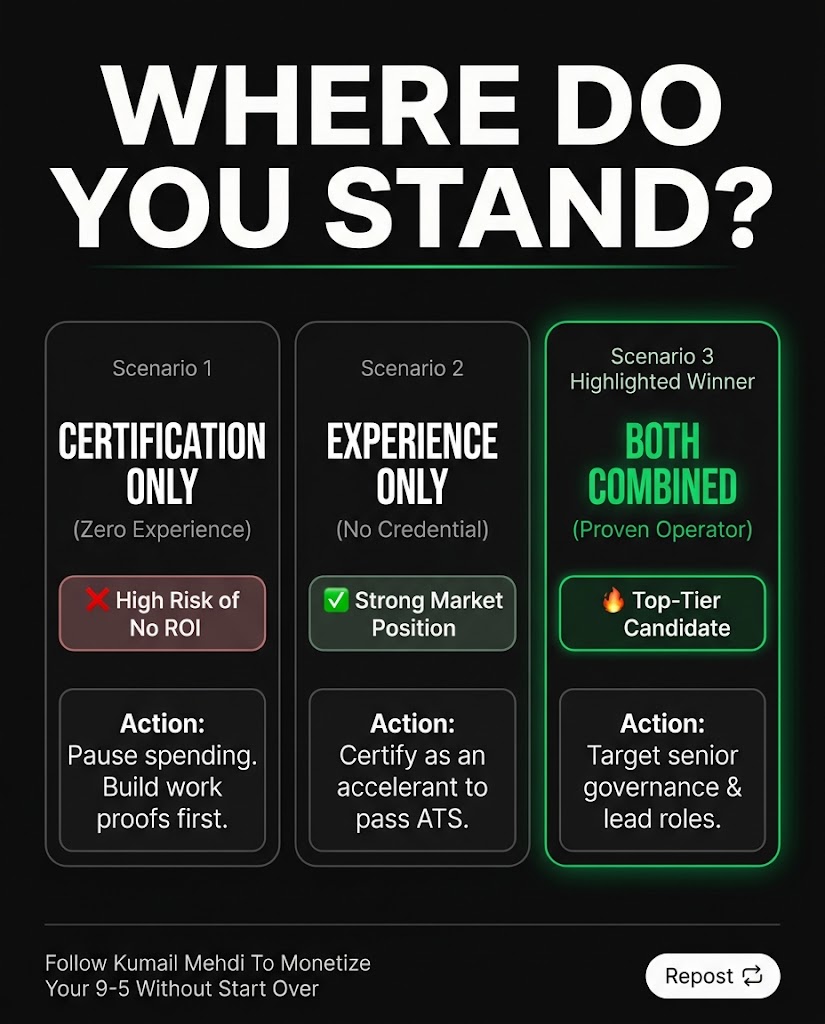
Scenario 1: Certification, but No Experience (The Trap)
This is where many aspiring professionals get stuck. You assume that lacking hands-on experience means you must spend $600 to $2,000 on an exam to "prove you are serious."
You pass, update your LinkedIn profile, and hear silence. Why? Because you still stumble during interviews when asked:
"Tell me about a time you identified and mitigated model bias or hallucination risk."
"Walk me through how you operationalized an AI governance committee."
"How would you audit our vendor pipeline under the EU AI Act?"
A test does not give you war stories, battle-tested templates, or verifiable proof of work. If this is your current situation, pump the brakes on paid exams.
Scenario 2: Experience, but No Certification (The Strong Position)
If you already work in compliance, legal ops, data protection, or enterprise risk management—or if you have led internal rollouts of generative AI tools—you sit in a much stronger position.
You have the muscle memory; you just haven't formalized it on paper. In this case, an AI or privacy certification serves as a powerful career accelerant. It helps you clear Applicant Tracking Systems (ATS) and assures recruiters that your real-world experience maps cleanly to standardized frameworks.
Scenario 3: Experience and Certification (The Gold Standard)
This is the optimal combination: you pair practical battle scars with recognized industry validation. Industry research shows this pays off: according to the IAPP Privacy and AI Governance Salary Report, professionals pairing foundational compliance backgrounds with AI-specific credentials earn significant salary premiums over non-credentialed peers.
Notice the sequence: Experience first, certification second.
4 Free Ways to Build Demonstrable AI Governance Experience
How do you get experience if companies will not hire you without it? Break the chicken-and-egg cycle with these four zero-cost approaches:
Build Public Sample Work Products
Draft an end-to-end AI Risk Assessment for a hypothetical healthcare or fintech startup. Create an enterprise Generative AI Acceptable Use Policy. Design an EU AI Act conformity assessment checklist. Publishing these case studies to GitHub or personal portfolio sites gives interviewers tangible proof of your operational depth.
Publish Thoughtful Technical Breakdowns
Analyze real-world AI compliance failures, regulatory fines, and frontier model developments publicly on LinkedIn or Substack. Deconstruct how recent regulatory enforcement actions apply to mid-market companies. Writing publicly demonstrates analytical clarity and critical thinking.
Offer Pro Bono & Advisory Support
Early-stage AI startups and nonprofits deploy AI tooling daily without dedicated legal or compliance teams. Offer to audit their shadow AI usage or draft vendor onboarding risk questionnaires for free. Real client delivery—even pro bono—outranks hypothetical multiple-choice exam prep.
Leverage Your Current 9-to-5 Role
If your employer uses tools like Microsoft Copilot, Claude, or internal Large Language Models (LLMs), get involved internally. Volunteer for cross-functional AI task forces, help IT evaluate third-party software vendors, or draft prompt safety guidelines. Internal contributions provide the concrete stories hiring managers look for.
Which AI Governance Certifications Are Actually Worth Considering?
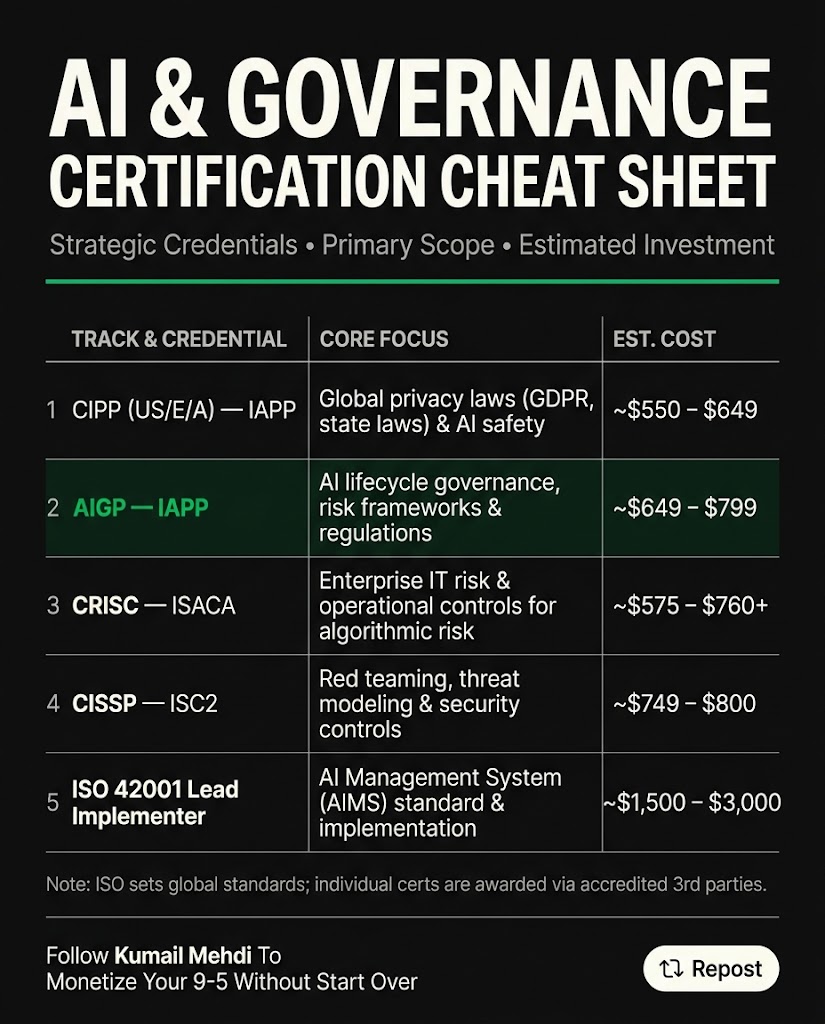
If you already have a foundation and need formal credentials to clear HR screens, categorize your options by specific career paths:
Master the Core Frameworks for Free Before Spending a Dollar
Before investing thousands of dollars in training camps, study the core foundational documentation that enterprise governance programs rely on:
NIST AI Risk Management Framework (AI RMF 1.0): The premier US operational benchmark outlining four primary functions: Govern, Map, Measure, and Manage. Read the core standard, cross-sector profiles, and the implementation playbook at nist.gov.
The European Union AI Act: Study the classification criteria dividing systems into unacceptable, high, and general-purpose AI (GPAI) systemic risk tiers.
OWASP Top 10 for Large Language Model Applications: The leading community standard detailing core generative risks like prompt injection, insecure output handling, and data poisoning.
Enterprise Responsible AI Principles: Examine public safety disclosures and governance documentation published by AI labs like Google, Microsoft, IBM, and Anthropic to see theoretical governance translated into production practices.
Frequently Asked Questions About AI Governance Careers
Do I need a technical coding background to work in AI governance?
No. AI governance is inherently interdisciplinary. Organizations structure governance across legal compliance, risk analysis, ethical impact, and technical controls. While you must understand model architecture, data flows, and risk taxonomy, roles focused on policy, audit, and vendor assessment prioritize regulatory comprehension and operational process design over writing production code.
How do I break into an AI governance role without prior direct experience?
The fastest path is leveraging existing domain experience—such as cybersecurity, data privacy, compliance, or product management, and positioning AI as an extension of your existing domain. Pair that with a public portfolio featuring model risk assessments, acceptable-use policies, and documented voluntary projects.
The 3-Question Decision Framework: Should You Certify Right Now?
Before committing your budget and time, run your decision through this three-part filter:
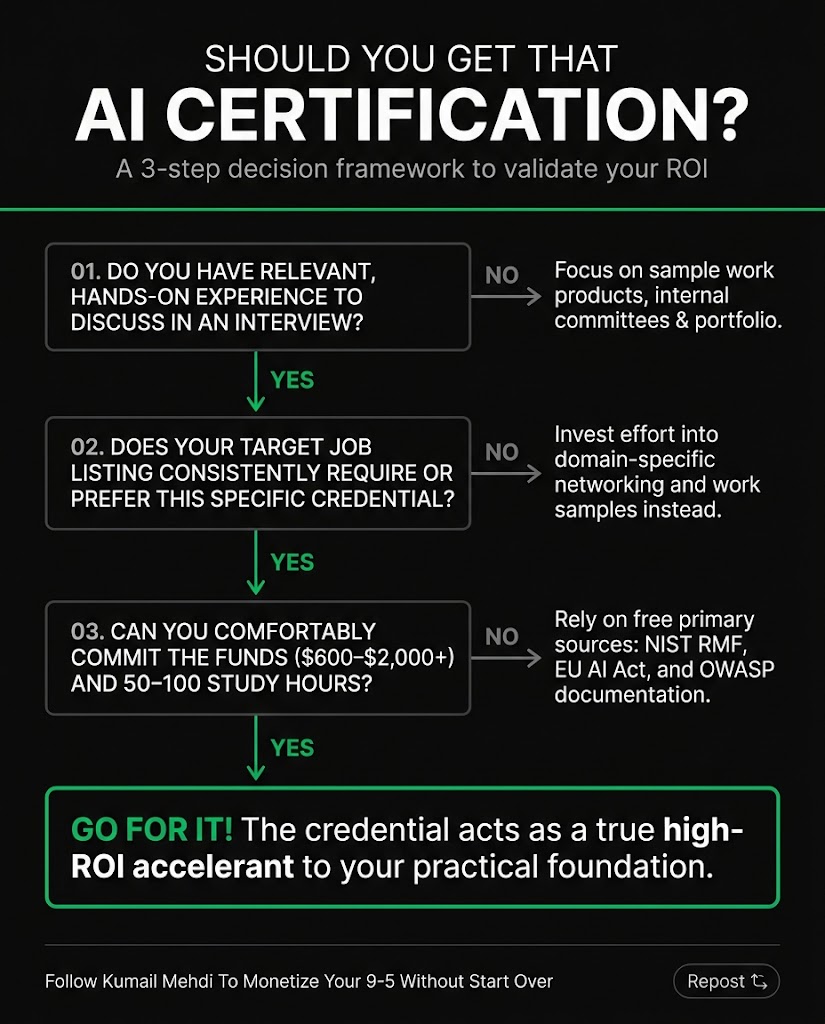
Sequence dictates career trajectory in emerging technology. Build practical capability first; acquire credentials second.
Ready to operationalize responsible AI and position your firm for enterprise-grade compliance?
Connect with me on LinkedIn to discuss implementing structured AI Management Systems (ISO/IEC 42001) and navigating emerging regulatory mandates.
I've launched a weekly newsletter designed to help you build demonstrable capability, the kind that actually gets you hired in AI Governance.
You will move beyond theory by creating real work products:
AI risk assessments
Governance frameworks
Policy documents (complete with feedback and guidance)
You will also learn how to position your background specifically for AI Governance roles so you walk away with a portfolio you can showcase in interviews.
To ensure I can work closely with each person, enrollment is strictly limited. If this sounds like what you need, subscribe at the link below. No pressure at all—just a hands-on resource for those who want deeper support.
Subscribe to "AI Governance - Decoded" Newsletter!
Quick question: What is your current approach? Are you pursuing certifications, self-studying, or taking another route? Drop a comment below and let me know!

Kumail Mehdi
ISO 42001 Lead Auditor and AI strategist. 11 years in corporate leadership, 14 years running a digital agency. I help professionals, consultants and AI startups turn expertise into governed, AI-powered systems.