If you need to manage your AI systems effectively, you first have to understand the fundamental mechanics driving them. Without a firm grasp of these elements, implementing functional AI governance is nearly…
If you need to manage your AI systems effectively, you first have to understand the fundamental mechanics driving them. Without a firm grasp of these elements, implementing functional AI governance is nearly impossible.
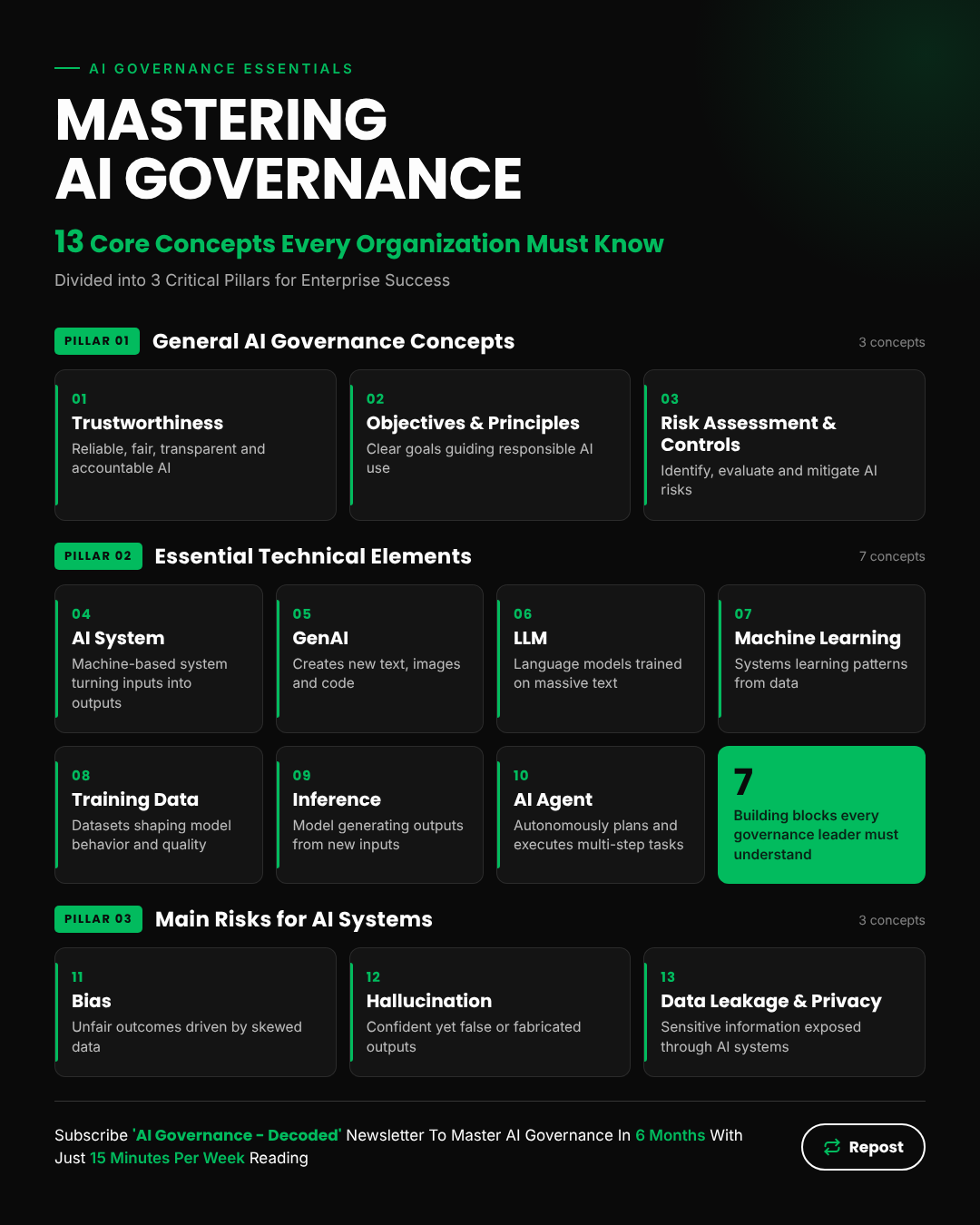
With the global AI governance market expanding rapidly—projected to surge past $419 million, organizations can no longer treat artificial intelligence as a simple IT asset. This article breaks down 13 core concepts divided into three critical areas:
(1) General AI Governance Concepts.
(2) Key Elements of AI.
(3) Main Risks for AI Systems.
Part 1: General AI Governance Concepts
Let’s start with the high-level governance concepts that shape how organizations approach oversight, compliance, and control.
1. AI Trustworthiness
AI trustworthiness is the ultimate objective of an effective AI Management System (AIMS). While terms like safe, responsible, and ethical AI are frequently used, they all roll up into trustworthiness: the measurable ability for stakeholders to verify that an AI system’s outputs meet expectations and align with human values.
2. AI Objectives and Principles
These are the high-level directives guiding your AI governance framework. Standard principles include accountability, environmental impact, fairness, maintainability, privacy and security, robustness, safety, transparency, explainability, and human oversight.
3. AI Risk Assessment & Controls
At the core of any functional AIMS are risk assessments and controls. You must identify what can go wrong (risks) due to your AI deployment and then implement appropriate technical and operational barriers (controls) to mitigate those vulnerabilities.
Part 2: Essential Technical Elements of AI
Understanding what powers modern AI systems helps clarify where governance boundaries must be drawn.
4. AI System
An AI system is an automated IT architecture designed to generate outputs—such as predictions, recommendations, text, audio, video, or decisions—based on human-defined parameters and inputs.
5. Generative AI (GenAI)
GenAI encompasses models capable of creating new content, including text, code, images, audio, and video. This category spans large language models (LLMs), diffusion models, multimodal networks, and code-generation tools.
6. Large Language Model (LLM)
An LLM is a deep-learning architecture trained on massive text corpora designed for natural language processing and generation. LLMs serve as the engine behind major conversational agents like ChatGPT, Claude, and Gemini.
7. Machine Learning (ML)
Machine learning is the computational process of optimizing model parameters using massive processing power. This optimization ensures the AI yields functional, contextually accurate outputs rather than random data streams.
8. Training Data
Training data teaches an AI model how to recognize patterns. Built-in training data comes from massive pre-release datasets managed by model creators, while user-provided training data (prompts, fine-tuning docs) shapes how the model behaves for specific organizational workflows.
9. AI Inference
AI inference is the operational phase where an AI system draws conclusions or executes tasks based on input data and reasoning. Because processing inference queries demands massive energy and computing power, global data centers handle these requests continuously.
10. AI Agent
An AI agent is an autonomous software component that perceives its environment and takes independent actions to achieve pre-set goals without requiring constant human prompts.
Part 3: Main Risks for AI Systems
Governance exists to counter specific hazards. The most prominent risks facing enterprise AI deployments include:
11. Bias
Algorithmic bias occurs when an AI system systematically produces prejudiced outcomes that disadvantage specific individuals or groups (e.g., automated hiring filters favoring one demographic over another).
12. AI Hallucination
Hallucinations occur when an AI model fabricates false, misleading, or completely incorrect data and presents it with absolute factual confidence. Because these outputs sound authoritative, detecting them requires strict verification controls.
13. Data Leakage and Privacy
AI systems pose acute data leakage risks. If sensitive corporate IP, customer data, or personally identifiable information (PII) is entered into unmanaged models or exposed via model outputs, severe privacy breaches follow.
Bringing It Together: How to Approach AI Governance
Trying to manage all of these moving parts manually can quickly become overwhelming. This is precisely why the ISO 42001 standard was developed—providing the world's first international framework for building a comprehensive Artificial Intelligence Management System (AIMS).
Ready to build trust with your enterprise clients?
Connect with me today to get your AI startup ISO 42001 certified and master your AI governance strategy.
Subscribe to my newsletter, AI Governance – Decoded: a 15-minute read that takes you from zero to confident on AI governance in six months.

Kumail Mehdi
ISO 42001 Lead Auditor and AI strategist. 11 years in corporate leadership, 14 years running a digital agency. I help professionals, consultants and AI startups turn expertise into governed, AI-powered systems.